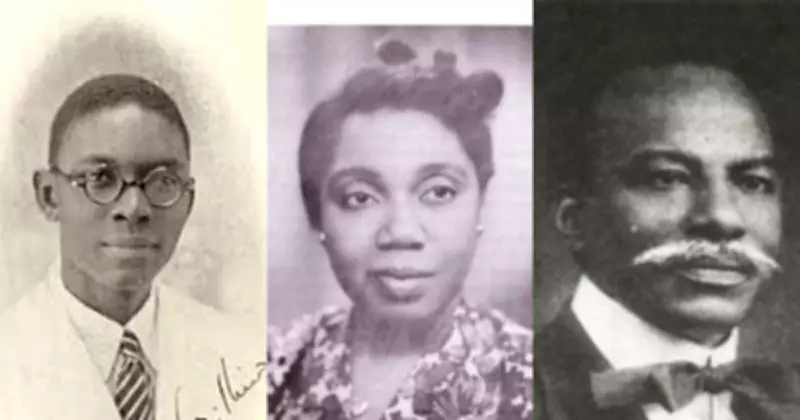
Pioneers of Progress: How Nigeria's First Foreign-Educated Graduates Shaped a Nation
Long before Nigeria established its own universities, a remarkable group of individuals embarked on journeys across oceans to pursue higher education in foreign lands. These pioneers returned not merely with degrees, but with transformative ideas that would fundamentally reshape their society and lay the groundwork for a modern nation.
The Dawn of Western Education in Nigeria
The introduction of Western education to Nigeria began in 1840 when British missionaries established the first primary school. This foundational step was followed nine years later by the opening of the Anglican Church Missionary Society Grammar School in Lagos in 1859, marking the country's inaugural secondary institution. However, a visionary few did not wait for the educational system to develop locally; they sought knowledge abroad, acquiring university degrees that would become instruments of profound change upon their return.
Olu Atuwatse I: The First University Graduate in Sub-Saharan Africa
Even before Nigeria existed as a political entity, Prince Oyeomasan of the Warri Kingdom achieved an extraordinary milestone. Around 1600, his father sent him to Portugal, where he studied theology at the Collégio de São Jerónimo in Coimbra. Returning in 1611 with a degree and a Portuguese wife, he later ascended as the 7th Olu of Warri around 1623. His education significantly altered the kingdom's diplomatic relations with Portugal, strengthened Catholicism within the royal court, and integrated European governance models into Itsekiri traditions.
The Sapara Brothers: Legal and Medical Trailblazers
Chief Christopher Alexander Sapara Williams made history on November 17, 1879, when he was called to the English bar at the Inner Temple in London, becoming Nigeria's first indigenous lawyer. Upon returning to the Lagos Colony, he served as Chairman of the Nigerian Bar Association from 1900 to 1915, challenged colonial sedition laws that restricted press freedom, and in 1910, inspired a young Herbert Macaulay to initiate organized resistance against colonial rule.
His younger brother, Chief Oguntola Odunbaku Sapara, pursued medicine in Scotland, obtaining qualifications from the University of Edinburgh and the University of Glasgow in 1895. Appointed as an Assistant Colonial Surgeon in Lagos Colony in 1896, he established the first public dispensary in 1901, advocated against slum clearance, trained midwives using scientific methods, identified overcrowding and poor ventilation as causes of a tuberculosis epidemic in 1918, and led the successful campaign against bubonic plague in Lagos in 1924. His dispensary later evolved into Massey Street Hospital, with Sapara Avenue named in his honor.
Herbert Macaulay: From Engineer to Political Architect
Born in Lagos in 1864 into a historically significant family—his grandfather was Samuel Ajayi Crowther, the first African Anglican bishop, and his father founded CMS Grammar School—Herbert Macaulay received a colonial government scholarship in 1890 to study civil engineering in Plymouth. He returned in 1894 as Nigeria's first qualified civil engineer, taking a position as Crown land inspector. However, he soon turned his skills toward challenging colonial authority, exposing corruption in railway finances in 1908, leading protests against water rates in 1915, and successfully arguing land seizure cases before the Privy Council in London. He founded Nigeria's first political party in 1923 and co-founded the National Council of Nigeria and the Cameroons in 1944, remaining politically active until his death in 1946.
Lady Kofoworola Ademola: Breaking Educational Barriers for Women
In a bold move for his era, Omoba Eric Olawolu Moore chose to educate his daughter abroad rather than prepare her solely for marriage. Kofoworola Moore attended Vassar College in New York, Potway College in Reading, and St. Hugh's College, Oxford, graduating in 1935 with a degree in Education and English at age 22, thereby becoming the first Black African woman to earn a degree from Oxford. She returned immediately to Nigeria, teaching at Queens College in Lagos, helping establish two girls' schools, serving as Secretary of the Western Region Scholarship Board, and becoming the first president of Nigeria's National Council of Women's Societies in 1958. She continued her advocacy until her passing in 2002 at age 89.
Jaja Wachuku: Diplomat and Legal Scholar
Jaja Wachuku enrolled at Trinity College Dublin in 1939, where he distinguished himself as the first African medallist and laureate in Oratory. Called to the Irish bar in November 1944, he graduated with a first-class BA in Legal Science, earning prizes in Roman Law, Constitutional Law, and Criminal Law. Returning to Nigeria in 1947, he became the first Speaker of the Nigerian House of Representatives and later served as Nigeria's first Ambassador to the United Nations. A particularly notable but often overlooked achievement occurred in 1963 when, as Foreign Affairs Minister, he intervened with the South African government, contributing to saving Nelson Mandela and his co-accused from the death penalty during the Rivonia Trial.
Nnamdi Azikiwe: From Academic to President
Nnamdi Azikiwe earned a BA from Lincoln University in Pennsylvania in 1930, followed by an MA in 1932 and an MS from the University of Pennsylvania in 1933. After returning to Africa in 1934, he faced sedition charges in the Gold Coast for a newspaper article but won on appeal, returning to Nigeria in 1937 with renewed determination. He built a media empire comprising five newspapers valued at over two million dollars, using their editorials to advocate for direct elections, African control of the civil service, and an end to British rule. By 1960, Nigeria achieved independence, and by 1963, Azikiwe became its first president.
Oladele Ajose: Pioneer of Community Healthcare
A Lagos prince educated at Methodist Boys' High School and King's College, Oladele Adebayo Ajose traveled to the University of Glasgow, graduating with an MB ChB in 1932, a Diploma in Public Health in 1935, and an MD in 1939. Upon returning to Nigeria, he established the Infectious Disease Hospital in Lagos and co-founded what would become the Nigerian Red Cross Society. He was also an early proponent of community-based healthcare, implementing a program in Ilora, Oyo State, where he insisted on resident involvement in all healthcare decision-making—a radical concept in the 1950s that is now standard practice.
These individuals exemplify how education acquired abroad was leveraged not for personal gain alone, but as a catalyst for national development. Their legacies in law, medicine, politics, education, and healthcare continue to influence Nigeria's trajectory, demonstrating the enduring power of knowledge when coupled with a commitment to societal transformation.