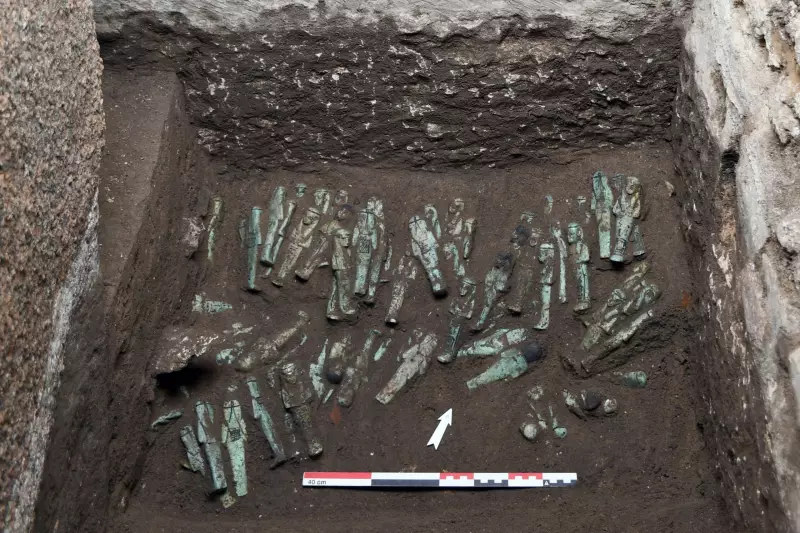
In a remarkable archaeological breakthrough, a team of French researchers has uncovered a treasure trove of 225 ancient funerary figurines inside a tomb in the historic Egyptian capital of Tanis. This rare find, the first of its kind in the Tanis necropolis since 1946, has also provided crucial clues to solve a mystery surrounding the burial of a powerful pharaoh.
A Night of Discovery in the Nile Delta
The incredible discovery was made on the morning of October 9, according to Frederic Payraudeau, the French Egyptologist leading the excavation mission. The team had been working in a narrow tomb occupied by a large, unnamed sarcophagus and had already excavated its other three corners. "When we saw three or four figurines together, we knew right away it was going to be amazing," Payraudeau told reporters in Paris. The excitement was so intense that the team decided to work through the night, setting up lights to continue after their normal 2 pm stop time.
It took a painstaking 10 days to carefully extract all 225 small green statuettes. These objects, known as ushabti, were intended to serve as servants for the deceased in the afterlife. Payraudeau described how they were "carefully arranged in a star shape around the sides of a trapezoidal pit and in horizontal rows at the bottom." Notably, more than half of the figurines are women, a detail the expert called "quite exceptional."
Solving a Royal Burial Riddle
The royal symbols inscribed on the newly discovered figurines provided the key to a long-standing puzzle: identifying who was buried in the imposing sarcophagus. The evidence pointed conclusively to Pharaoh Shoshenq III, who reigned from 830 to 791 BC. This revelation was "astonishing," Payraudeau said, because another tomb at the same site—featuring the largest sarcophagus—already bears his name.
"Why isn't he buried in this tomb?" the expert pondered. He explained that for a pharaoh, building a tomb was always a gamble, as there was no guarantee a successor would carry out the burial as planned. "Clearly, we have new proof that these gambles are not always successful," Payraudeau remarked with a smile. Shoshenq III's four-decade rule was marked by a turbulent and "very bloody civil war between upper and lower Egypt," with multiple claimants to power, which may have disrupted the intended burial plans.
The Historical Significance of Tanis
The ancient city of Tanis, located in the Nile Delta, was founded around 1050 BC and served as the capital during Egypt's 21st dynasty. According to Payraudeau, this period saw the abandonment of the famed Valley of Kings near modern Luxor—which had suffered extensive looting—and the royal necropolis was relocated to Tanis. This context makes the intact discovery of the ushabti even more significant, as most royal tombs in Egypt have been plundered over the centuries.
After thorough study, the collection of 225 figurines will be displayed in an Egyptian museum, allowing the public to witness this direct link to a pharaoh's journey to the afterlife. The Tanis find not only enriches the historical record but also vividly illustrates the unpredictable nature of ancient Egyptian royal succession and burial practices.