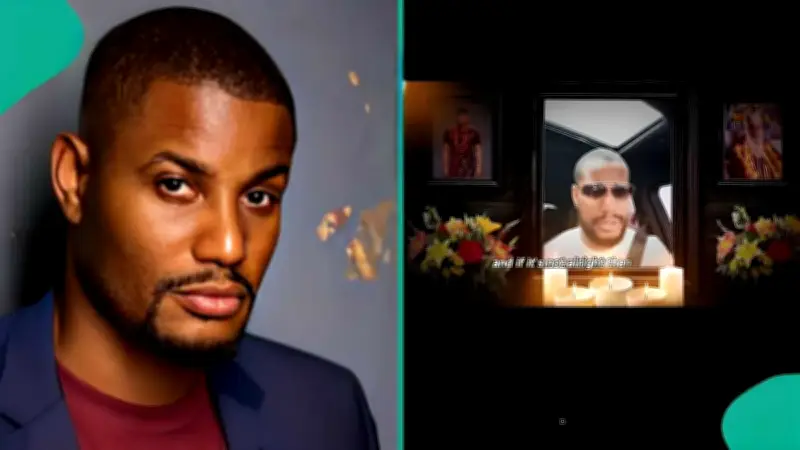
The death of Nollywood actor Alexx Ekubo has once again thrust the industry into the spotlight, not just for his life and career, but for the increasingly public nature of mourning that now characterizes celebrity deaths in Nigeria. As social media timelines fill with tributes and fans who never met the star become active participants in his farewell, the phenomenon reveals a deep emotional bond between audiences and their screen idols.
A Service of Songs and Public Grief
At the service of songs for Alexx Ekubo in Lagos, the atmosphere was not that of just another goodbye. It was a rendezvous for an industry intimately familiar with bereavement, where colleagues who had shared screens and sets united under a sombre sky. Inside the hall, quiet conversations died out as quickly as they started, interrupted by elongated stares at screens broadcasting Ekubo's trajectory from young romantic lead to prominent public figure. Outside, social media blazed with tributes, memories, and movie clips. Fans expressed shocked disbelief, while peers recalled personal anecdotes chronicling a man deeply entrenched in filmmaking's social architecture.
The Recurring Motif of Loss in Nollywood
Ekubo's passing cannot be disentangled from a recurring motif of loss gripping Nollywood. The industry has become accustomed to saying goodbye, with each death triggering a predictable cycle: shock, disbelief, curated tributes, and large funeral gatherings. In 2024 alone, the demise of veteran comedian John Okafor, known as Mr Ibu, triggered waves of nostalgia. His illness had garnered national attention, and his death led viewers to relive his most memorable movie moments. Not long after, veteran actor Amaechi Muonagor's death sparked debates about healthcare in the industry and the plight of aging actors. Even before Ekubo, audiences contended with the shocking loss of Junior Pope, whose death during a boat accident raised concerns about actor safety and pushed the industry to re-evaluate risk management. In 2023, the industry lost Saint Obi, Murphy Afolabi, and Sisi Quadri, underscoring a perceived instability and forcing public grieving on the entertainment sector in unnerving succession.
From Grief to Digitally Curated Mourning
Ekubo's death followed a now-established pattern of public remembrance. Unlike previous eras, when news of an actor's death came via newspapers or television, mourning now unfolds instantaneously on social media. Within minutes of a death announcement, timelines become digital memorials teeming with images, videos, and heartfelt tributes. Dr Kemi Ogunyemi, a scholar of media and communication, explains: "In recent decades, social media has blurred the boundaries between celebrities and their fans. These actors were visible every day on social media, so their demise directly impacts that daily connection. The grieving process naturally starts immediately, amplified by this intimacy." She notes that social media amplifies grief but also creates an expansive space for collective emotional experience across distances.
The Emotional Currency of Death
Funeral ceremonies are no longer confined to close family and industry friends. They draw media coverage, live streaming, social media influencers, and fan participation both online and in person. At Ekubo's service of songs, these trends were evident: the venue gathered Nollywood personalities from diverse generations, while platforms showcased live updates and tributes throughout. Mourning became a public, shared experience mediated by technology. Ayo Adeleke, a media analyst, states: "It shows an emotional engagement between fans and the celebrities they follow that continues into the funeral process. People want to be involved in witnessing how the narrative ends. However, it is also a sensitive ground where one could debate the lines between authentic sorrow and spectacle."
The Emotional Toll of Recurrent Loss
Behind the glamour of public mourning lies the weight of repeated loss. Actors and producers find themselves at funeral gatherings so often that they have become part of their everyday landscape. While each death prompts deep sorrow, the sheer volume of loss has recalibrated Nollywood's narrative, shifting it toward one that defines its recent history and prompts reflection on deeper systemic issues in the entertainment sector. But at its heart, every death—from John Okafor's to Junior Pope's to Alexx Ekubo's—represents a loss to family members and friends who grapple with grief away from public attention. In the end, while the mode of mourning has transformed from private to public, its foundational truth endures: Nollywood is no longer just an entertainment business; it has also become an institution of national sorrow.