Akinola Davies Jr. was only twenty months old when his father passed away. His older brother Wale, who authored the script, was just four at the time. Together, they have produced a film about a man whom neither of them can recall. Instead of concealing this void in their memories, they have constructed the movie around it. For much of My Father's Shadow, viewers are not witnessing a childhood being recollected but a father being created: pieced together from family anecdotes and later trips to Lagos by the brothers.
Davies has no interest in neatly recovering the past. The film transitions between what the boys observe and what they seem to remember observing, without indicating which is which. Sudden bursts of visuals punctuate the story at intervals, merging earlier and later moments as actual memory does. You are not watching the past; you are watching two brothers attempt to find it, which is a completely different and more intriguing endeavor.
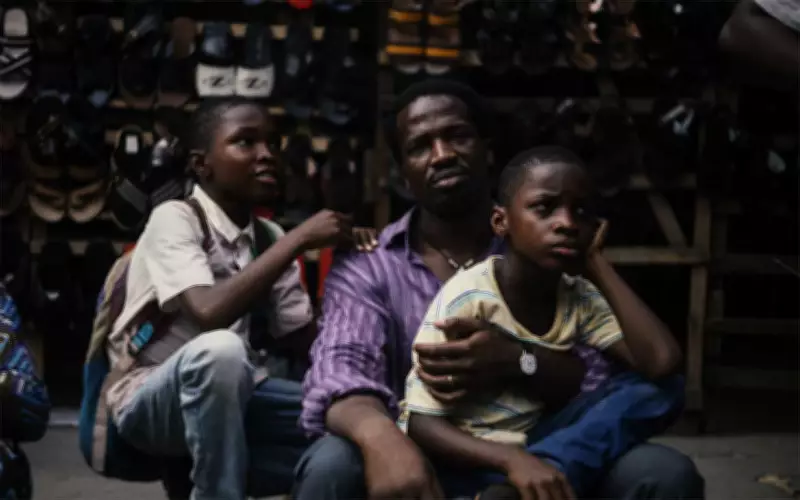
As the film opens, we see older versions of the brothers alone at home, then their father, Folarin, portrayed by Șopé Dìrisù, arrives. He is preparing to leave again for Lagos, where he works, when the boys start complaining, prompting Folarin to take them along. The narrative unfolds over a single day in Lagos, June 1993. The boys, aged eleven and eight, have never seen Lagos before. Folarin grew up there, and as he takes them around on okadas, through bars, past a closed amusement park, and down to the sea, we see him moving through his own past, revealing who he was before becoming their father.
He tells them how he met their mother. A friend recalls the couple as the neighborhood's great romance. Each story adds to a portrait of a man they are only beginning to understand. Outside, the country is falling apart. The June 12 election is unraveling in real time. The boys catch fragments: headlines glimpsed on the bus, their father's argument with a pro-regime passenger, the word 'massacre' on a front page that no one explains to them. When the annulment is announced on a bar television, gunshots follow almost immediately. Folarin moves his sons out of the city. The film simply shows what the boys see and lets the fear do its work.
Davies holds the entire film together through the eyes of children who absorb everything but comprehend only some of it. He trusts the image and does not reach for explanations. Dìrisù's performance works similarly. In one of the film's most precise scenes, a recently widowed friend of Folarin's reproaches himself at length for how he treated his wife. The camera holds on Folarin's face for the entire monologue. He says nothing. The scene hints at troubles in his own marriage that the film will never directly name.
By the time the boys board a bus back home, with the city behind them, they know more about their father than they did that morning. Not everything. Not the parts he could not say. But enough to have started building something: a person made of stories, of the streets where he came from, of the way he muttered 'stupid people' under his breath when a military truck rolled past. This is what the Davies brothers have been doing for their entire lives, and what the film is about. What they construct belongs to all three of them: the brothers, the father, and the country. All three lost something in 1993. They lost something nearly held, then taken before it could be kept.
Davies does not force that connection. He places all three losses in the same frame and steps back. For a Nigerian audience, it will feel less like cinema and more like recognition of the weight carried by a generation raised in the shadow of June 12, by parents who never quite said what it cost them. Folarin is one of those parents. The film is his son's final understanding of why, who, and what.