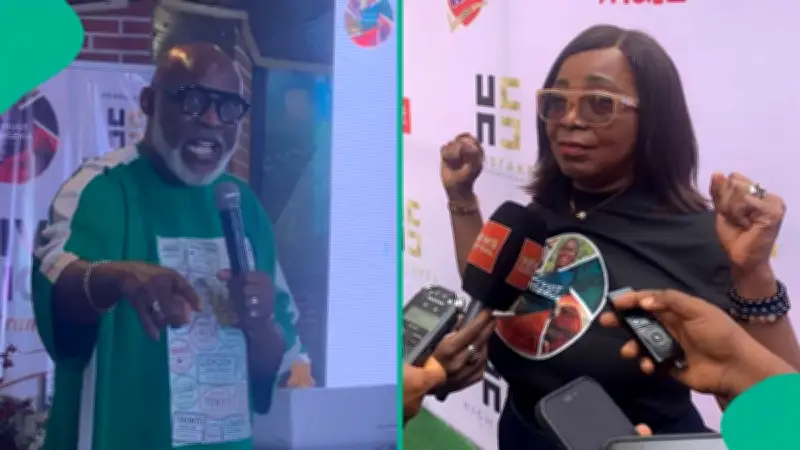
Veteran actor and filmmaker Richard Mofe-Damijo, popularly known as RMD, has called on Nigerians to see themselves as ambassadors of the country, stressing that their daily conduct shapes how Nigeria is perceived both at home and abroad. He made the remarks while speaking at the 2026 Pivot Nigeria conference held at the MUSON Centre in Lagos, themed “The Reputation Dividend: Who Pays for Nigeria’s Perception?”
The conference brought together figures from the creative, media and communications sectors, along with students and members of the public, to discuss Nigeria’s image, national narratives and the impact of the country’s reputation on citizens, businesses and opportunities.
RMD: ‘I Am an Ambassador of Nigeria’
RMD said his understanding of representation began in childhood, recalling how his mother repeatedly reminded him to remember his identity and where he came from. “I just remember that my mom drilled this thing down into my head so much that it became like an obsession for me, which is to say, remember whose child you are,” he said.
He explained that this sense of identity continues through school, work and other institutions people become associated with. “We are constantly representatives or ambassadors of different people or institutions at different times in our lives,” he added.
The actor said his experiences working outside Nigeria made him realise that he no longer represented only himself. “I have come to accept that when I walk into a room or when I go somewhere, I am not just representing myself anymore or representing my family anymore,” he said. “I am, in fact, representing all the institutions and people and country that I have encountered or that have branded me at one point or the other in my life.”
He stressed that this was especially important when Nigerians travel abroad because their conduct could shape perceptions of the country. “And so I am an ambassador of Nigeria. So when I walk into any place, the story I am telling or that I am carrying is not the story of Richard Mofe-Damijo alone. It is the story of Nigeria itself,” he said.
RMD: ‘We Have a Responsibility, Not a Burden’
RMD urged Nigerians to stop viewing the responsibility of representing the country as a burden. “We have a responsibility, not a burden, because I used to think of it as a burden. But if you carry it as a responsibility, as an ambassador for your country, then it becomes a thing that you do with pride,” he said.
The veteran actor also challenged the stereotype of “African time”, arguing that punctuality was not foreign to African societies. “We were on time for everything, as Africans,” he said, citing activities such as planting, harvesting, farming and hunting. He argued that the perception that Africans were habitually late should not be allowed to define the continent.
RMD linked reputation to consistency, drawing from his experiences in theatre and film. He recalled being trained to treat acting with discipline and to be ready before performances or productions began. He said he later applied the same principle to his own productions, insisting that shows should start at the advertised time even when audiences had yet to arrive. “That was what we built over time,” he said, adding that “people will come to identify you as that consistent person.”
RMD: ‘Leave the Institution Better Than You Came In’
RMD challenged Nigerians to examine what they represent beyond their individual identities. “What is it that you carry inside of you? Who is it that you represent? Is it just your father's name? Is it just your school? Or is it just your company? Or is it just your country?” he asked. He said people who represent their families, schools and organisations are also, by extension, representing Nigeria.
Speaking about his experience in government, RMD said individuals should strive to improve institutions rather than allow institutions to erode their values. He said he had seen the potential for positive change within government but also observed how systems could affect people who entered them with good intentions. “The system itself is so badly designed that when good people come in, if your training cannot sustain over a period of time, it sucks you in,” he said. He urged people not to allow difficult systems to permanently change their values.
The actor said Nigerians could influence perceptions of the country by remaining consistent in their values despite negative narratives surrounding the country. He said reputation was not built through words alone but through repeated actions that people could observe over time. “You will find that people will point at you and say, this one is a true ambassador of our country, and that is the people we are looking for,” he said.
Uwadoka: Reputation Is Infrastructure for Trust
Victoria Uwadoka, convener of Pivot Nigeria and lead consultant of HighStakes PR Professionals, said reputation should not be treated as a superficial concept because it provides the foundation on which trust is built. “Reputation is not just a soft word; it's not just a fancy thing. Reputation is actually very, very critical for us as citizens and as a nation. Every organisation or individual needs reputation management. You know why? Because it's the infrastructure. And it is on that infrastructure that trust is built,” she said.
Uwadoka said trust, in turn, was important for sustaining businesses, institutions, individuals and nations over the long term. She said responsibility for Nigeria’s reputation could not be assigned to a single group. “Media has a responsibility. Individuals have a responsibility. Institutions have a responsibility. Corporate Nigeria has a responsibility. Government has a responsibility. We all have responsibilities because this nation belongs to all of us. We're all responsible,” she said.
She said Nigeria’s progress should be assessed not simply by its age but by what it has achieved and learned from its experiences. Uwadoka said improving Nigeria’s international reputation should begin with Nigerians themselves. “It starts from inside. We have to start from inside,” she said. She pointed to Nigerian entrepreneurs who, according to her, built skills and businesses locally before taking their work and reputations beyond the country.
Uwadoka: ‘You Shouldn’t Trash Nigeria. You Should Build Nigeria’
Uwadoka urged government to focus on creating an enabling environment through effective policies and infrastructure. She also described trust and perception as forms of infrastructure that needed to be deliberately built. “Trust is also an infrastructure. You see, perception is an infrastructure. We need to build on that,” she said. She said the country also needed to tell its own stories and communicate its cultural and other strengths more effectively.
Explaining the purpose of Pivot Nigeria, Uwadoka said the platform was created to encourage Nigerians to examine how they see themselves and how others experience them. She urged Nigerians, particularly young people and the media, to present a balanced picture of the country. “I want it to convince you that you shouldn't trash Nigeria. You should build Nigeria. Tell the truth about where we are. Be balanced. There's not only bad about us, but there's also good as well. Be balanced in your storytelling,” she said.
Uwadoka also called on Nigerians to actively participate in elections, saying citizens who choose not to vote are effectively allowing others to determine their leaders. “Sometimes people disengage when it concerns elections. But it concerns you. You choose your leaders, and your decision not to participate in that is a decision in itself. You have given your rights to somebody else, and whoever they choose for you, don't complain because you gave them that,” she said.
She also urged Nigerians to hold leaders and institutions accountable when things do not work as they should. “If something is not going the way it should go, hold power accountable. Hold people accountable. Hold yourself accountable,” Uwadoka said. She said Nigerians should recognise their collective responsibility for the country's future. “We should because Nigeria belongs to all of us. And if we don't push back, who will?” she said.