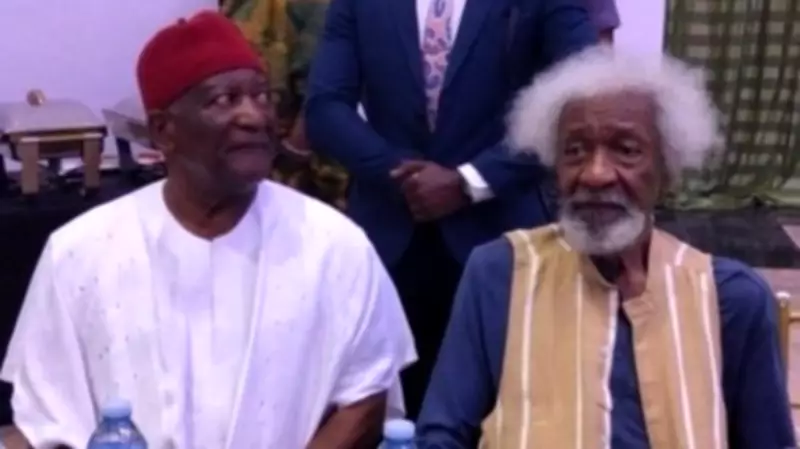
Nobel Laureate Wole Soyinka has called on well-meaning Nigerians and Africans to unite in efforts aimed at projecting the continent positively and liberating it from what he described as the 'shackles of darkness'. Soyinka made the call on Monday evening when he was guest of the FESTAC Africa Festival 2027 team in Asaba, Delta State, where he stressed the need for Africans to renew their commitment toward celebrating the continent's cultural identity, values, and achievements.
According to him, Africa must deliberately showcase its strengths and rich heritage to the world while confronting narratives that continue to undermine the continent's image. 'We have to rejuvenate our challenge and, more importantly, intensify our efforts in the struggle with distinction to celebrate Africa today,' Soyinka stated.
Soyinka Commends Newton Jibunoh
The literary icon commended renowned environmentalist and culture advocate Newton Jibunoh for his long-standing commitment to connecting Africa through cultural and humanitarian causes, particularly recalling his daring desert-crossing experiences aimed at promoting African unity and awareness. Soyinka described Jibunoh as a courageous figure whose sacrifices should inspire others to contribute their quota, no matter how little, toward illuminating the continent. He urged more Africans to support the FESTAC vision by 'putting their stamps' on efforts aimed at promoting African culture, unity, and identity.
Jibunoh on Colonial Legacy
Speaking earlier, Jibunoh, the architect of Mandela Gardens and a leading advocate of the FESTAC Africa Festival initiative, said Africans must remain concerned about freeing themselves from mental and cultural subjugation inherited from colonialism. According to him, colonial powers not only distorted African history and identity but also altered indigenous names and narratives in ways that negatively affected the continent. Jibunoh explained that his passion for reviving FESTAC was rooted in his involvement in FESTAC '77 hosted by Nigeria, insisting that the festival must not be allowed to fade into history. He recalled how colonial masters carted away valuable African artefacts and renamed several African nations, noting however that Nigeria retained its identity as a nation named after the River Niger.
The veteran cultural promoter also paid glowing tribute to Soyinka for standing by him during difficult periods of activism and advocacy. He named the museum after the Nobel Laureate, 'Wole Soyinka' in appreciation of his support and encouragement during his struggles for a better Nigeria. 'You are one of those who believed in me during my struggle for a better Nigeria and possibly saved me from being jailed,' Jibunoh said, adding that Soyinka was also the first prominent figure to officially open the DIDI Museum annex in Asaba.
FESTAC Africa Festival Vision
In his remarks, Chairman of FESTAC Africa Festival, Yinka Abioye, said the idea behind FESTAC was born out of the need to restore unity among African nations after the era of imperialism and colonial domination. Abioye explained that the first global gathering celebrating Black and African arts and culture took place in Senegal in 1966 under the World Festival of Negro Arts, while Nigeria hosted the historic FESTAC '77, which he described as a powerful symbol of African togetherness. He noted that after decades of inactivity in Nigeria, the festival was revived in Zanzibar in 2022 before moving to Eritrea and Tanzania in 2023, Kenya in 2024, and Ghana in 2025. According to him, the festival would return to Senegal later this year in honour of former Senegalese leader and cultural icon Léopold Sédar Senghor.
Abioye further announced that FESTAC Africa Festival would return to Nigeria in 2027 to commemorate the 50th anniversary of FESTAC '77, emphasizing that art and culture remain the most effective instruments for rebuilding Africa's identity and unity. He stressed that neither money, technology nor grammar alone could save Africa without cultural rebirth and collective identity. The FESTAC chairman commended Jibunoh for his active involvement in preparations for the 2027 edition scheduled for November next year and expressed delight that Asaba had been designated as one of the festival's event centres.