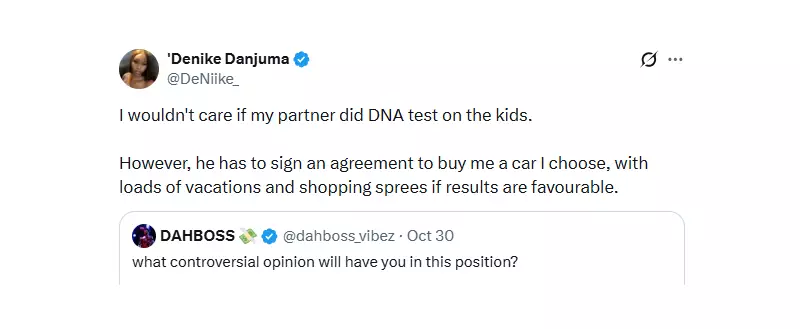
A Nigerian woman has sparked a significant conversation online by outlining specific conditions under which she would allow her partner to conduct paternity tests on their children. The woman, identified as Denike Danjuma, stated that while she does not object to the tests, her partner must agree to a substantial reward for her if the results confirm his fatherhood.
The Viral Social Media Post
Denike Danjuma took to social media to share her unconventional stance. In a post made on December 1, 2025, she clearly stated her terms. She expressed that she would not care if her partner decided to carry out DNA tests on their kids. However, this permission came with a major caveat that has since captivated public attention.
Her condition was that the man must first sign a formal agreement. This document would legally bind him to provide her with significant gifts should the DNA results turn out to be favourable, meaning they confirm he is the biological father. This proposition has ignited debates about trust, relationships, and modern dynamics in Nigeria.
Details of the Proposed Agreement
The rewards demanded by Danjuma are not modest. According to her post, the agreement must stipulate that her partner will purchase a car of her choosing for her. This is just the beginning of her list of demands.
Furthermore, the agreement would require him to finance multiple vacations for her. She also explicitly included funding for shopping sprees as part of the package. The core of her argument appears to be that if a man requires scientific proof of paternity, he should be prepared to offer tangible proof of his appreciation and commitment in return when his doubts are proven unfounded.
Public Reaction and Broader Implications
The post, which was shared on a popular blog, has generated thousands of reactions. The public response is sharply divided. Some commentators applaud Danjuma for what they see as a clever way to deter unnecessary suspicion and to ensure she is compensated for the emotional distress of being doubted.
Others, however, criticize the approach, arguing that it commercializes trust and turns a serious family matter into a transactional arrangement. This incident highlights the ongoing and often heated discourse in Nigeria surrounding DNA tests, paternity confidence, and the evolving expectations within romantic partnerships. The story continues to trend, making Denike Danjuma's name synonymous with this bold relationship proposition.