New Mum's House Banner with Strict Rules for Guests Goes Viral Online
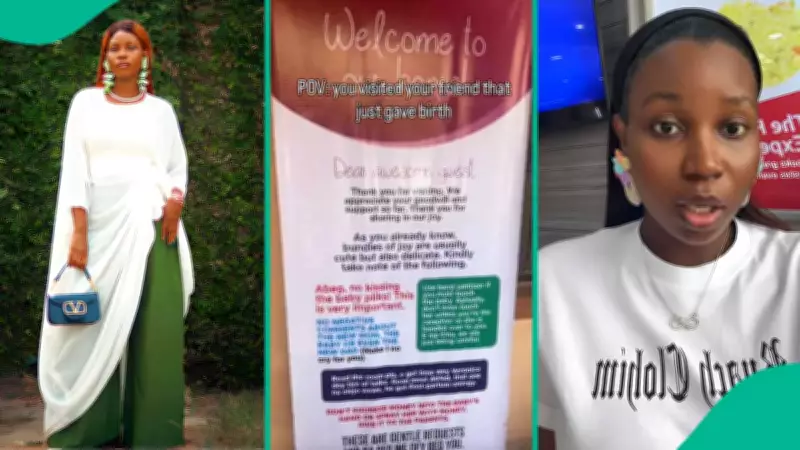
A Nigerian lady has shared a video on TikTok that has captured widespread attention, showcasing a detailed banner she encountered at the house of her friend who recently welcomed a newborn baby. The banner, which humorously outlines a set of rules for prospective guests, has sparked a flurry of reactions across social media platforms.
Banner Details and Content
The guest, identified as @thephenomenalgoodness on TikTok, filmed the banner that was prominently displayed in the new mum's home. According to the lady, she was not surprised by the banner, attributing it to the predictable nature of her friend and the baby's father. The banner begins with a warm greeting, expressing appreciation for visitors' goodwill and support, but quickly transitions into a list of specific prohibitions and requests.
Key rules listed on the banner include:
- Strictly no kissing the baby, emphasized with the plea "Abeg, no kissing the baby pliks! This is very important."
- Avoidance of any negative comments about the new mum, the baby, or the father, with a playful warning: "Make I no cry for you."
- Initial advice to use hand sanitizer before touching the baby, later amended to restrict touching to only the caregiver or if the baby is handed over, stating "Ema binu, we are just being careful."
- A request to read the room, noting times when the mother, referred to as Veronica, might be tired of talking, and suggesting visitors engage with the father, Ablad, instead.
- Prohibition on squeezing money into the baby's hand or spraying her with money, with instructions to give it directly to the parents.
The banner concludes with a gentle tone, stating "These are gentle requests and na beg we dey beg you. May your joy be full to the overflow," and is signed by "Baby Daddy Ablad, for the family."
Mixed Reactions from Netizens
The video has elicited a wide range of responses from online users, highlighting diverse perspectives on postpartum etiquette and parenting boundaries.
Supportive comments included:
- Personality Highlights praised the concept, saying, "I love this!... Na only people wey calm down read the signage go understand the gist!"
- itunuoluwa0624 remarked, "They are even nice o, you won’t even gat to see the baby till the naming day talk less of touching."
- lobaloba_commenter1 shared a personal experience: "I did something like this!! When I had my baby, send broadcast messages to some of our family/friends that were allowed to visit, my own self plenty pass this one?? very helpful for new parents."
Other reactions varied:
- Phaena Blays expressed a stricter approach, stating, "This is something I can easily do, I don’t think I’ll accept visitors until after 3 months sef."
- MmaArrange commented on visitor timing, saying, "I personally don't go visiting immediately a baby is born, I'll give you a month plus. then when I come, nothing concern me with baby, I'll wash your clothes and help wash plate."
Context and Related Traditions
This incident touches on broader cultural practices in Nigeria, such as the Igbo tradition of omugwo, where family members, often the mother, visit to offer support and assistance after childbirth. In a related story, a Nigerian mum was reported to have visited her daughter with gifts like yams, rice, beans, and palm oil after delivery, highlighting the nurturing aspect of such visits.
The viral banner reflects a modern twist on these traditions, emphasizing health precautions and personal boundaries in the postpartum period. It underscores the evolving dynamics of parenting in the digital age, where social media platforms like TikTok serve as a space for sharing and discussing such experiences.
As the video continues to circulate, it has sparked conversations about the balance between cultural hospitality and the need for new parents to set boundaries for the well-being of their newborn and themselves.