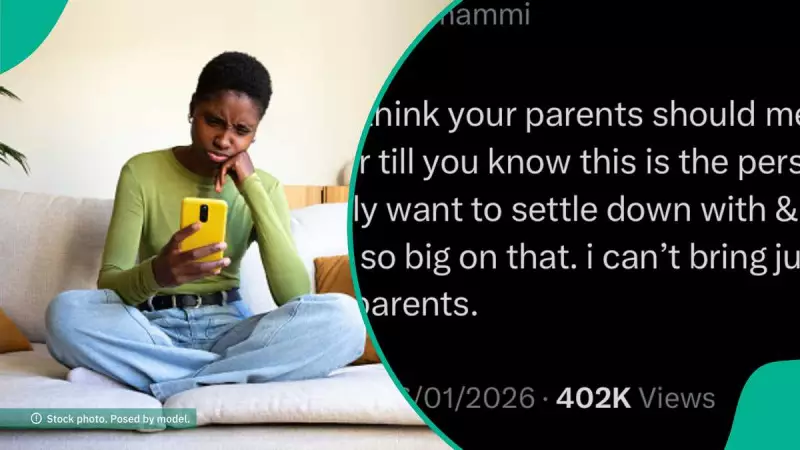
A recent social media post by a Nigerian woman, identified as @yslmammi, has ignited a fiery debate about the appropriate time for romantic partners to meet the family. Her firm stance, shared online, has drawn a spectrum of reactions from netizens and parents alike, highlighting a generational and personal divide on relationship protocols.
The Controversial Stance: Wait for Certainty
The core of the debate began with a clear statement from the lady. She expressed a strong belief that parents should not meet their children's partners until marriage is a definite prospect. "I don't think your parents should meet your partner till you know this is the person you actually want to settle down with & get married to. I'm so big on that. I can't bring just ANYBODY to my parents," she tweeted. For her, such an introduction is a significant step reserved for a serious, committed future, not for casual dating phases.
Social Media Clashes: Early Introductions vs. Cautious Delay
The post quickly attracted a flood of comments, with many users vehemently disagreeing. A common counter-argument focused on the utility of early family meetings as a vetting tool. One user argued for introductions once marriage potential is suspected, not confirmed, stating that seeing how a partner interacts with loved ones is part of the certainty-building process. Another user, Christopher, suggested that waiting too long could backfire if parents and the partner ultimately don't get along, robbing them of valuable bonding time.
Kabila offered a pragmatic view, advocating for quicker introductions to uncover red flags. "My mother takes one look at people and says yeah no, and they always turn out problematic," the user shared, suggesting parental intuition can be a valuable early warning system.
Parental Perspectives: Safety, Bonding, and Selection
The discussion took a deeper turn as parents entered the fray, offering insights often centered on protection and long-term family dynamics. A user named flymamacita, speaking from a mother's viewpoint, advised bringing "everyone" to meet her. She proposed a collaborative selection process to prevent in-law issues later, arguing that post-marriage strife often stems from parents and spouses being strangers at the wedding.
A father's perspective highlighted paramount safety concerns. "As a father I wanna always know who my daughter is dating... I need to be able to trust my daughter is in good hands even if it's temporary," he wrote, prioritizing his child's wellbeing over relationship formalities.
However, not all parental advice aligned with early meetings. User Jenni agreed with the original poster, instructing her son not to introduce anyone until he was ready to propose. "I don't want to meet anything casual. Waste of time. Just bring me the one," she stated, adding confidently that she could assess a person's character quickly.
Support for Caution and Personal Regrets
The original poster's caution found support from others who shared experiences of regret. One user admitted to nearly regretting introducing ex-partners to their parents, calling it a "dumb decision" to be avoided. Antanise shared a personal boundary, stating, "No man has met my dad until now. And I regret allowing the guy to come around my dad. No man will be meeting my dad again until I know for sure for sure."
Fifi echoed the sentiment of guarded access, explaining that involving parents elevates a relationship from casual to serious, a level not everyone deserves. This perspective frames the introduction as a major milestone, not a casual step in dating.
The debate, which unfolded on January 8, 2026, underscores that there is no one-size-fits-all answer in Nigerian relationships. Factors like family dynamics, personal dating history, safety concerns, and the desire for parental approval all play crucial roles in deciding this significant step. While some see early meetings as essential for evaluation and bonding, others view them as a privilege to be earned only with the highest commitment, protecting both their family's peace and their own emotional journey.