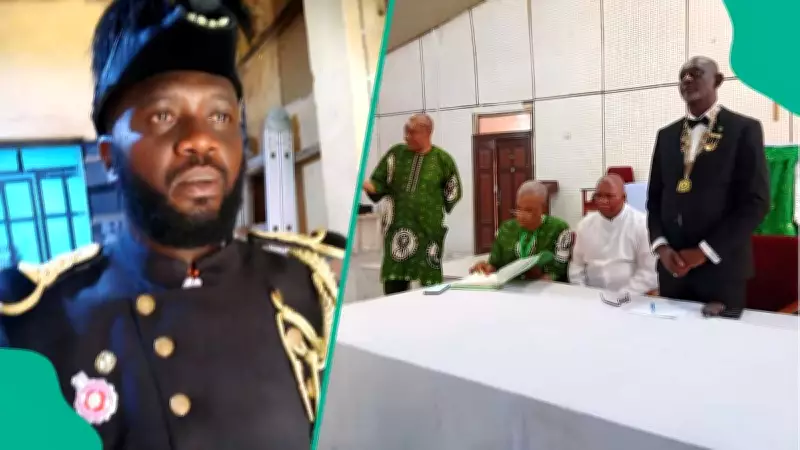
Supreme Knight Addresses Controversial Church Protest and Expulsion Incident
The Supreme Knight of the Knights of St. Mulumba Nigeria, Sir Steve Adehi, has responded to the recent controversy involving the expulsion of a fellow knight following a public protest during a church dedication ceremony in Nnewi, Anambra State. The incident has sparked significant discussion within religious and social circles across Nigeria.
Background of the Church Protest Incident
Sir James-Louis Okoye, a member of the Knights of St. John International, was reportedly expelled by his order's Commandery 511 in Nnewi after staging a loud protest during the dedication of Our Lady of Assumption Cathedral on January 14, 2026. The protest centered on what Okoye described as the church's failure to adequately recognize the contributions of late Senator Ifeanyi Ubah to the cathedral project.
Following the protest, Okoye reportedly renounced both his Christian faith and Catholicism, prompting the Knights of St. John International to establish an investigative panel. The panel found him guilty of misconduct, leading to his expulsion from the order. This development has generated considerable debate on social media platforms, with opinions divided on the appropriateness of the disciplinary action taken against the knight.
Supreme Knight's Perspective on Christian Service
In an exclusive interview, Supreme Knight Sir Steve Adehi, who also serves as a Senior Advocate of Nigeria, addressed the incident and broader questions about Christian duty and service. Speaking at the Knights of St. Mulumba headquarters in Onitsha during his inaugural meeting with members from various districts across Nigeria, Adehi emphasized fundamental principles of Christian service.
"All of us are aware that anything we do as Christians and as Catholics, we do it to the glory of God, as well as service to the Church and humanity," Adehi stated. "As Christians assigned some duties in the vineyard of God, we must not expect our rewards on earth. This is why the Scripture tells us that our right hand must not know what our left hand is doing."
The Supreme Knight elaborated on the philosophical approach of the Knights of St. Mulumba, noting that for many years, the order worked largely in silence, motivated by conviction rather than avoidance. "We believed that service, to remain pure, must remain modest. That belief still holds," he explained. "But today, silence alone is no longer neutral. In an environment saturated with noise, absence from the moral conversation can be mistaken for irrelevance."
KSM's Comprehensive Community Interventions
Adehi detailed the extensive social interventions undertaken by Knights of St. Mulumba councils across Nigeria, emphasizing their commitment to turning faith into tangible action that reaches the most vulnerable populations.
In the education sector: KSM councils have become consistent partners with struggling schools, supporting infrastructure development, subsidizing fees for indigent students, and providing mentorship programs. In some regions, the order has adopted entire classrooms to ensure children displaced by violence or poverty do not lose years of learning.
In healthcare: KSM councils have funded comprehensive medical outreaches in rural and semi-urban communities, covering surgical procedures, maternal care, and chronic illness management for families who would otherwise endure sickness without medical attention. These represent sustained interventions rather than symbolic gestures.
In criminal justice: KSM councils have provided legal support to prisoners, facilitated dialogue with justice sector stakeholders, and in some cases helped secure the release of unjustly detained inmates. Beyond advocacy, the order has supplied food, clothing, medical support, and reintegration assistance for released prisoners.
In social welfare: Across several states, KSM councils operate feeding programs for indigent elderly individuals without support systems, widows, families displaced by conflict, and residents of internally displaced persons camps. In these camps, knights have provided not only basic necessities but also educational materials for children and trauma-sensitive support for families navigating post-violence recovery.
Mentorship and Values Formation Initiatives
The Supreme Knight highlighted the order's commitment to youth development, noting that "too many young people are growing up without credible maps for patience, responsibility, or lawful ambition." The Knights of St. Mulumba are strengthening mentorship and values-based formation programs across schools, tertiary institutions, and informal learning spaces.
"Knights are committing time, not just resources, walking with young people through questions of purpose, discipline, and civic responsibility," Adehi emphasized. "What distinguishes the KSM's approach is not scale or spectacle. We work slowly, consistently, but without expectation of applause. This is what an ideal Christianity and Catholicism should be - not protesting when we're not appreciated for works done in the house of God."
Church Response to Recognition Controversy
Separately, the Catholic Diocese of Nnewi has addressed claims regarding the recognition of late Senator Ifeanyi Ubah's contributions to the cathedral project. Church officials explained that Bishop Jonas-Benson Okoye did acknowledge Ubah's support during the cathedral's dedication ceremony, though the expelled knight had expected a different form of public recognition.
Church leaders have appealed for calm and unity among parishioners, urging them to focus on faith and reconciliation rather than leaving the church over disagreements about how contributions should be honored. This response aims to maintain harmony within the religious community while addressing the concerns raised by the controversial incident.
The Supreme Knight's comments and the broader discussion surrounding this incident highlight ongoing conversations within Nigerian religious communities about the nature of Christian service, recognition, and the appropriate response to perceived slights within religious institutions.