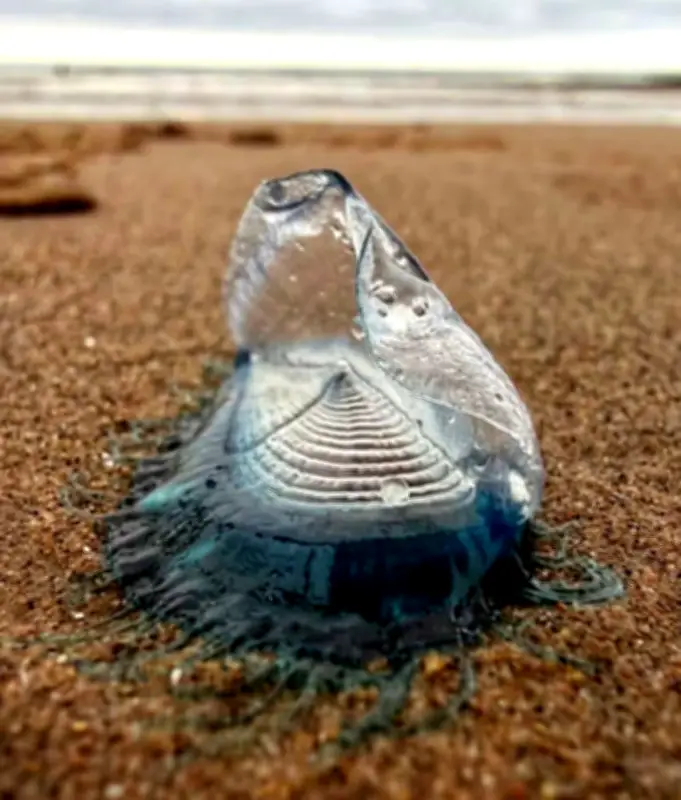
Hundreds of mysterious blue sea creatures have washed up on a UK beach, leaving visitors baffled. Beachgoers at St Bees in Cumbria were met with an extraordinary sight as countless jellyfish-like organisms lined the shore, sparking curiosity and confusion.
What Are These Blue Creatures?
The creatures have been identified as by-the-wind-sailors, scientifically known as Velella velella. They are closely related to the Portuguese man o' war but are significantly smaller, typically measuring around five centimeters, and are generally considered harmless to humans. Despite their benign nature, people are advised to avoid touching them due to their stinging tentacles.
The name by-the-wind-sailor derives from a distinctive fin that resembles a small sail, which allows them to drift across the ocean surface. These creatures possess short stinging tentacles used to prey on young fish as they journey through the seas.
Local Resident's Discovery
Local resident Louise Nicholson stumbled upon the blue creatures while enjoying a day at the beach. Initially, she mistook them for an unusual type of seaweed and nearly picked one up before deciding to take photographs instead. She described the experience, saying, "There were hundreds of them and there were lots of visitors to the area taking photos. They are absolutely beautiful, only about five cm in size. It was a great find on a beautiful day."
Nicholson sent her pictures to the Cumbria Wildlife Trust, which shared the images along with information about the by-the-wind-sailors. The trust explained that these creatures are carried in by warm waters from the Atlantic, which explains their sudden appearance on the beach.
Not True Jellyfish
The Cumbria Wildlife Trust provided fascinating insights into the nature of these organisms. In a statement, they said: "They're called by-the-wind-sailors and, as the romantic name suggests, they spend their lives drifting on the wind. They're also not true jellyfish, despite the very jellyfishy appearance. The reality is far more bizarre – each sailor is actually a colony of polyps functioning as one organism, with various types of polyps performing different roles, such as feeding, reproduction and defence."
This revelation highlights the complex biology of these creatures, which are not individual animals but colonial organisms working together as a single entity. The trust added that they are typically spotted along the coastlines of Britain and Ireland throughout autumn and winter when stormy weather strikes.
Impact and Advice
While the by-the-wind-sailors are not dangerous to humans, the Cumbria Wildlife Trust advises beachgoers to avoid touching them. Their stinging tentacles, though not harmful to humans, can cause mild irritation. The presence of these creatures is a natural phenomenon, and their arrival on UK shores is a reminder of the diverse marine life that inhabits our oceans.
The event has generated significant interest among visitors and locals alike, with many taking photos and sharing their experiences on social media. The Cumbria Wildlife Trust's post about the creatures has attracted attention, educating the public about these remarkable organisms.
Seasonal Phenomenon
By-the-wind-sailors are known to appear on British and Irish coastlines during the autumn and winter months, particularly after storms. Their arrival is driven by wind patterns and ocean currents, which carry them from warmer Atlantic waters to the shores of the UK. This seasonal phenomenon is a natural part of the marine ecosystem, and while it may surprise beachgoers, it is a normal occurrence for those familiar with marine life.
For now, the beach at St Bees has become a temporary attraction, with hundreds of these blue beauties drawing crowds. The Cumbria Wildlife Trust continues to monitor the situation and provide information to the public, ensuring that everyone can appreciate this rare sight safely.