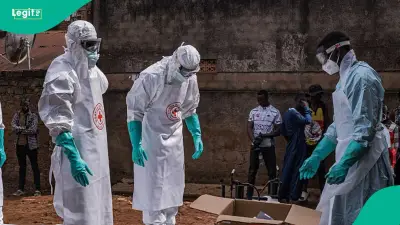
The Africa Centres for Disease Control and Prevention (Africa CDC) has reported notable progress in efforts to contain the Ebola outbreak in the Democratic Republic of the Congo (DRC) and Uganda, but warned that rising infections continue to outpace the response. Wessam Mankoula, Head of the Continental Incident Management Support Team for the Ebola response, disclosed this during a webinar on Thursday, emphasizing that while laboratory capacity has improved and clinical trials have begun, the virus is spreading faster than containment measures.
Response Under Pressure
Mr. Mankoula stated that confirmed Ebola cases increased by 25 percent over the past week, raising concerns about sustained transmission. He noted that Ebola treatment centres remain under severe pressure, with bed occupancy reaching 95 percent across affected facilities. Contact tracing also remains inadequate, with only seven contacts identified for every confirmed case—well below the recommended target. Additionally, infections among frontline health workers continue to pose a major challenge.
Uganda's Progress
Mr. Mankoula described Uganda’s response as encouraging, stating that the country had demonstrated that Ebola could be contained through strong surveillance and rapid action. Uganda has recorded 20 Ebola cases, most linked to imported infections, but authorities quickly contained transmission. Currently, the country has only one patient receiving treatment, after recording two deaths and 17 recoveries. Uganda achieved complete contact tracing for all identified contacts, helping to interrupt further transmission. Mr. Mankoula added that Uganda’s experience demonstrates that early detection, prompt isolation, and effective contact tracing remain critical to controlling Ebola outbreaks.
Situation in DR Congo
In contrast, Mr. Mankoula said the DRC had recorded 1,759 confirmed Ebola cases as of 7 July, including 353 new infections reported within one week. The outbreak has claimed 600 lives, representing a case fatality rate of about 34 percent. Among healthcare workers, 112 infections have been recorded, while 35 frontline workers have died during the response. Mr. Mankoula described the current epidemic as the fastest-growing Ebola outbreak recorded during its first six weeks. He said the virus continues to spread faster than response efforts, with the effective reproduction number estimated at 1.4. “This means the outbreak is still progressing. Currently, the estimated reproduction number is 1.4, meaning every 10 infected individuals are expected to transmit the virus to approximately 14 others,” he said.
The outbreak has affected 37 health zones in the DRC, with 94 percent of confirmed cases reported in Ituri Province. Mr. Mankoula noted that six affected health zones had not reported any confirmed cases in the past 21 days, suggesting progress in some locations. Most infections have occurred among people aged between 15 and 44 years, with women accounting for 53 percent of confirmed cases. However, insecurity in North Kivu continues to hamper response activities, contributing to high fatality rates and limiting access for emergency response teams.
Call for Increased Capacity and Funding
Mr. Mankoula called for a 50 percent increase in treatment bed capacity, faster case detection, stronger community engagement, and sustained funding to strengthen the Ebola response. He also announced the deployment of additional experts and 4,000 community health workers, while Uganda and the DRC continue implementing joint border surveillance under their bilateral agreement. The continental Incident Management Support Team is now operational in Uganda, coordinating the Ebola response with support from partners across Africa.
Ebola Virus and Challenges
Ebola virus disease (EVD) is a severe and often fatal illness caused by infection with the Ebola virus. It spreads through direct contact with the bodily fluids of an infected person or contaminated materials and can cause symptoms including fever, vomiting, diarrhea, and, in severe cases, internal and external bleeding. The current outbreak in the DRC and Uganda is caused by the Bundibugyo strain of the Ebola virus. Unlike the more common Zaire strain, which caused the 2014 West African epidemic, there is currently no approved vaccine or specific antiviral treatment for the Bundibugyo strain, making containment efforts more challenging.
Nigeria's Preparedness
Although Nigeria has not recorded any confirmed Ebola case, the Nigeria Centre for Disease Control and Prevention (NCDC) has classified the risk of importing the virus as high because of increased travel and trade with affected countries. The agency has intensified surveillance at the country’s entry points, activated emergency preparedness measures, strengthened laboratory capacity, and directed states and healthcare facilities to heighten surveillance and rapidly report suspected cases.