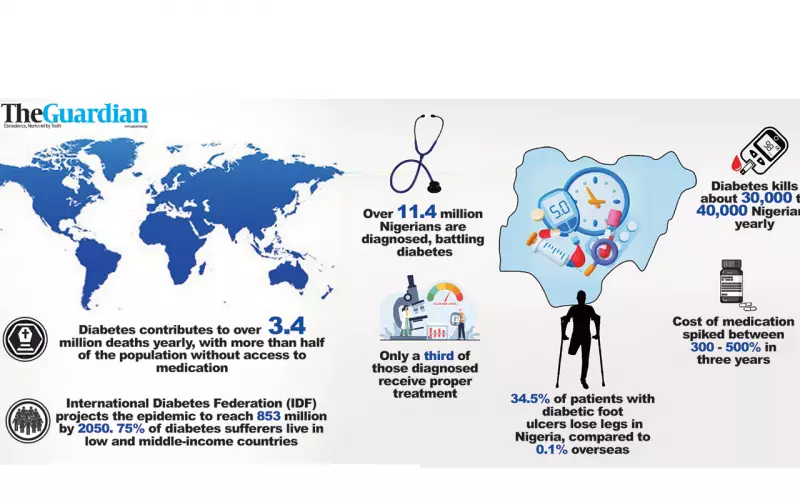
A silent epidemic is turning deadly in Nigeria, with over 30,000 to 40,000 citizens dying annually from diabetes complications. A perfect storm of a 300 per cent spike in medication costs, inadequate healthcare facilities, and harmful cultural beliefs is pushing millions to the brink, forcing patients to ration life-saving drugs or abandon treatment altogether.
Patients Forced to Choose Between Food and Medicine
The human cost of this crisis is stark. Mrs Leticia Nnabuike from Abuja, who has lived with diabetes for eight years, saw her monthly medical expenses jump from N35,000-N40,000 to over N120,000. "What I do nowadays is to ration the medication; I skip my medications some days," she confessed. Her story is not unique.
Lukman Hassan, a 59-year-old plumber in Abuja, has completely abandoned orthodox medicine. After being diagnosed in 2019, he could no longer afford his prescriptions by late 2023. "I had to search for herbal alternatives," he said, now relying on a mix of bay leaf, Moringa, and ginger. Another patient, Odafe, highlighted the grim reality: "Many are dying because they can't sustain the medications." His own monthly drug cost soared from less than N4,000 to N14,000 for the cheapest options.
A National Health Emergency Ignored
Diabetes ranks among Nigeria's top 10 killer diseases, afflicting over 11.4 million citizens, according to the Diabetes Association of Nigeria (DAN). Shockingly, the International Diabetes Federation (IDF) projects that 75 per cent of the global diabetic population will live in low and middle-income countries like Nigeria by 2050.
Despite the scale, experts accuse the Federal Government of paying scant attention. Only about one-third of diagnosed Nigerians receive appropriate treatment, and only a third of those achieve good blood sugar control. Professor Ejiofor Ugwu, National President of DAN, revealed that approximately two-thirds of diabetes cases in Nigeria remain undiagnosed due to a lack of routine screening.
"Diabetes is not supposed to kill anybody if it is well-controlled," Professor Ugwu stated. "But it is killing because most patients are not on treatment because they cannot afford the 300 to 500 per cent increase in the cost of diabetes medications."
Skyrocketing Costs and Dire Consequences
An investigation into drug prices reveals the severity. Despite a government zero-tariff on pharmaceuticals, costs have galloped. For example:
- Galvus Met 50 mg/1000 mg rose from N3,000 in January 2025 to N9,700.
- Glucophage (metformin) 1000 mg increased from N1,500-N2,000 to N5,000.
- Amaryl 4 mg skyrocketed from N500 to N11,000 per sachet.
This financial barrier has catastrophic health outcomes. Professor Ugwu cited a study showing a 34.5 per cent amputation rate for Nigerians hospitalized with diabetic foot ulcers—meaning nearly 4 in 10 such patients lose a limb. In contrast, rates in the U.S. and Australia are below 0.1 per cent.
Professor Felicia Anumah, an endocrinologist at the University of Abuja, painted a grim picture of the ripple effect: more strokes, heart attacks, kidney failures, and blindness. She noted that the weekly cost for dialysis due to diabetes-induced kidney failure has risen from about N100,000 to N250,000.
Failed Policies and the Call for Action
Stakeholders argue that government interventions have been ineffective. A tax waiver on locally produced pharmaceutical reagents does little when over 95 per cent of anti-diabetic medications are imported. Furthermore, the suspension of the Sugar-Sweetened Beverage (SSB) tax—intended to curb consumption of diabetes-fueling drinks—has been criticized as prioritizing industry profits over public health.
"Which country trades off the life of its citizens for the profit of a few companies?" Professor Ugwu questioned, advocating for the tax to be increased to at least N130 per litre to have a real impact.
Groups like Corporate Accountability and Public Participation Africa (CAPPA) join DAN in demanding urgent action, including a higher SSB tax and front-of-pack nutrition labelling. Experts like Professor Emmanuel Okoro of the University of Ilorin call for locally tailored solutions and smarter use of existing resources to identify at-risk populations early through diet and physical activity programs.
As community pharmacist Kayode Rafiu observed, patients are rationing drugs and struggling to afford prescribed diets, leading to uncontrolled blood sugar levels. With the naira's volatility and foreign exchange challenges persisting, the situation demands a declared state of emergency before the mortality figures climb even higher.