Grace, a bank worker in Uyo, Akwa Ibom, had for years relied on a discreet home delivery service for her antiretroviral medicines, arranged by community health workers. The arrangement kept her healthy without risking stigma from neighbours or colleagues. That support ended in February 2025 when international funding cuts forced the programme to shut down. She had no choice but to collect her medication herself from a treatment facility. Someone recognised her entering the HIV clinic, and within days, whispers spread through her church and neighbourhood. Ashamed, she stopped returning for treatment. By April 2025, she was dead. Her sister, Mary, told Premium Times: “If that support had remained, she would still have been taking her drugs.”
Patients Left Without Guidance
Grace’s experience mirrors that of many others in Akwa Ibom and Rivers states after donor-funded community HIV programmes were scaled back in early 2025. Mercy, another patient in Akwa Ibom, recalled arriving at her treatment facility after the cuts to find many familiar faces gone—adherence counsellors, laboratory personnel, peer supporters who guided patients through counselling and documentation. “The first thing that came to my mind was uncertainty,” she said. “Everything happened suddenly. Nobody prepared us. You asked questions, and they told you, ‘Your people are not here.’” She fears medication alone is not enough: “People need someone who genuinely cares whether they survive.”
Loss of Home-Based Care
For Johnson, a former community referral officer in Rivers State and a person living with HIV, the disappearance of home-based drug delivery is one of the greatest losses. He used to travel daily delivering ARVs to patients who could not safely visit clinics due to work, transport costs, or fear of stigma. “Many of those people are no longer coming to the facilities, and we don’t know where some of them are anymore,” he said. Patients who repeatedly miss appointments are classified as “lost to follow-up,” increasing risk of viral rebound, illness, and transmission.
Elizabeth Udo, Akwa Ibom State Coordinator of the Network of People Living with HIV/AIDS in Nigeria (NEPWHAN), said the organisation has seen similar tragedies. “We have lost people. They did not die because HIV treatment stopped completely. Many died because the support systems that helped them remain healthy disappeared.” She noted that donor-funded programmes supported home visits, appointment reminders, adherence counselling, support groups, adolescent education, and stigma-reduction campaigns. “Today, all of those activities have stopped.”
Funding Cuts Fuel Stigma
Peter, a patient in Rivers State, said the uncertainty around HIV funding has also fuelled stigma. He heard people mock those living with HIV: “Now that your drugs have been stopped, let’s see how all of you will survive.” While he has personally outgrown stigma, he worries about newly diagnosed patients. He recalled accompanying another patient to a facility where someone warned him not to sit in the HIV waiting area, unaware he too was HIV-positive.
Government Inaction
A Rivers State coordinator of NEPWHAN, who requested anonymity for fear of victimisation, said the network repeatedly appealed to the state government to be proactive as donor support withdrew. “We have written letters. We have sought meetings. We have continued to ask: now that donor partners are leaving, what is the state’s plan? Unfortunately, we have not seen the urgency this situation requires.” She said more than 300 workers engaged through donor programmes had lost their jobs, including 185 field personnel, leaving overstretched government health workers struggling to fill the gap. Many peer counsellors relied on their stipends to feed themselves and maintain their health.
The Scale of the Crisis
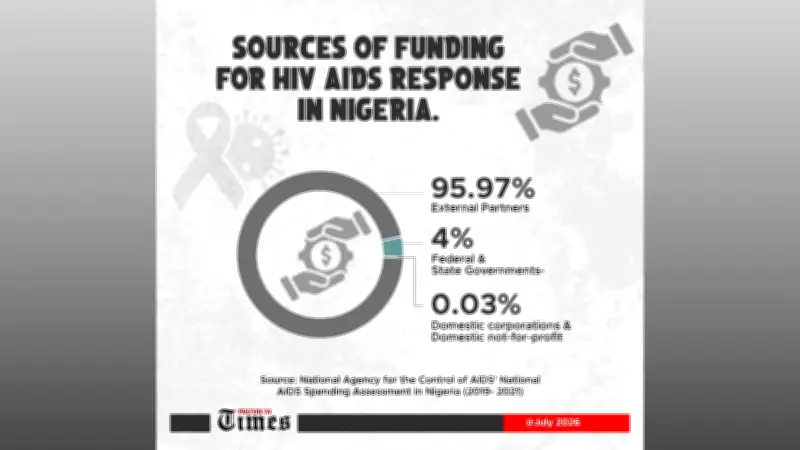
According to the Federal Ministry of Health’s State of the Health of the Nation 2025 report, Nigeria recorded 102,025 new HIV infections across 36 states and the FCT. Rivers State ranked second with 6,287 new infections, and Akwa Ibom fourth with 5,413. Rivers already has the highest number of people living with HIV in Nigeria, followed by Benue and Akwa Ibom. An analysis by NACA showed that external partners financed 95.97% of Nigeria’s HIV response in 2021, while federal and state governments contributed just 4%. Since 2005, Nigeria has attracted over $6 billion for HIV programmes, with 80% from PEPFAR and the Global Fund.
The funding cuts exposed a question Nigeria had postponed for years: what happens when donors step back before governments are ready to take over? As one coordinator warned, “People don’t disappear from the epidemic; they disappear from the health system and may keep spreading the virus.”