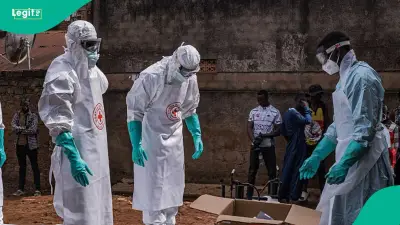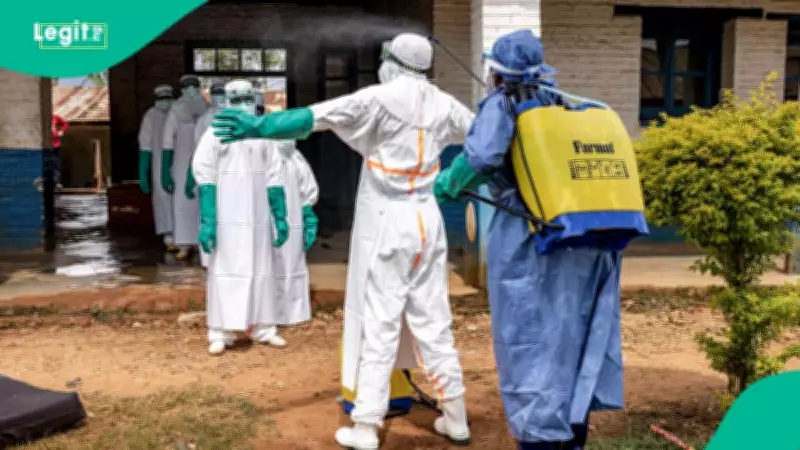
The federal government has identified 21 states and the Federal Capital Territory (FCT) as areas at high or moderate risk of Ebola importation following renewed outbreaks in parts of Africa.
The Nigeria Centre for Disease Control and Prevention (NCDC) announced on Thursday that states across the country have been placed on heightened alert amid fears of cross-border transmission.
According to Premium Times, NCDC Director-General, Jide Idris, confirmed that Nigeria currently has no confirmed Ebola case linked to the ongoing outbreak in East and Central Africa. However, he warned that increasing regional transmission has significantly elevated the country's importation risk.
"The risk of Ebola importation into Nigeria is high because of international travel, regional population movement, porous borders, and extensive trade networks," he said.
High-risk states identified
According to the NCDC, the following states were classified as high-risk due to international airports, porous land borders, and active travel and trade routes:
- Lagos
- FCT
- Rivers
- Kano
- Enugu
- Borno
- Akwa Ibom
- Cross River
- Taraba
- Adamawa
Moderate-risk states listed
The NCDC also listed the following states as moderate-risk, requiring sustained surveillance and preparedness measures:
- Ogun
- Nasarawa
- Kaduna
- Plateau
- Kogi
- Niger
- Jigawa
- Katsina
- Bauchi
- Ebonyi
- Abia
- Bayelsa
Rising Ebola cases in Africa
Mr Idris explained that the classification followed a fresh dynamic risk assessment conducted in response to rising Ebola cases in the Democratic Republic of Congo (DRC) and Uganda. Health authorities in both countries have reported 1,077 suspected cases and 247 deaths, with persons aged 14 to 45 years accounting for most infections.
The outbreak involves the Bundibugyo strain of the Ebola virus, for which there are no approved vaccines or targeted treatments. This makes rapid detection, isolation, contact tracing, infection prevention, and supportive care critical to containing infections.
Symptoms and transmission
The NCDC warned that Ebola symptoms closely resemble those of malaria and Lassa fever, increasing the risk of delayed detection and possible transmission. The agency stressed that Ebola is not airborne and spreads mainly through direct contact with infected blood, body fluids, contaminated surfaces, or infected animals.
Preparedness measures
The NCDC urged state governments to:
- Activate emergency mechanisms
- Strengthen surveillance at airports and border points
- Prepare isolation facilities
- Protect frontline workers with adequate equipment
States have been directed to submit readiness reports within 72 hours and immediately report any suspected Ebola case, unusual fever clusters, or high-risk exposure incidents.
Nigeria successfully contained Ebola in 2014 after an infected Liberian-American traveller arrived in Lagos, triggering one of the country's most significant public health emergencies in recent history.
The World Health Organization (WHO) has declared the latest Ebola outbreak in the DRC a public health emergency of international concern. The rare Bundibugyo strain has already claimed 220 suspected lives, with cases spreading across borders into Uganda.