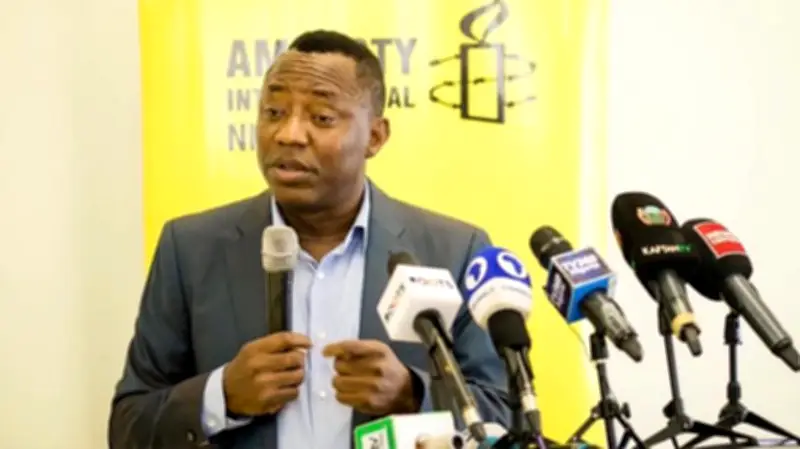
Amnesty International Nigeria has condemned the Federal High Court in Abuja for revoking the bail of activist Omoyele Sowore over his alleged absence in a cyberbullying case. The case stems from Sowore's social media posts labeling President Bola Tinubu as a criminal.
Amnesty's Stance on the Bail Revocation
In a statement released on Friday, Amnesty argued that the court's decision violates Sowore's constitutional and international rights to freedom of expression, liberty, and a fair trial. The organization emphasized that criticism of public officials is protected speech under Nigerian law and international treaties such as the International Covenant on Civil and Political Rights (ICCPR).
“The reported revocation of Sahara Reporters publisher and activist Omoyele Sowore’s bail represents a deeply troubling development that risks undermining the rights to liberty, fair trial and freedom of expression in Nigeria,” Amnesty said.
Details of the Case
The Federal High Court in Abuja on Tuesday ordered Sowore's arrest after he failed to appear for proceedings in which he faces cyberbullying charges. The charges relate to his social media posts calling President Tinubu “a criminal” last year. The judge also issued a bench warrant for Sowore's arrest following an oral application by the prosecution.
“The revocation of Sowore’s bail is linked to the peaceful expression of his views, and criticism of public officials, which are clearly protected under the Nigerian Constitution 1999 [as amended] and the country’s international human rights obligations including under the International Covenant on Civil and Political Rights and the African Charter on Human and Peoples’ Rights to which Nigeria is a state party,” Amnesty added.
Violation of Rights
Amnesty stressed that the revocation of Sowore's bail violates his rights to freedom of expression, liberty, and a fair trial. The organization noted that any restrictions on these rights must be lawful, necessary, and proportionate, and must not be used to silence criticism or suppress peaceful dissent.
According to Amnesty, freedom of expression is a cornerstone of any society based on the rule of law. Public figures, journalists, human rights defenders, activists, and political commentators must be able to express opinions, criticize government policies, and participate in public debate without fear of arrest, detention, or other forms of retaliation.
Chilling Effect on Society
The organization warned that using criminal proceedings, restrictive bail conditions, or misusing the criminal justice system to punish or deter legitimate expression creates a chilling effect that extends beyond the individual concerned. Such actions discourage others from speaking out, weaken civic space, and undermine public confidence in the rule of law.
Amnesty's Demands
Amnesty International has called for the immediate reversal of the bail revocation, the dropping of all charges against Sowore, and an end to the use of judicial processes to silence journalists, activists, and critics. The organization urged Nigerian authorities to protect civic space and uphold the rule of law.
“The authorities must immediately drop all bogus charges against Sowore solely for the peaceful exercise of his human rights. They must fully comply with international fair trial standards and respect due process guarantees,” Amnesty said.
Amnesty further called on Nigerian authorities to uphold and respect the right to freedom of expression, including criticism of public officials and government policies, and to refrain from using criminal law, judicial processes, or restrictive measures to intimidate, harass, or silence critics, journalists, activists, and human rights defenders.
The organization added that authorities must demonstrate their commitment to the rule of law and human rights by ensuring that no one is deprived of their liberty or subjected to abuse of the judicial system simply for peacefully exercising their right to freedom of expression.