The destructive ways in which social media is being deployed by many Nigerians, especially opposition politicians and aggrieved citizens, often cross the red line of responsible citizenship. Many individuals fail to distinguish between criticizing government and bringing down their country, inadvertently becoming saboteurs. The time has come to heed the clarion call to stop spreading evil reports about Nigeria. Even if you dislike the government in power, there must be a respected Nigeria for your desire for change to take place. If Nigeria is brought to its knees, where will your desire for change happen?
There is a sobering truth that must shape our national conversation: what you see is what you get. You cannot build a nation while staring only at the cracks in the wall. If your eyes are trained to scan for failure, you will never notice the foundation being laid beside it. The great irony of our time is that the people cursing the darkness loudest are usually still standing inside the very house they are cursing.
This is not an argument against criticism. Democracy suffocates without accountability. Every citizen has the right and duty to point out where government and institutions fail. But there is a chasm between constructive criticism and the deliberate circulation of evil reports designed to deepen despair and summon collapse. History has already priced this path for us, and the cost was blood.
During the Second Republic under President Shehu Shagari, prominent political actors openly canvassed for military takeover. The chorus was deafening: "Anything is better than this government." When the tanks rolled in December 1983, they did not ask for party cards or sort saint from sinner. The calamity swept everyone. Many of those leaders who invited the storm found themselves in detention, handed decades-long sentences, their careers shattered, their health broken. Some never walked out; some emerged blind. The house they wanted burnt did not spare them. Fire does not vet its victims.
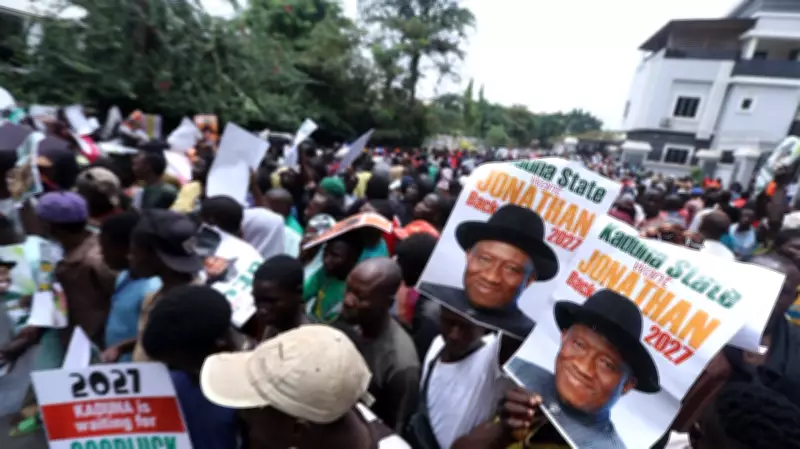
Fast forward to the Goodluck Jonathan administration. The word "clueless" became a national anthem. Airwaves and timelines drowned in ridicule, caricature, and prophecy of doom. The government was voted out in 2015, but the calamity that followed—widening insecurity, economic shocks, institutional strain—is a bill we are still paying today. Those who shouted loudest did not escape. The economy they mocked contracted under their feet. The insecurity they weaponized moved into their streets, their homes, their families. When you pray for the house to burn down, you do not get to choose who gets out alive.
These two chapters should sober every Nigerian who thinks national collapse is theatre. History sweeps saints and sinners together when the house burns. Here is the hard truth: In the same Lagos, on the same night, two realities run parallel. One timeline screams collapse, hopelessness, finality. In another room, entrepreneurs are closing deals, engineers are laying fiber, founders are raising capital, and farmers are scaling harvests. Both Nigerians are real. The difference is which room you choose to sit in.
We have normalized consuming Nigeria like a crime scene, especially online. But no nation was ever built on outrage alone. Every country that rose had a generation that refused to rehearse hopelessness. They built anyway. Tunnel vision is the silent killer of nations. When all you consume is bad news, you become psychologically addicted to negativity. Your expectations bend, your decisions shrink, your outcomes mirror what you magnify. A man conditioned to see only darkness will miss the sunrise when it comes. A people trained to expect only failure will fumble the keys to success when they are handed over.
Yes, acknowledge what is broken. No serious person will pretend all is well. But do not become addicted to the brokenness. Negativity is cheap; building is expensive. Only one pays dividends for the next generation. The question is no longer "What is wrong with Nigeria?" The real question is: "What am I doing with what is still working, and what am I building while others are arguing?"
There are Nigerians building wealth in silence, young people innovating with fury, industries expanding beyond headlines, opportunities hiding in plain sight, and citizens solving problems while others rehearse despair. If you are not in those rooms, you will swear those rooms do not exist.
A call to the rebuilding generation: to those who have turned the spread of evil reports into a daily duty, especially in this political season, stop. Be careful what you pray for. The instability you summon will not skip your address. Be careful what you consume. A diet of doom destroys your capacity to create. Position yourself where solutions breathe. Your environment will either enlarge your vision or bury it. Become part of the rebuilding generation. Nations rise because a remnant decides to stop cursing the darkness and start laying bricks.
Nigeria is not perfect. No nation is. But history and life have a strange habit: they reward those who can still see possibilities in the middle of chaos. May this land produce an incredible harvest for all of us who choose to build rather than to burn. Let us all strive to build a nation out of these many nations. This we can do by renewing our pledge to build a new nation and to refrain from the current actions, activities, and utterances that are tearing rather than building.
Therefore, as a patriot, I am inviting other patriots to join hands with me wherever they are in making a new pledge that is different from the one we merely recited as tradition or ceremony. Now let us dedicate ourselves to the Nigerian Co-Existence Pledge—a one-page commitment for every Nigerian:
"I am a Nigerian; my ethnicity is my heritage, my citizenship is my bond. Nigeria is stronger because of our 250+ ethnic groups, not in spite of them. I pledge to put Nigeria first. I will judge people by character and competence, not by tribe, religion, or state of origin. I will treat every Nigerian as a citizen with equal rights, anywhere in this country. I demand fairness and accountability at all levels of governance, groups, personal and interpersonal relationships. I will support leaders who serve all Nigerians, not just their own. I will reject corruption, impunity, and divisive politics. I will hold my local, state, and federal representatives accountable for results. I will promote and protect peace where I am. I will not share hate, fear, or divisive content. If conflict starts, I will de-escalate. I will defend the rights of every Nigerian to live, work, and own property safely anywhere in Nigeria. I will build shared prosperity. I will support projects and policies that connect Nigerians across regions. I will trade, learn, and work beyond ethnic and religious lines, learn and teach honest history without distortion. I will remember the past without being imprisoned by it. I will teach my children that diversity is our advantage when we manage it well."
Why does this renewed pledge matter? It matters because a nation of over 220 million cannot be glued together by force. It holds together when citizens believe they have a stake in its survival, wellbeing, dignity, prosperity, and future. Therefore, this renewed pledge is my stake. I will live it, I will teach it, and I will defend it.
Alabi, a senior lawyer, business consultant, and statesman, is the National Chairman of the Ondo State Eminent Persons Group.