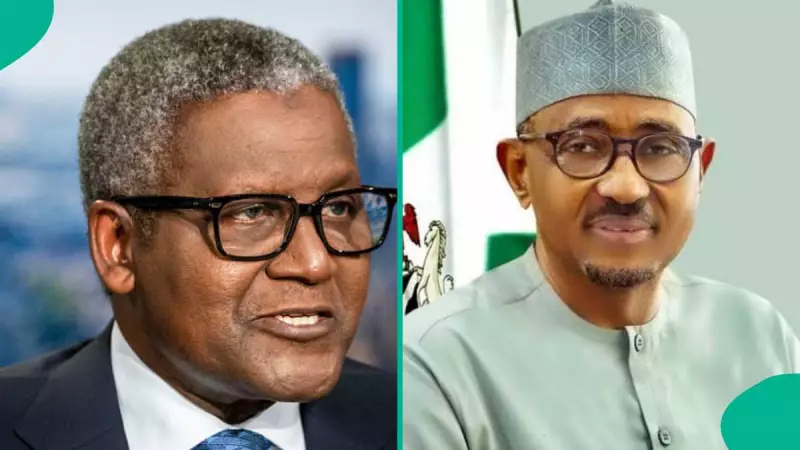
The simmering tension between Africa's richest man, Aliko Dangote, and the chief executive of the Nigerian Midstream and Downstream Petroleum Regulatory Authority (NMDPRA), Farouk Ahmed, has erupted into a public confrontation. The dispute centers on a serious allegation of corruption and reveals deeper fissures over government policy affecting the massive Dangote Refinery.
The Core Allegation: A $5 Million School Fees Payment
At the heart of the conflict is a direct accusation from Dangote. The billionaire industrialist has petitioned the Independent Corrupt Practices and Other Related Offences Commission (ICPC), alleging that Farouk Ahmed paid a staggering $5 million as school fees for his children attending an institution in Switzerland. This allegation, made public in mid-December 2025, has ignited widespread reactions across Nigerian social media platforms.
Dangote's move to involve the ICPC signifies a formal escalation, pushing for an official investigation into the financial affairs of the regulatory chief. The NMDPRA, under Ahmed's leadership, is the key regulator for the petroleum sector where Dangote's multi-billion dollar refinery operates, making the allegation particularly sensitive.
Beyond Corruption: A Policy Clash Explained
While the corruption allegation is explosive, a Nigerian social media commentator, @Mimi_yakigar, provided a viral analysis suggesting the root cause is a fundamental policy disagreement. She argued that Dangote's pursuit is not merely about corruption but about regulatory actions that threaten his refinery's viability.
"You invest billions in a refinery, take the risk, build under a clear understanding that you'll produce at capacity then a civil servant... wakes up and disrupts it with unfavourable policies," she stated. Her post claims that local production is being quietly constrained by policies that prioritize revenue from imported fuel.
She pointed out that the government imposes taxes and levies, including a 7.5% Value Added Tax (VAT), on imported petroleum products, making imports costlier. However, instead of this creating an advantage for Dangote's locally produced fuel, she alleges output is being limited and the label of "monopoly" is being used against him. This, she concludes, is a "revenue-first policy disguised as competition."
Nigerians React: Market Dynamics and Civil Service Corruption
The public debate has drawn diverse perspectives from Nigerians online. Some users focused on the market implications. @Jehoshua247 suggested Dangote should simply flood the market with his cheaper products, making imports economically unviable. @SamObi9 argued that as long as import licenses exist and there is no ban, Dangote cannot create a monopoly or sell above market price.
Others highlighted systemic issues. @GamalielAminu remarked, "Until you engage a civil servant as a private business owner you will not understand... the corruption in our civil service is something else." Meanwhile, @judeorazulike questioned the strategy, suggesting petitioning the Minister of Petroleum, President Bola Tinubu, might have been more effective. Skepticism about the anti-graft agencies' effectiveness was also voiced, with @JoshLyffe asking if they were previously unaware of such issues.
In a related development, the Nigerian National Petroleum Company (NNPC) Limited was reported to have reduced petrol pump prices slightly in major cities like Lagos and Abuja around the same period, adding another layer to the ongoing fuel market discussions.
The clash between Dangote and the NMDPRA boss, therefore, transcends a personal allegation. It has become a flashpoint for discussing the intersection of big business, regulatory power, government revenue policy, and allegations of corruption within Nigeria's critical energy sector. The outcome of the ICPC petition will be closely watched for its impact on both governance and the business landscape.