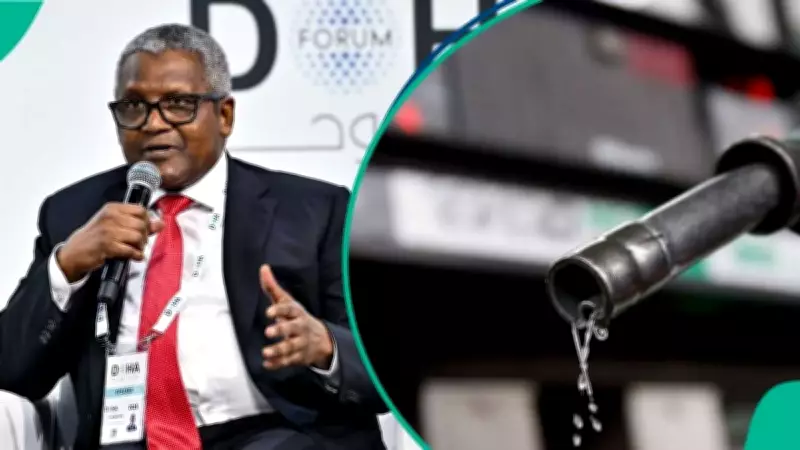
Aliko Dangote has again challenged the Nigerian government in court over fuel import licences granted to marketers. The latest suit adds another chapter to a protracted dispute over the importation of petrol despite the functioning refinery. Dangote Refinery Petrochemicals Company (DRPC) accounted for about 80 per cent of Nigeria’s daily petrol consumption.
Fresh Legal Action
Dangote Petroleum Refinery has filed a fresh suit before the Federal High Court in Lagos seeking an order to quash recent fuel import licenses granted or renewed by the Nigerian Midstream and Downstream Petroleum Regulatory Authority (NMDPRA) to the Nigerian National Petroleum Company (NNPC) and certain independent marketers. The move by Dangote is based on the argument that these licenses were contrary to a subsisting court order maintaining the status quo and the Petroleum Industry Act (PIA), which prohibits fuel imports during periods of supply sufficiency in the country.
The refinery stated in its court documents: "These licences that were granted this month are contrary to the law and negatively impacts our business." Dangote argues that Nigeria now has enough refining capacity not to need comprehensive import approvals. The NMDPRA has not reacted to requests for comments, nor has the Attorney General's office, which stated it could not comment immediately.
Background of the Dispute
The latest court case is taking place less than a year after a similar one filed by the refinery in July 2025 was withdrawn without reasons, giving rise to widespread speculation about a potential truce with regulators or strategic manoeuvring. The revival of the legal challenge marks a renewed phase of confrontation in a dispute that has come to the forefront of Nigeria's reform discourse following the start-up of the refinery in 2023. Built on a 2,635-hectare land on the outskirts of Lagos, the Dangote refinery has a processing capacity of 650,000 barrels per day and was initially expected to solve Nigeria's long dependence on imported refined petroleum products, despite possessing crude oil reserves, on which Nigeria hinges to power its economy.
Dangote Fuel Sufficiency
Dangote refinery supplied almost 80% of Nigerian daily petrol consumption in April 2026, having nearly utilised its maximum capacity, according to a report by the Nigerian Midstream and Downstream Petroleum Regulatory Authority. From a factsheet of April 2026, it was confirmed that the daily consumption of petrol surged to 51.1 million litres from 47.3 million litres in March, while the overall daily supply stood at 44.4 million litres. The refinery produced daily 53.6 million litres of petrol, with 40.7 million litres allocated for local use and 17.1 million litres exported. Imported petroleum decreased to 3.7 million litres per day from 5.9 million litres per day recorded in March as local refineries took the majority share of the Nigerian market. The Dangote refinery, as reported, ran at 99.12% capacity utilisation in April.
Marketers Import Fuel
Legit.ng earlier reported that no fewer than 164,000 metric tonnes of imported petroleum products were across major ports. The incoming cargoes, made up of petrol and diesel, are expected to strengthen supply across the country and provide fresh competition for Dangote refinery. According to the Daily Shipping Position obtained on Sunday, the shipments include 82,000 metric tonnes of Automotive Gas Oil (AGO), also known as diesel, and 81,882 metric tonnes of Premium Motor Spirit (PMS), commonly called petrol.