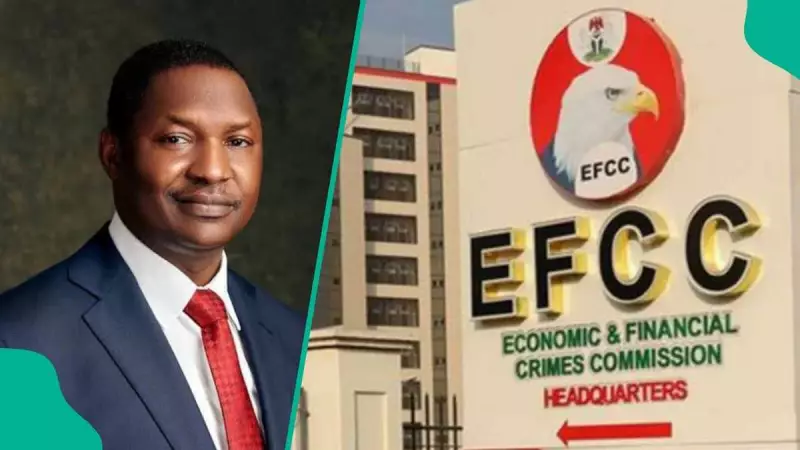
Fresh investigations by Nigeria's Economic and Financial Crimes Commission (EFCC) have revealed a complex trail of assets valued at over N200 billion linked to the former Attorney-General of the Federation and Minister of Justice, Abubakar Malami (SAN).
Three Major Financial Trails Under Scrutiny
Operatives of the anti-graft agency have connected Malami's substantial wealth to three key financial transactions that occurred during his tenure under former President Muhammadu Buhari from 2015 to 2023. The former minister, who has been detained by the EFCC, has denied all allegations, labeling the probe as political persecution and vowing to defend himself in court.
Paris Club Refund Controversy
A significant portion of the traced assets is allegedly tied to kickbacks from the controversial Paris Club refund consultancy payments. Nigeria had settled its debts with the Paris Club in 2005, but later processes involved refunds to states. During Malami's time as AGF, the federal government approved the payment of over $400 million to consultants hired to calculate these refunds.
Acting on Malami's legal advice, these funds were deducted directly from state allocations, a move strongly opposed by the Nigeria Governors' Forum (NGF). The NGF accused Malami of pursuing personal interests and acting on behalf of the consultants, alleging the claims were fraudulent. Despite this opposition, former President Buhari approved the payments. EFCC sources indicate that a bulk of Malami's sudden wealth originated from kickbacks linked to this deal.
Unpaid CBN Anchor Borrowers' Programme Loan
Another major focus of the investigation is the Central Bank of Nigeria's Anchor Borrowers' Programme (ABP). Launched in 2015 to boost food production, the programme has disbursed over N1 trillion, with more than N600 billion yet to be recovered. Investigators discovered that Malami allegedly obtained a N4 billion loan under the ABP using the name of one of his wives, Hajiya Bashir Asabe.
The loan was reportedly never repaid. Both Malami and his wife have now been charged in court over this transaction, raising concerns that portions of the ABP funds may have been diverted for purposes other than agriculture.
Duplicated Fees on Abacha Loot Repatriation
The EFCC also uncovered serious irregularities in the repatriation of $321 million of Abacha loot. The funds had already been recovered and frozen in 2013 under former President Goodluck Jonathan, with all professional fees fully paid to Swiss lawyers.
However, in December 2017, Malami, as the sitting AGF, engaged two Nigerian lawyers—Oladipo Okpeseyi and Temitope Isaac Adebayo—for the same concluded job. This suspicious move cost Nigeria an additional $16.9 million in commission and professional fees from the already recovered funds. The EFCC has detained and interrogated both lawyers, who reportedly made useful statements. Payments from this duplicated commission were subsequently traced to Malami by investigators.
Malami's Defense and Current Status
From EFCC custody, Abubakar Malami has dismissed the allegations. Through his media office, he stated that his interaction with the EFCC was solely to clarify an allegation of duplication in the Abacha loot recovery process. He denied being questioned over terrorism financing, multiple bank accounts, or money laundering.
Regarding the Abacha loot, Malami explained that a Swiss lawyer reapplied for engagement in 2016, demanding 40% in fees, but the Buhari administration capped fees at 5%, leading to the engagement of the Nigerian lawyers. He has remained in detention after failing to meet bail conditions set by the EFCC ahead of his arraignment before a federal high court in Abuja.
The unfolding case highlights significant questions about the management of large-scale public financial transactions during the Buhari administration and sets the stage for a major legal battle concerning accountability and alleged corruption at the highest levels of government.