Ahead of the June 2026 Ekiti State governorship election, the Executive Director of the Centre for Media and Society (CEMESO), Akin Akingbulu, has called on media professionals to treat their role in the electoral process not as mere observers, but as active, load-bearing participants in the democratic architecture. This appeal comes as members of the European Union (EU) also emphasize the need for electoral integrity in the state.
Media as Load-Bearing Participants
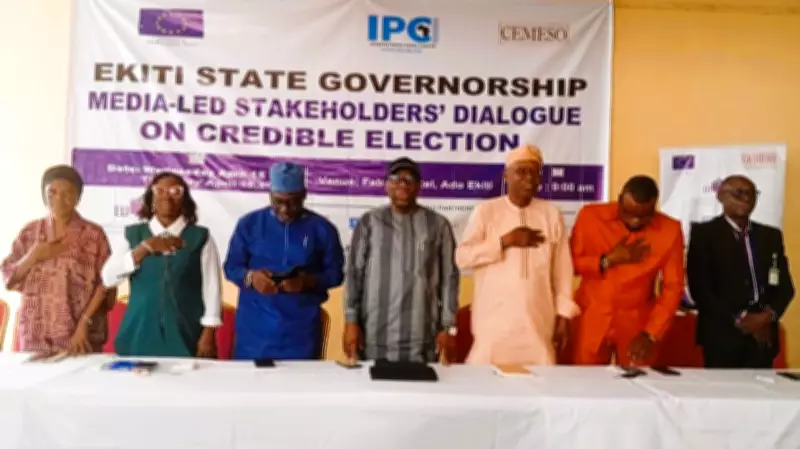
Speaking at a recent Media Stakeholder Forum on Credible Elections held in Ado-Ekiti, Akingbulu noted that the integrity of an election is determined long before voters reach the ballot box. He stated, "There is a question that should precede every election—not who will win, but whether the process will be believed." He argued that in the nation's democratic journey, this question is central to whether citizens trust their institutions and whether the media fulfills its highest obligation to inform, rather than inflame.
Power of the Pen and Microphone
Akingbulu further reminded journalists of the power they wield, noting that the choices they make regarding framing and narratives will ultimately shape the electoral reality for the people of Ekiti. He emphasized, "The pen, microphone, and digital platform—wielded with integrity, guided by evidence, and offered in service of an informed public—remain among the most powerful democratic instruments that exist."
Challenges of Off-Cycle Elections
Akingbulu also drew specific attention to the unique vulnerabilities of off-cycle elections, such as the upcoming contest in Ekiti. He noted that these elections often suffer from diluted public attention and compressed media programming, creating an environment where political interference can thrive and voter apathy can rise. He added, "The evidence is unambiguous: in off-cycle elections, the gap between what citizens know and what they need to know to participate meaningfully is wider." To counter this, he asserted that media engagement must be intentional and sustained, rather than episodic.
Interventions by CEMESO and IPC
Akingbulu disclosed that CEMESO and the International Press Centre (IPC) have implemented a series of interventions—including the Journalists–INEC Voter Education and Publicity Dialogue and the Broadcast Audience Voter Opinion Lab—to bolster this capacity. IPC Executive Director, Lanre Arogundade, warned that the media must remain vigilant in the face of evolving threats. He stated, "Electoral integrity in Nigeria continues to be undermined by violence, interference, vote buying, weak enforcement, misinformation, and the growing threat of deepfakes, all of which erode public trust in the process."
Media Responsibility Greater Than Ever
With the current landscape, Arogundade observed that the media's responsibility is greater than ever. He noted that given the media's pivotal role in promoting truth and accountability, accurate and responsible reporting remains essential to safeguarding electoral probity. When the media is well-prepared, connected to credible information sources, anchored in professional ethics, and equipped to resist the undertow of partisan pressure, electoral outcomes are more trusted.
Training and Support Activities
Members of CEMESO and the IPC also pledged to provide additional training and media support activities planned for the coming weeks to ensure that all eyes—on INEC, security agencies, the National Orientation Agency (NOA), and the media—remain focused on delivering a fair and credible electoral outcome. They highlighted that their work is not merely theoretical but grounded in tested practices from similar engagements in states such as Edo, Kogi, Anambra, and Ondo.
Combating Digital Threats
To address the modern digital threat, they pointed to practical tools now available to journalists, including the AI Fact-Checking Guide and the Haltfake.org platform, which help newsrooms build the internal verification capacity needed to outpace misinformation.
EU Support to Democratic Governance
The forum, convened jointly by CEMESO and IPC under the European Union Support to Democratic Governance in Nigeria (EU-SDGN II), represents a critical, coordinated effort to strengthen the nation's democratic communication ecosystem. The EU recognizes that electoral credibility is not built on logistics and legal frameworks alone, but on three foundational pillars: informed citizens, accountable institutions, and a media ecosystem capable of serving both. Through its Support to Media Component, the EU has invested in funding six interconnected components supporting the Independent National Electoral Commission (INEC), the National Assembly, the judiciary, political parties, civil society, and the media. This represents a coherent, integrated commitment to a more inclusive, pluralistic, and participatory democracy in the country.