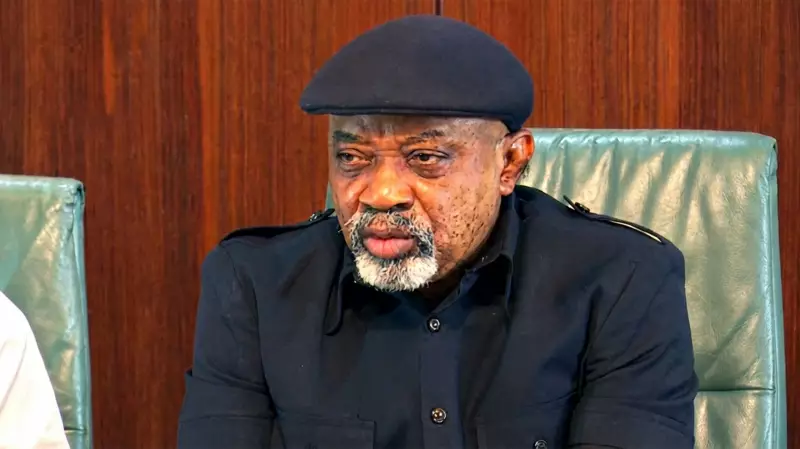
Former Minister of Labour and Productivity, Senator Chris Ngige, has vehemently denied any wrongdoing in the high-profile N2.2 billion fraud case brought against him by the Economic and Financial Crimes Commission (EFCC). The ex-minister, who was recently granted bail, maintains that his hands are clean and his long career in public service remains untarnished.
The Charges and Court Proceedings
The EFCC arraigned Ngige on December 12, 2025, before a High Court in the Federal Capital Territory. He faced an eight-count charge related to abuse of office and acceptance of corrupt gifts. Following his arraignment, the presiding judge ordered his detention at Kuje Prison.
However, Justice Maryam Hassan of the FCT High Court in Gwarimpa later granted him bail ahead of his trial scheduled for next year. Shortly after meeting his bail conditions, Ngige proceeded directly to attend a caucus meeting of the All Progressives Congress (APC) National Working Committee at the Aso Villa in Abuja.
Details of the EFCC's N2.2 Billion Allegations
The anti-graft agency's case centres on accusations that Ngige used his ministerial position to confer unfair advantages on companies linked to his associates. The prosecution outlined a series of contracts awarded by the Nigeria Social Insurance Trust Fund (NSITF) during his tenure.
The EFCC alleges that Ngige approved:
- Seven NSITF consultancy, training, and supply contracts worth N366.47 million in favour of Cezimo Nigeria Limited.
- Eight contracts valued at N583.68 million awarded to Zitacom Nigeria Limited.
- Influenced the award of eight contracts worth N362.04 million to Jeff & Xris Limited.
- Four contracts valued at N668.14 million to Olde English Consolidated Limited.
- Another four contracts worth N161.6 million through Shale Atlantic Intercontinental Services Limited.
The commission further claims that between May and June 2022, Ngige corruptly received monetary gifts from these NSITF contractors. These alleged gifts include N38.65 million from Cezimo Nigeria Limited through his campaign organisation, N55.003 million from Zitacom Nigeria Limited via a scholarship scheme, and N26.13 million from Jeff & Xris Limited.
The charges are said to contravene Sections 17(a) and 19 of the Corrupt Practices and Other Related Offences Act, 2000.
Legal Arguments and Ngige's Robust Defence
During the bail hearing, the EFCC counsel, Senior Advocate of Nigeria Sylvanus Tahir, urged the court to deny bail. He argued that Ngige had previously breached administrative bail terms by failing to return his passport after a medical trip abroad. The prosecution also emphasised the gravity of the charges, which carry a minimum five-year prison term upon conviction.
In contrast, Ngige's defence counsel, Patrick Ikwueto (SAN), successfully argued for bail. He described the offences as bailable and stressed that his client, a well-known public figure, would not abscond. Ikwueto also raised concerns about Ngige's health, stating that the correctional facility lacked adequate medical care for his condition.
In a detailed statement after his release, Chris Ngige launched a forceful defence of his reputation. He thanked his supporters and insisted that no fraud was discovered in the petitions against him.
"In all my years of over three decades of public service, including as Governor of a state, I have not been found wanting in the handling of public funds and use of my office," Ngige declared.
He clarified a critical point, noting that the charges did not allege embezzlement, misappropriation, or outright theft of public funds. He questioned the very basis of the "unfair advantage" accusation, arguing that ministers have no direct control over the contract award process.
"My hands are clean, and it will be interesting to see where and how these companies were allegedly given 'unfair advantage' in a process over which ministers neither participate in nor control," he stated.
Ngige explained that Permanent Secretaries, as chairmen of Ministerial Tenders Boards, preside over such matters. He asserted that the five companies named were traditional bidders who often lost contracts. "In some cases, as we now know, they were even disqualified for not meeting specific requirements," he added.
What Comes Next?
The case has drawn significant public attention, pitting a prominent political figure against the nation's foremost anti-corruption agency. With the trial set for the coming year, the courtroom will be the ultimate arena to test Ngige's claims of innocence against the EFCC's detailed allegations. The outcome will have profound implications for Nigeria's ongoing fight against corruption and the accountability of high-ranking public officials.