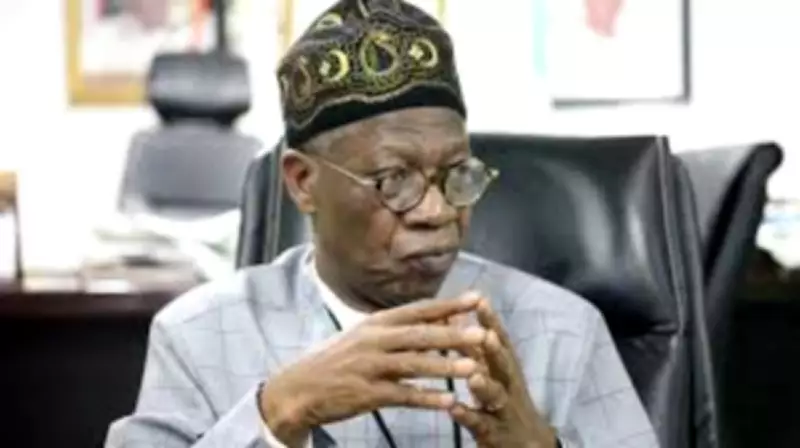
Former Minister of Information and Culture, Lai Mohammed, has dismissed allegations of a targeted genocide against Christians in Nigeria as false. Speaking at Abbey College in Cambridge, United Kingdom, on Wednesday, April 21, Mohammed addressed questions from students regarding religious persecution in Nigeria.
Mohammed emphasized that Nigeria's security challenges are multifaceted and not driven by a deliberate campaign to eliminate any faith. He stated, "There should be more understanding on the part of the developed world. Now, people say that there is religious persecution in Nigeria and that there is genocide against Christians. It’s not true. It is fake news."
Historical Context of Boko Haram
The former minister explained that Boko Haram initially emerged as a movement targeting Muslims who embraced Western education. Early victims were predominantly Muslims, not Christians. He noted that the group's name, Boko Haram, translates to "Western education is forbidden," and that he himself, as a Western-educated Muslim, was considered an enemy by the group.
Mohammed acknowledged that the group later expanded its attacks to Christians, partly to attract wider attention. He remarked, "They realised that Muslims killing one another doesn’t gain traction. When Muslims start killing Christians, it causes an uproar. That is the honest truth."
Banditry and Religion
Mohammed also refuted claims that banditry in Nigeria is driven by religion. He pointed out that bandits are predominantly Muslims and Hausa-Fulanis, and their victims are also Muslims and Hausa-Fulanis. "So how can you now talk about religion? It has nothing to do with religion," he said.
Records indicate that Muslims account for the largest number of victims of insurgent attacks in Nigeria, according to Mohammed.
Religious Tolerance in Nigeria
The former minister highlighted the spirit of religious tolerance in Nigeria, challenging anyone to deny it. He stated, "People can hide under anything to commit crime but one, it is not a policy. Number two, the average Nigerian is not bothered about your religion or ethnicity."
He added that average Muslims and Christians in Nigeria disagree over money, not theology, and that interfaith marriages are common. Mohammed cited President Bola Tinubu, a Muslim, whose wife is a leader in the Redeemed Christian Church of God (RCCG), as an example of religious coexistence.
Mohammed concluded, "This narrative about Christian genocide, it is not true and we must vigorously use public communication to challenge it."