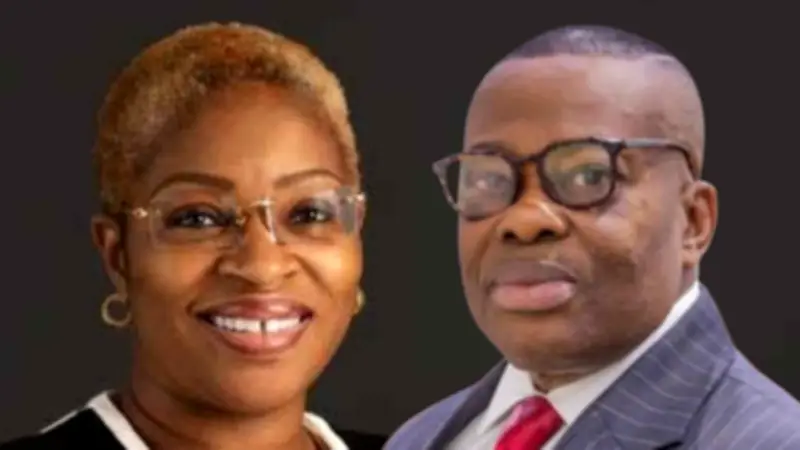
Monday Ubani, a Senior Advocate of Nigeria (SAN), has called for a comprehensive review of the Nigerian Bar Association (NBA) 2026 national officers' election, which was marred by technical failures that reportedly prevented many eligible lawyers from voting. Ubani made the call in a Facebook statement on Tuesday while congratulating Oyinkansola Badejo-Okusanya, also a SAN, who won the presidential election.
Ubani and Son Unable to Vote
Ubani said he and his son, also a lawyer, were unable to vote despite repeated attempts. The One-Time Password (OTP) required for electronic voting did not arrive after several tries. “After several unsuccessful attempts, the response on my device changed to the now-familiar refrain: ‘This site can’t be reached.’ Sadly, that remained my experience until voting eventually came to an end,” he stated.
Ubani, a former chairman of the NBA Ikeja branch and former second vice president at the national level, explained that his son experienced similar difficulties. Several colleagues and friends also contacted him during the election to report comparable problems. Some voters switched from mobile devices to laptops after being advised that laptops might provide better access, but their difficulties persisted.
Widespread Complaints Cannot Be Ignored
“Against this background, it would be difficult to dismiss these complaints as isolated incidents or the frustrations of a few disgruntled voters. An electoral process that technically disenfranchises a significant number of eligible voters cannot, by any stretch of the imagination, be described as wholly free, fair, credible and inclusive,” Ubani lamented. He stressed that the problems were particularly unfortunate given the high interest generated by the election. Lawyers who were willing and eligible to vote should not have been prevented by failures in the electoral system.
“Whoever insists that there was no problem with the process, in the face of the widespread complaints experienced and reported by members, would simply not be presenting a fair account of what transpired,” he stated.
Ubani Does Not Diminish Badejo-Okusanya's Victory
Despite his misgivings, Ubani said he was not out to diminish the victory secured by Badejo-Okusanya and other elected officers. He called on her upcoming leadership to reform the NBA's electoral process, noting that she and the other winners could still have won convincingly. “Indeed, I believe Madam Badejo-Okusanya could still have won resoundingly even without the technical glitches that unfortunately cast a shadow over the process,” he wrote, but maintained that “issues arising from the election should not be ignored or swept under the carpet.”
Badejo-Okusanya defeated fellow SANs Lateef Akangbe and Olumuyiwa Akinboro in the election held between Saturday and Sunday. She polled 12,317 votes, while Akangbe scored 7,934 votes and Akinboro 5,855 votes, according to the final tally on the live results dashboard of the Electoral Committee of the NBA (ECNBA). Her victory made her the first elected female president of the NBA and the second woman to lead the 66-year-old association, after Priscilla Kuye, who served as president between 1991 and 1992. She is billed to be inaugurated during the NBA's annual general conference from 21 to 28 August in Port Harcourt, Rivers State, as the 33rd president.
Ubani Urges Reform, Cites Yar'Adua's Example
Ubani called on the incoming leadership to champion reform of the association's electoral process. “The legitimacy of leadership is strengthened, not weakened, when legitimate questions surrounding the process that produced it are openly acknowledged and addressed,” he wrote, adding, “The starting point for the new NBA leadership should therefore be a candid interrogation of the electoral process through which it emerged.” He urged them to draw lessons from Nigeria's democratic history, citing late President Umaru Musa Yar'Adua's acknowledgment in 2007 that the electoral process that brought him into office was flawed and his subsequent initiation of electoral reforms. “That acknowledgment did not diminish his office; rather, it demonstrated an important willingness to confront deficiencies in the system,” Ubani said, urging “the incoming NBA leadership should demonstrate similar institutional courage.”
“Madam Oyin Badejo-Okusanya owes the NBA constituency a responsibility to acknowledge the genuine complaints arising from this election and to support a transparent review of what went wrong,” he wrote.
Key Questions Raised by Ubani
To guide future interrogation into the controversial election, Ubani raised questions requiring clear answers: “Why did so many eligible voters reportedly experience difficulties receiving OTPs? Why were members confronted with inaccessible platforms and error messages? What was the extent of voter disenfranchisement caused by these technical failures? Were adequate contingency measures in place? And, most importantly, what concrete reforms will ensure that these failures are never repeated?” He stressed that these questions should not be treated as partisan attacks against the winners but as institutional questions that go directly to the integrity of the NBA.
Ubani noted that lawyers routinely demand credible elections, transparency, and accountability from the Independent National Electoral Commission (INEC) and other public institutions, adding that the NBA “cannot demand from others a standard that it is unwilling to apply rigorously to itself.” He called for a comprehensive post-election audit and review of the 2026 electoral process, with findings made available to members, technological and administrative failures addressed, and appropriate safeguards instituted well ahead of the next election.
Election Conducted Amid Controversy
The election was conducted amid controversy over the electronic voting system and other aspects. Voting, scheduled to begin at midnight on Saturday, did not start until 7:35 a.m. The ECNBA attributed the delay to a “deliberate, coordinated and sustained cyberattack” on the voting platform. The poll had also been preceded by legal and administrative disputes, including concerns over the composition of the ECNBA and the credibility of the voters' register. The Court of Appeal in Ibadan cleared the way for the election after overturning an order of the Oyo State High Court restraining the ECNBA from conducting the poll.
The election recorded 26,184 votes across 13 national officer positions, representing 31.86 per cent of the 82,172 registered voters. The turnout was lower than the more than 40,000 votes recorded in the 2024 NBA election.
Akangbe Rejects Process as 'Shambolic'
Lateef Akangbe, who came second in the presidential race, rejected the process, describing it as “shambolic” and “a shame to the Bar.” In an interview with ARISE NEWS, he said the problems went beyond low voter turnout. “It's not a case of low turnout. It was a case of disenfranchisement. I couldn't vote myself. The other candidate couldn't vote. I understand even the winner couldn't vote, but nothing has been said about it,” he noted. Akangbe stated that the election had damaged the legal profession's moral authority to criticise electoral failures by public institutions. “We've become a laughingstock to entire Nigeria,” he stressed, arguing that lawyers would struggle to demand credible elections from INEC when the NBA itself had allegedly failed to conduct a credible election. He also questioned the legitimacy of the outcome, saying a flawed electoral process could not produce a legitimate result. Akangbe stated he would have supported a fresh election if he had been in the position of the declared winner, arguing that a rerun could help restore confidence in the NBA presidency. He noted that his concerns were not personal but centred on reforming the NBA's electoral system. “We're not talking about personalities; we're talking about the system. I'm only interested in the system. How do we fix the system?” he said.
Outgoing President Defends Process
The outgoing NBA President, Afam Osigwe, defended the process, saying the election survived a coordinated cyberattack that nearly disrupted the exercise. According to Osigwe, the ECNBA and its technical team migrated to a secure server after the voting platform was disrupted, allowing the election to continue. He urged members to put the contest behind them and called on the new officers to be magnanimous in victory. “This is a time for healing. At the end of the day, the Bar must be the ultimate winner,” he stated. Osigwe also said the ECNBA would conduct a comprehensive review of the election to examine challenges encountered and strengthen future elections.
The election has received divided reactions. On Tuesday, President Bola Tinubu congratulated Badejo-Okusanya, describing her emergence as a watershed in the legal profession and a triumph for merit, excellence, and gender inclusion. He urged her to reach out to other contestants, unite the Bar, and address issues that arose during the election.