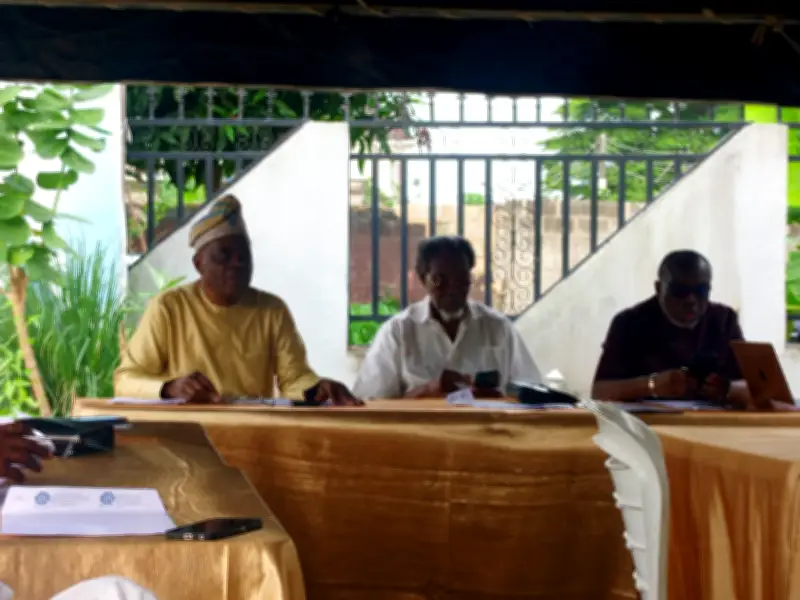
The Chairman of the Nigerian Bar Association (NBA) Anti-Corruption Committee, Babafemi Badejo, has asserted that Nigeria cannot overcome corruption through laws and enforcement agencies alone, emphasizing the need for a moral reawakening to reverse decades of institutional decay. Mr. Badejo made this statement on Sunday in Lagos at the inaugural Magodo Associates Seminar Series, where he presented a paper titled 'Re-awakening the Nigerian Conscience Against Corruption.'
Limitations of Legal Frameworks
Mr. Badejo acknowledged that Nigeria has established anti-corruption institutions such as the Economic and Financial Crimes Commission (EFCC) and the Independent Corrupt Practices and Other Related Offences Commission (ICPC). However, he noted that the country's fight against graft continues to face deep structural and social resistance. Despite repeated prosecutions and periodic recoveries of stolen public funds, concerns over weak institutions, selective enforcement, and the tolerance of unexplained wealth in society have shaped public perception of the anti-corruption war.
The political scientist and former Deputy Special Representative of the United Nations Secretary-General for Somalia explained that corruption has grown beyond isolated acts of misconduct to become deeply embedded across public institutions, private organizations, and communities. According to him, corruption is fundamentally 'a moral problem requiring ethical reorientation' rather than merely a legal issue requiring prosecution. He stated, 'Corruption in Nigeria has evolved from a deviance to a norm, from an exception to an expectation, and from a secretive transaction to a publicly celebrated achievement.'
Societal Celebration of Corrupt Wealth
Mr. Badejo highlighted that families, religious institutions, and communities often celebrate wealth without questioning how it was acquired, thereby weakening society's moral compass. He noted that individuals widely believed to have acquired wealth through corrupt means are frequently honored with leadership positions in religious and community organizations because of their financial contributions. 'When society consistently rewards the fruits of corruption while neglecting integrity, corruption becomes normalized, socially endorsed, and actively encouraged,' he said. He described this trend as 'moral anesthesia,' arguing that prolonged exposure to corruption without consequences has dulled society's ability to distinguish right from wrong.
Enforcement Alone Cannot Solve Corruption
Mr. Badejo acknowledged that Nigeria has an extensive legal framework against corruption but argued that prosecution alone cannot succeed if society continues to admire corrupt public officials. 'The EFCC can arrest a thousand corrupt officials, but if society celebrates such people as heroes, the war is already lost,' he stated. He argued that laws are most effective when they reinforce existing moral values, warning that countries with weak ethical foundations require unsustainable levels of enforcement to combat corruption.
Historical Roots of Corruption
Tracing corruption through Nigeria's history, Mr. Badejo explained that traditional societies maintained communal sanctions that helped check abuses of power despite the existence of corrupt practices. He cited examples from the Oyo Empire, the Benin Kingdom, the Sokoto Caliphate, and Igbo communities, saying accountability mechanisms discouraged misconduct. He also referenced controversies involving some of Nigeria's founding political leaders, including Nnamdi Azikiwe, Obafemi Awolowo, Ahmadu Bello, and Abubakar Tafawa Balewa, arguing that early debates over ethics and public accountability were not sufficiently addressed and contributed to the collapse of the First Republic.
According to him, successive military administrations further entrenched corruption despite often seizing power on anti-corruption platforms. He cited wartime procurement under Yakubu Gowon, the Structural Adjustment Programme under Ibrahim Babangida, and the looting linked to the late Sani Abacha as examples of periods that deepened corruption within state institutions. Mr. Badejo also reviewed anti-corruption efforts under successive civilian administrations, saying inconsistent enforcement and political interference have weakened public confidence despite institutional reforms and prosecutions.
Economic Consequences
Mr. Badejo stated that corruption has imposed enormous economic and social costs on Nigeria, including losses in the oil and gas sector and the weakening of healthcare, education, infrastructure, and other public institutions. He also linked corruption in the defense sector to worsening insecurity, arguing that diversion of public resources has reduced the capacity of security agencies to tackle terrorism, banditry, and kidnapping. According to him, the resulting insecurity has displaced communities, disrupted economic activities, and eroded public trust in government.
Proposed Reforms
To reverse the trend, Mr. Badejo called for reforms centered on ethics and accountability. He advocated for the inclusion of integrity and civic responsibility in school curricula, stronger whistleblower protection, greater support for investigative journalism, and increased involvement of religious institutions in promoting ethical values. He also urged traditional rulers to withhold honors from individuals of questionable integrity and encouraged anti-corruption agencies to complement prosecutions with sustained public education campaigns. He said judicial reforms, transparent procurement systems, and leadership by example across government and society would strengthen the country's anti-corruption efforts. 'The war against corruption cannot be won by anti-corruption agencies alone. It must be won in the hearts and minds of the Nigerian people,' he stated.
Speaking on the sidelines of the seminar, the Chairman of Magodo Associates, Remi Aromiwura, explained that the event was organized to stimulate public discourse on issues capable of shaping policy and societal values, beginning with corruption. He said the association chose Mr. Badejo, a member of the group, because corruption remains one of Nigeria's most pressing challenges. According to him, the seminar's communiqué will be circulated through traditional and social media platforms to sustain public engagement and policy conversations. He added that although the association was founded by alumni and former lecturers of the University of Lagos, it has expanded its membership to accommodate younger professionals and ensure continuity. The chairman said the association has undertaken community development initiatives, including career guidance programs, educational support, welfare activities, and campaigns against irregular migration.
Also speaking on the sidelines, Mr. Badejo stressed that Nigeria's anti-corruption campaign must begin with a collective recognition that corruption poses an existential threat to the country. 'If we don't kill corruption, corruption will kill us,' he said. He emphasized that the responsibility for fighting corruption extends beyond government institutions, arguing that families, communities, schools, religious bodies, and the private sector all have roles to play in rebuilding a culture of integrity. While acknowledging the risks faced by whistleblowers, he called for stronger legal protections to encourage citizens to expose wrongdoing without fear of victimization. He added that restoring honesty and accountability in homes and communities would be critical to reversing the country's moral decline, noting that sustained commitment from leaders, institutions, and citizens would be required to achieve lasting change.
About Magodo Associates
Magodo Associates is a non-partisan think tank and professional forum made up of retired and serving professors, many of them drawn from the University of Lagos, as well as other distinguished professionals across different fields. The group began in 2008 with about 20 members and has since grown into a wider intellectual network dedicated to structured dialogue on Nigeria's political, economic, and socio-developmental challenges. It provides a platform for sustained engagement on national issues, with a focus on generating policy-relevant ideas through regular discussions and public symposia. Based in Magodo GRA, Lagos, the association brings together scholars, policymakers, and practitioners who meet periodically to reflect on governance, development, and the country's long-term socio-economic direction. Although rooted in academic tradition, Magodo Associates positions itself as an independent platform for idea exchange, deliberately detached from partisan politics. Its emphasis, members say, is on evidence-based discussion and research-driven contributions to national debates rather than political alignment or advocacy.