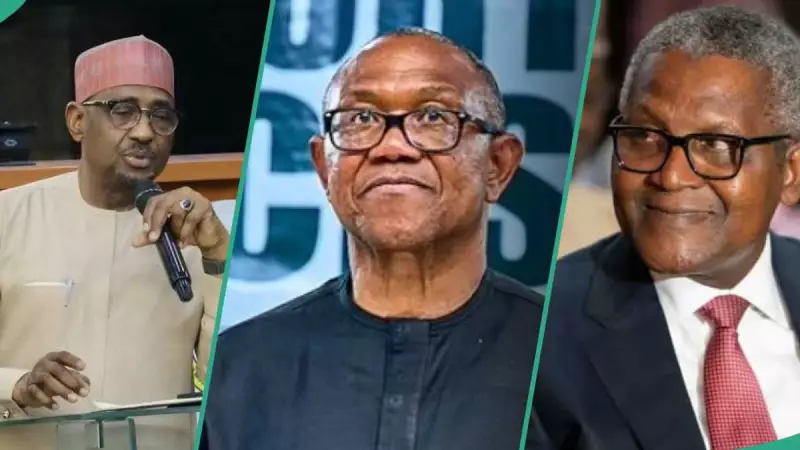
Former presidential candidate Peter Obi has dramatically reframed the heated controversy between business magnate Aliko Dangote and ousted NMDPRA CEO Farouk Ahmed, moving it from a personal clash to a profound national debate on morality, inequality, and public responsibility.
From Personal Allegation to National Conscience
The dispute ignited after Dangote alleged that Farouk Ahmed spent approximately $5 million on the secondary education of his four children in Switzerland. While many Nigerians debated the legality or truth of the claim, Peter Obi, in a social media post dated December 22, 2025, presented a different lens. He acknowledged every parent's desire for quality education but argued that the sheer scale of the alleged spending, within Nigeria's context of deprivation, demands a deeper ethical scrutiny.
Obi connected the issue directly to Nigeria's crippling social realities, notably the estimated 18 million out-of-school children and the widening chasm between privilege and poverty. He stressed that when such immense resources are linked to public office, the conversation must transcend legal compliance and enter the realm of moral duty and public trust.
The Staggering Alternative: 25 Schools vs. One Family's Fees
Providing a detailed, tangible alternative, Obi illustrated the transformative potential of the same funds within Nigeria. At the prevailing exchange rate, $5 million converts to roughly ₦7.5 billion.
He projected that this sum could be used to construct 25 fully equipped school blocks, capable of educating about 6,000 students annually while creating employment for 450 teachers. Crucially, his calculations showed a significant balance would remain after covering construction and initial wages.
Obi's proposed model involved investing the remainder in government bonds. The generated interest, he argued, could create a self-sustaining ecosystem to perpetually fund teacher salaries, school maintenance, and learning materials, all while preserving the original capital for future expansion.
A Test for Nigeria's Governing Elite
Widening the scope, Obi situated the Farouk controversy within Nigeria's broader governance failures. He referenced past critical descriptions of the country by foreign leaders like former British PM David Cameron and ex-US President Donald Trump to highlight how systemic issues enable a small elite to control vast resources.
His central argument was that if a fraction of wealthy public office holders redirected similar sums towards public good, Nigeria could make massive strides in solving its out-of-school children crisis. He framed the moment as a critical test of national conscience, forcing a choice between entrenched privilege and shared responsibility.
Peter Obi concluded by reiterating his long-held conviction that education remains the bedrock of social stability, good governance, and national dignity. He insisted the controversy is "not merely about one man," but a symbolic reflection of the choices that will define Nigeria's future.