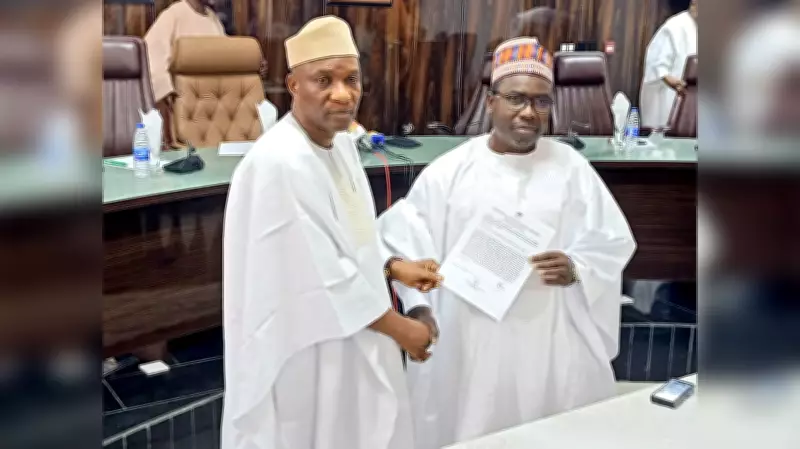
Why BOB Deserves Serious Consideration as APC's 2027 Candidate in Kwara
The debate over who should secure the All Progressives Congress (APC) ticket for the Kwara State governorship in 2027 has reignited discussions on equity, rotation, and senatorial balance. These concerns are valid, with Kwara North making a strong moral and political case for inclusion and fairness. However, a ruling party aiming to retain power cannot reduce a governorship contest to mere geography alone. Ultimately, elections are won by candidates who can unify the party, energize the grassroots, protect existing gains, and persuade voters across all three senatorial districts. This is why Bashir Omolaja Bolarinwa, known as BOB, warrants serious consideration—not as a sectional entitlement, but as a tested political figure with a proven record in party organization, public service, and electoral struggle.
APC's Framework and Bolarinwa's Qualifications
The starting point should be the rules of the APC itself. The party constitution emphasizes internal democracy, allowing governorship candidates to emerge through direct or indirect primaries, with consensus only via a ratified democratic process. It also states that nomination guidelines should consider geo-political spread and rotation of offices. In plain terms, fairness matters, but no provision automatically disqualifies a qualified aspirant based on his zone. The party's framework therefore supports an open, credible contest where merit, acceptability, and electability should carry significant weight.
This framework is crucial because Bolarinwa is not just another ambitious politician riding on the APC's success. He has served as the Kwara APC state chairman, a former councillor, a former local government chairman, and a former member of the House of Representatives. In 2022, he chaired the Governing Board of the National Broadcasting Commission. This combination of roles means he has operated at the grassroots, in the legislature, in party administration, and in federal-level institutional leadership. In a state where political management is often as vital as policy vision, this breadth of experience is not a minor qualification; it is a governing asset. Kwara does not deserve a governor in 2027 with no pedigree, discernible education, political track record, or grassroots stakes—not again!
Bolarinwa's Role in Kwara's Political Shift
More importantly, Bolarinwa's case is tied to the most consequential political shift in modern Kwara history: the collapse of the old order in 2019. The facts of that election remain striking. APC's AbdulRahman AbdulRazaq won the governorship with 331,546 votes, while PDP's Razak Atunwa polled 114,754. APC also secured all three Senate seats, all six House of Representatives seats, and all 24 House of Assembly seats in the state. This was not an ordinary victory; it was a political earthquake. Bolarinwa was a key figure in the 'Otoge' movement and the opposition organization that helped bring APC to power in Kwara. Regardless of internal disagreements within that coalition, no serious analysis of recent Kwara politics can dismiss his role in the success of the 'Otoge' revolution.
Since APC is now the governing party in Kwara, succession cannot be treated as a symbolic exercise. The party's challenge in 2027 will not merely be to reward sentiment; it will be to preserve incumbency and avoid fragmentation. In 2023, Governor AbdulRazaq was re-elected with 273,424 votes against PDP's 155,490, and APC won convincingly across all 16 local government areas in the state. This outcome demonstrated that the APC coalition still possesses statewide strength. The next candidate must therefore be someone who can defend that spread, not shrink it. The test is simple: who can hold the base, expand the coalition, and prevent avoidable internal bitterness? Bolarinwa's supporters argue that he is one of the few aspirants with the political memory, organizational relationships, and party credentials to achieve exactly that. Whether one agrees entirely or not, this argument is serious and cannot be brushed aside.
Competence vs. Zoning: A Balanced Approach
This is also why the current attempt in some circles to frame the race as though competence and zoning are mutually exclusive is unhelpful. They are not. A party may legitimately consider balance, but it must still ask who can govern and who can win. Even within the current debate, anti-zoning voices have not argued that equity is meaningless; they have contended that the office should not be closed in advance against qualified contenders. Kwara South leaders and other stakeholders have publicly insisted that there is no binding constitutional provision reserving the office for any district and that competence must remain central to the conversation. This is not a declaration of war against any zone; it is a call for political realism.
Bolarinwa's candidacy should be assessed based on the strength of what he brings to the table. He has a visible history in local governance, legislative exposure, leadership of a state party structure, and federal board responsibility. He is credited as a mobilizer with grassroots reach and is a former APC chairman and key 'Otoge' figure who has entered the 2027 race. He is also attracting organized support from APC-aligned blocs such as the Like Minds group in Ifelodun and the Kwara Legacy Group, both of which have publicly argued that his experience and sacrifices warrant serious consideration. Endorsements do not settle elections, of course, but they show that his aspiration is not imaginary and that he is already a factor within the political conversation.
Strategic Argument for Bolarinwa
The strongest argument for Bolarinwa is neither emotional nor tribal; it is strategic. APC in Kwara should not enter 2027 by narrowing its own options before the real contest begins. A party that overthrew a political dynasty in 2019 and defended its mandate in 2023 should be wise enough to understand that its next candidate must emerge from a process that is transparent, merit-driven, and politically expansive. If that process is truly fair, Bashir Omolaja Bolarinwa has enough experience, party history, and electoral relevance to stand among the leading contenders. He should not be dismissed because of where he comes from. He should be judged by whether he can unite APC, defend its record, and win Kwara. On the evidence available, that is a case he is entitled to make.