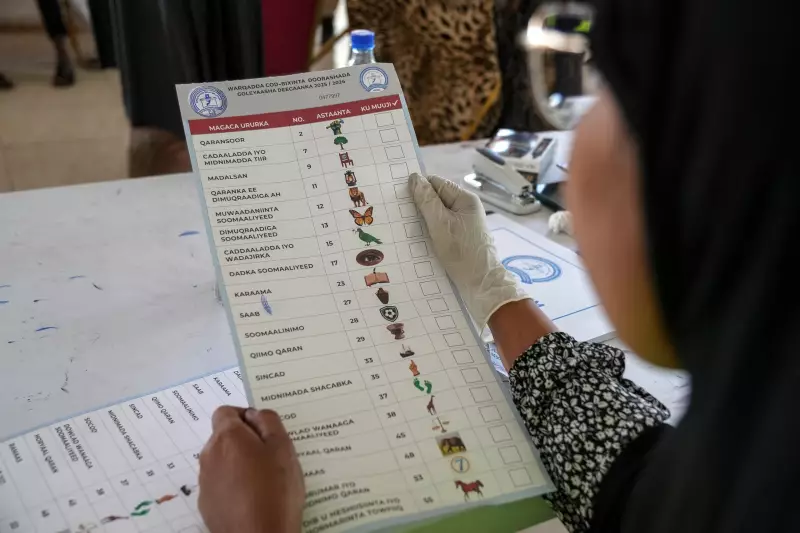
For the first time in more than five decades, residents of Mogadishu cast their ballots in a direct local election on Thursday, 26 December 2025. The historic vote, conducted under a massive security blanket, marks a significant shift in Somalia's political landscape but has been marred by an opposition boycott and warnings of escalating tensions.
A Historic Day Under Heavy Guard
Somali authorities mobilised approximately 10,000 security forces to ensure the safety of the electoral process. As part of the security measures, the city's airport was closed for the day. The election is widely seen as a crucial test run for the presidential ballot scheduled for next year in a nation still grappling with the aftermath of decades of conflict, a persistent Islamist insurgency, and recurring natural disasters.
An AFP correspondent reported that long queues formed outside some polling stations in the morning. However, voter numbers had significantly decreased by early afternoon. Abdikarin Ahmed Hassan, the election commission chief, confirmed that all stations closed without incident at 1500 GMT. He announced the counting would begin "soon" but did not provide a timeline for the release of the final results.
"This is a great day," said Guhad Ali, a 37-year-old voter, proudly displaying the ink on his finger as proof of his participation. Another resident, 51-year-old Ali Salad, recounted waiting in line for hours to exercise his democratic right.
Political Tensions and a Contentious Boycott
The return to direct voting represents a major political change. Universal suffrage was abolished after military ruler Siad Barre seized power in 1969. Following the collapse of his authoritarian regime in 1991, Somalia's political system has been dominated by a complex, clan-based structure for selecting leaders.
President Hassan Sheikh Mohamud has been a strong advocate for reintroducing direct elections, declaring on election day that they represent "the future of the Somali people." According to the electoral body, more than 1,600 candidates are competing for 390 local council seats in the Banadir region, which includes the capital Mogadishu.
However, the process faces serious challenges. The opposition coalition, Somali Future, boycotted the ballot. Several federal states have also criticised it, viewing it as a manoeuvre by the central government to consolidate power in Mogadishu. Former Prime Minister Hassan Ali Kheire, a Somali Future member, accused the government of orchestrating the election to extend the president's mandate, a move he warned "is not going to be accepted."
Security Challenges and the Road to 2026
The security situation remains fragile. Since 2006, Somali forces have been battling Al-Shabaab militants linked to Al-Qaeda. While security has improved in the capital itself, fierce fighting continues just 60 kilometres away. The past year has witnessed several high-profile attacks, including an attempted ambush on the president's convoy, missile fire near the international airport, and an assault on a detention centre.
The political strain surrounding the electoral model is fueling anxieties ahead of next year's critical national elections. The mandate of the current parliament expires in April 2026, and the president's term ends the following month. The vote had already been postponed three times this year before finally proceeding on Thursday.
In September 2025, the International Crisis Group cautioned that the government's push to replace the clan-based system with direct elections "could plunge the country back into turmoil if leaders fail to compromise." The group warned that without an inclusive electoral roadmap, Mogadishu could see a repeat of the deadly street battles of 2021, which erupted over election delays and a bid by the then-president to extend his term.
The opposition has threatened to organise a rival presidential ballot in 2026 if the federal government continues to insist on direct elections for the national vote, setting the stage for a potential constitutional crisis.