
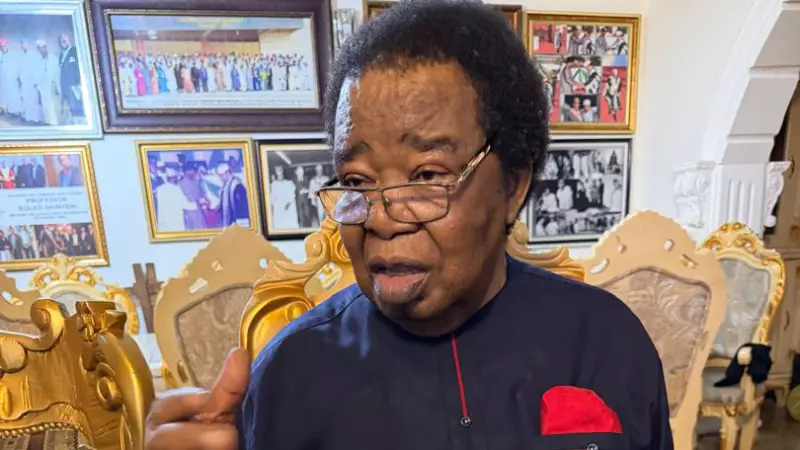
As he prepares to mark his 84th birthday, iconic scholar and former Minister of External Affairs, Professor Akinwande Bolaji Akinyemi, has shared a profound reflection on Nigeria's political trajectory. In a candid interview, he expressed hope that the recent military intervention by the United States under President Donald Trump could lead to positive developments in Nigeria's fight against terrorism and, more importantly, halt what he termed 'internal colonialism' within the country.
A Lifetime of Service and Observation
Born on January 4, 1942, in Ilesa, Osun State, Professor Akinyemi's distinguished career spans academia and high-level diplomacy. Educated at Temple University, the Fletcher School of Law and Diplomacy, and Trinity College, Oxford, he served as Director-General of the Nigerian Institute of International Affairs (NIIA) from 1975 to 1983 and later as Minister of External Affairs. He is the originator of the Technical Aid Corps (TAC) and the conceptual thinker behind the 'Concert of Medium Powers.' Recently, in January 2025, President Bola Tinubu reappointed him as Chairman of the NIIA board.
Reflecting on his life's journey, Akinyemi described the early trajectory of Nigeria as overwhelmingly positive, filled with the expectation of greatness. "I was born into colonial Nigeria, and grew up with the expectation... this is going to be a flying country," he recalled, citing the quality of education and the visible progress in nation-building.
The Diminishment of Hope and Spiritual Interventions
However, Akinyemi pinpointed the assassination of General Murtala Mohammed in 1976 as the first major shock that diminished hope for his generation. He described Nigeria's history since then as a series of promising upward movements followed by disappointing setbacks, from the annulment of the June 12 election to the untimely death of President Umaru Yar'Adua.
He intriguingly framed some of these setbacks as 'spiritual interventions,' particularly Yar'Adua's illness. He revealed that Yar'Adua, upon inaugurating the Electoral Reform Panel (Uwais Commission) which Akinyemi served on, openly admitted he did not believe he had won the election but vowed to implement the panel's recommendations fully to end electoral corruption. "I've never had this before, where somebody in government will be pledging to implement a report he hasn't read," Akinyemi stated.
On Trump's Intervention: A Message to Sokoto and a Hope for Equity
The conversation turned to the recent US airstrike in Sokoto against insurgents, ordered by President Donald Trump. Akinyemi analysed this within a historical cycle, comparing it to the Obama administration's overt engagement with Northern governors in Sokoto, which he saw as a political signal.
"Trump decides to send a message to Nigeria... he sends the message to Sokoto, but a different kind of message," he observed. He argued that the Nigerian government's public stance on the intervention was mere 'diplomatic gamesmanship,' as Trump had been clear about his intent for American military action. Akinyemi welcomed the intervention as a necessary step to stop an evil Nigerians have been unable to curb themselves.
His primary hope is that this external pressure will foster internal equity. "I hope that the intervention by Donald Trump will be a positive one in the sense that now, we will have a Nigeria of equity," he said. "All Nigerian groups will be regarded as having equal stakeholders. There will not be marginalisation... it will stop the internal colonialism." He recalled being warned as a minister that "fingers are not equal in Nigeria," a mentality he believes must end.
On diplomatic efforts to counter the 'Christian Genocide' narrative that prompted Trump's action, Akinyemi was blunt. He noted that American delegations to Nigeria were unequivocal about their findings and did not meet with certain Northern spokesmen because they already had the evidence they sought. "If I were to advise the government... when you send a delegation made up of Muslims then what are you saying to Trump?" he questioned.
Nigeria's Path Forward: Embracing Medium Power Status
To regain influence and security, Akinyemi urged Nigeria to consciously embrace its destiny as a medium power. This requires a strategic foreign policy backed by tangible military and economic strength. "Power must underwrite your objectives," he asserted, echoing a lesson from Trump's rhetoric.
He argued that Nigeria does not need to defeat global powers but must build a defence capability that makes the cost of invading it 'unacceptable' to any African nation. Using Brazil as an example, he stressed the need for a self-reliant defence industry, noting that both Nigeria and Brazil started theirs on the same day, with Brazil having advanced significantly. "You think twice before you decide to attack Brazil. And that's what Nigeria should be aiming for," he concluded.
Finally, Akinyemi dismissed the idea of a unipolar world under Trump, stating we are in a multipolar era with the rise of China. He used the Russia-Ukraine conflict to illustrate the dangers of broken security agreements and internal ethnic complexities, drawing a parallel to Nigeria's own delicate ethnic landscape and warning against similar fragmentation.




