
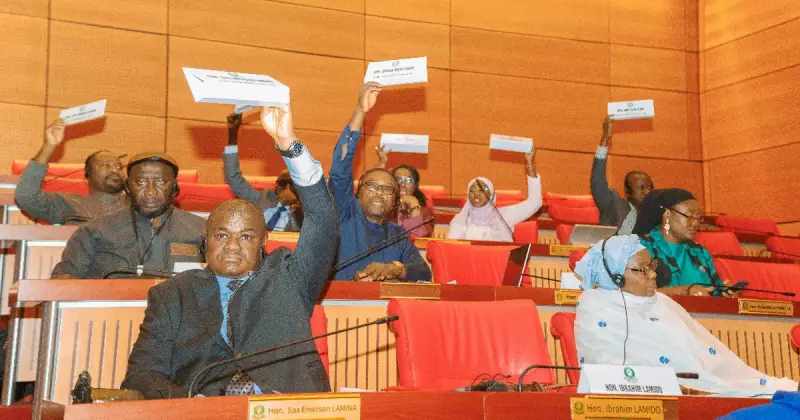
The Parliament of the Economic Community of West African States (ECOWAS) concluded an extraordinary session on Wednesday, December 3, in a state of deadlock, unable to forge a unified regional response to the recent military takeover in Guinea-Bissau.
Divisions Halt Consensus on Crisis Response
The session, held in Abuja, was called following the gunfire that rocked Bissau on November 26, an event several lawmakers labeled an unconstitutional change of government. However, hours of deliberation revealed sharp disagreements on the causes, responsibilities, and appropriate next steps for the bloc.
Presenting a committee's investigative report, Hon. Awaji-Inombek Abiante of Nigeria highlighted the conflicting narratives that preceded the unrest. He detailed disputes over a recent election, the disqualification of an opposition candidate, and competing claims of victory, which collectively heightened tensions. Abiante issued a stark warning, stating that democracy in the region was "gradually heading southwards" and urged his colleagues not to ignore early signs of trouble.
Lawmakers Clash Over Causes and Solutions
The debate fractured along several lines, preventing any consensus. A faction of parliamentarians pushed for the potential deployment of a regional military force, ECOMOG, to restore constitutional order. Another group advocated for a negotiated political solution with the new authorities in Bissau. Meanwhile, a significant number of MPs insisted that ECOWAS must look inward and investigate the systemic governance failures across its member states that repeatedly create conditions for military interventions.
Ghanaian MP Laadi Ayii Ayamba criticized the bloc's reactive approach, accusing ECOWAS of repeatedly "massaging and managing" crises instead of intervening when early warning signs appear. She argued this pattern only entrenches long-term instability. Echoing calls for a firm stance, Nigeria’s Senator Osita Izunaso demanded an unequivocal condemnation of the coup and called on Guinea-Bissau’s National Electoral Commission to release the contested election results.
A Scathing Critique of ECOWAS Credibility
The most pointed criticism came from Liberian MP Moima Briggs Mensah, who accused the Parliament of losing its nerve. She characterized the institution as too soft, overly diplomatic, and unwilling to confront the root causes of coups.
"I get frustrated when people are condemning," she told journalists after the session. "Before I condemn you, I should know what caused the problem. We don't condemn leaders who change their constitutions to stay in power, but we rush to condemn a coup. Parliament has become too compromised, too friendly, too afraid to speak the truth."
Mensah warned that the bloc's credibility was eroding and called for a tougher, more honest posture. "We must have the political will. Put every country on the table in a war-room. Know the issues, confront them, stop being soft," she urged.
Deepening Concerns Over Regional Stability
Her remarks underscored the broader frustration within ECOWAS as it struggles to contain a wave of military takeovers across West Africa, following recent events in Mali, Burkina Faso, and Niger. The failure to adopt any resolution by the session's close leaves the regional bloc without a clear roadmap for addressing the crisis in Guinea-Bissau. This stalemate deepens concerns about ECOWAS's capacity to respond decisively to the growing threat of political instability within its own ranks.




