
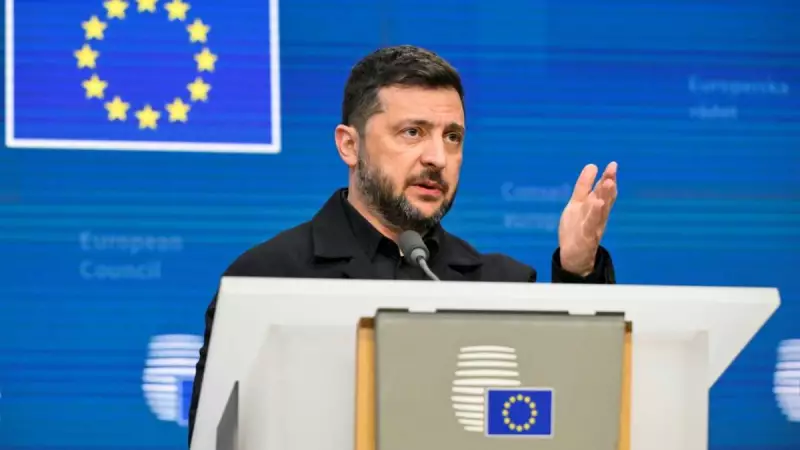
European Union leaders are gathering in Brussels for a high-stakes summit on Thursday, with the future of a multi-billion euro plan to aid Ukraine hanging in the balance. The bloc is attempting to agree on a controversial proposal to use frozen Russian central bank assets to fund Kyiv's war effort and reconstruction, a plan currently being blocked by a key member state.
The High-Stakes Proposal and Belgian Opposition
At the heart of the emergency talks is a European Commission plan to tap approximately 210 billion euros of Russian state assets frozen within the EU. The innovative financial mechanism would provide Ukraine with an initial 90 billion euros over the next two years, a crucial sum as the country faces an estimated 135-billion-euro shortfall to stay afloat. The scheme involves loaning the frozen funds to the EU, which would then forward them to Kyiv as a "reparations loan." Ukraine would only be required to repay the money once Russia compensates for the damage caused by its invasion.
However, the plan has hit a formidable roadblock: Belgium. The country is home to Euroclear, the international securities depository holding the vast majority of the frozen Russian funds. Belgian Prime Minister Bart De Wever has firmly opposed the initiative, citing fears of severe financial and legal retaliation from Moscow. Russia has already initiated legal action against Euroclear, underscoring the risks. De Wever insists that any guarantees to protect Belgium must be unlimited and has argued that frozen assets in other nations should also be utilised.
A Test of European Unity and Credibility
The summit is widely seen as a critical test of the EU's resolve and unity. German Chancellor Friedrich Merz issued a stark warning ahead of the meeting, stating that failure would severely damage the bloc's ability to act for years. "We will show the world that we are incapable of standing together and acting at such a crucial moment in our history," Merz declared. European Commission President Ursula von der Leyen has emphasised that leaders must reach a decision on Ukraine funding at this gathering.
EU officials have tried to assuage Belgian concerns, offering multiple layers of protection including guarantees from other member states. They argue the risks are minimal. While the EU could theoretically override Belgium using a weighted majority vote, this is considered a "nuclear option" that diplomats believe is unlikely at this stage. Italian Premier Giorgia Meloni, who may provide political cover for Belgium, noted that "these are complex decisions that cannot be forced."
Broader Context and Alternative Plans
The urgent push for a solution comes as Ukraine's financial crunch is set to begin as early as April. The war approaches its fourth year, and the political landscape is shifting. US President Donald Trump is pushing for a quick deal to end the conflict, and some reports suggest Washington has pressured the EU to preserve the frozen assets as a bargaining chip. EU officials deny this, countering that the push for peace has actually spurred efforts to access the Russian funds.
With the primary plan stalled, discussions have turned to a potential Plan B: the EU raising money on capital markets itself to lend to Ukraine. This alternative has been shelved, however, as it requires unanimous approval and has been ruled out by Hungary. Despite this, De Wever is expected to attempt to revive the idea during the summit. One EU diplomat, speaking anonymously, described the fallback option as being "on the shelf, not in the bin," but confirmed the focus remains on the reparations loan plan.
Diplomats and officials remain cautiously optimistic that a solution will be found to keep funds flowing to Ukraine, even if the summit yields only a political agreement with details finalised later. "We need to find a solution," stated a second EU diplomat. "I'd be surprised if they break up on Saturday or Sunday without a decision." The outcome will not only impact Ukraine's immediate survival but also define the European Union's strategic autonomy on the global stage.




