
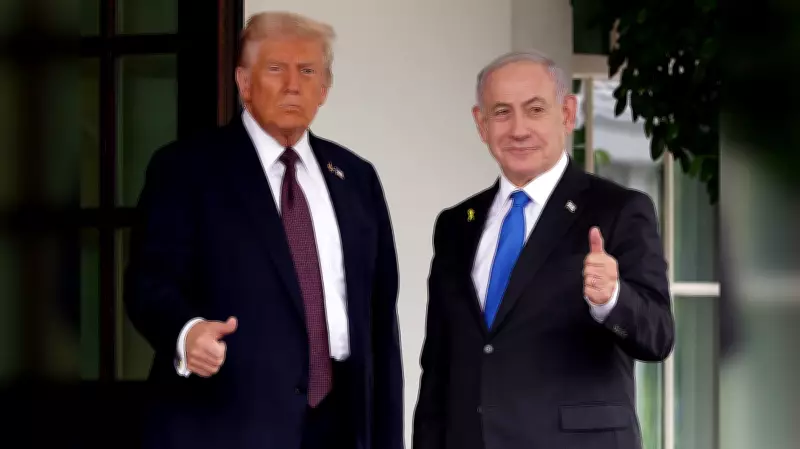
Iran War: Global Crisis Looms as Trump and Netanyahu Escalate Tensions
In a prime-time presidential address on April 2, 2026, President Donald Trump reaffirmed his commitment to sending Iran back to the stone age, a statement that has sent shockwaves across the globe. The speech, delivered in the early hours of Thursday, was notably devoid of any clear timeframe for ending the conflict, reopening the Strait of Hormuz, or addressing the 441 kilograms of uranium enriched to 60% still under Iran's control. Observers noted that Trump's demeanor suggested a closure of diplomatic avenues, raising alarms about the potential for further escalation.
Netanyahu's Alliance and Regional Dynamics
Just hours before Trump's address, Israeli Prime Minister Benjamin Netanyahu announced the formation of a new Israel-Arab alliance aimed at dismantling Iran's capabilities. Intelligence reports indicate that Saudi Arabia and other Gulf countries have urged Trump to persist in the war until the job is done. Within minutes of Trump's speech, global gasoline prices surged by 4%, signaling immediate economic repercussions. The Middle East is teetering on the brink, with the world at risk of a catastrophic conflict reminiscent of historical triggers like the assassination of Archduke Franz Ferdinand in 1914 or the invasion of Poland in 1939.
Three Potential Scenarios: Breakdown, Attrition, or Breakthrough
Analysis of Trump's speech points to three major possibilities: a breakdown scenario, a war of attrition, or a diplomatic breakthrough. A breakdown could occur if ego-driven decisions by Trump, Netanyahu, and Iran's IRGC lead to a chaotic era, potentially ending the America-led unipolar world order. This might involve Gulf countries joining the war, Trump invading Kharg Island, Israel annexing parts of Lebanon, and Russia funding Iran more aggressively. Such actions could cripple global supply chains, with oil prices soaring to $150-$200 per barrel, triggering inflation, factory shutdowns, and a global food crisis.
The closure of key waterways like the Strait of Hormuz and the Bab-el Mandeb could halt 35% of global trade, pushing the world toward a depression worse than the 1930s. The war is already costing America $1 billion daily and Israel $320 million daily, with Iran facing tens of billions in infrastructure damage. A war of attrition, favored by Russia and China to exhaust American resources, could prolong the conflict for years, mirroring the Soviet Union's experience in Afghanistan.
Diplomatic Breakthrough and Lessons for Africa
A breakthrough scenario hinges on diplomacy, with peace plans from Pakistan, Turkey, Saudi Arabia, and Egypt offering hope. However, irreconcilable differences persist: Israel seeks a crippled Iran, America aims for a subdued Iran to control oil, and Iran desires the downfall of both nations. The world needs a King Solomon type of wisdom to mediate. Africa must learn from this crisis by prioritizing technology education, as demonstrated by America and Israel's rapid dismantling of Iran's military. Energy independence is crucial, with Nigeria urged to foster conglomerates like Dangote Refinery to compete globally.
The Iranian Onion-Layered Leadership Structure shows resilience, while low-cost drone technology highlights both defensive opportunities and security threats. Africa should integrate drones and robotics into military and conventional education. The interconnected global economy underscores the need for strategic sovereignty and a unified African mindset to avoid internal conflicts like those in the Middle East.
Recommendations and Conclusion
To avert disaster, Trump should adopt a three-point agenda: Iran vacates the Strait of Hormuz, abandons nuclear ambitions, and ceases missile attacks on Gulf countries. In return, America and Israel should halt bombings and lift sanctions, with peace talks commencing. A Trump Aid Plan of $1 trillion, funded by redirected war budgets and Gulf support, could foster Middle East recovery and balance economic power between America and China. War benefits Russia with $864 million daily in extra revenue, while Aliko Dangote's refinery capitalizes on market timing. Africa must act now to achieve sovereignty in energy, technology, and economy, learning from past crises to avoid future devastation.
Tim Akano is President of One Africa Initiatives (OAI), advocating for strategic African development in the face of global instability.




