
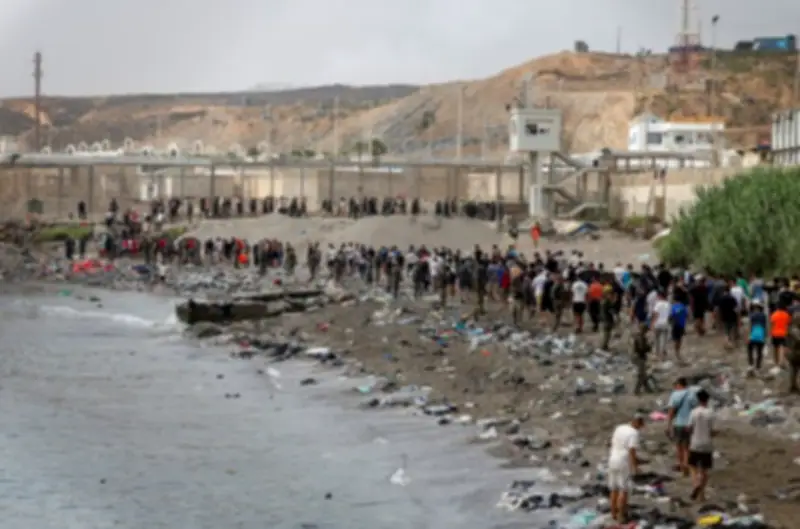
Italy has announced a temporary suspension of the European Union’s passport-free Schengen arrangement with Spain, effective for one month. The decision means travellers arriving in Italy from Spain by air or sea will have to present a valid passport at entry points, unless they are Spanish or other EU citizens. The measure, announced by Prime Minister Giorgia Meloni, is a direct response to the arrival of approximately 60,000 migrants in the Spanish enclave of Ceuta from neighboring Morocco.
Why Italy Took This Step
In a post on X, Meloni explained that the suspension was necessary to safeguard national security and prevent “possible repercussions on our nations.” She stressed that the measure would remain in force only for as long as needed. “The measure will be kept in force only for the time necessary,” she wrote, while adding that “particular attention” would be paid to “limiting any impact on summer tourist flows.”
The Italian government’s move is one of the most significant cracks in the Schengen area in recent years. Schengen rules normally allow citizens and visitors to move freely across internal EU borders without identity checks. By invoking the suspension, Rome has effectively reintroduced border controls at its airports and seaports for passengers coming from Spain. Although the EU framework provides for temporary border reinstatement in exceptional circumstances, it is rarely used for such a prolonged and dramatic break with a single partner country.
The Ceuta Border Crisis
The backdrop is a dramatic surge in crossings from Morocco into Ceuta, a small Spanish territory on the North African coast. Over the course of a single night, roughly 60,000 migrants entered the enclave after breaching the border fence. Local authorities and humanitarian groups were overwhelmed, and at least 41 people lost their lives during the attempt, according to Premium Times reports.
Ceuta is one of only two EU land borders with Africa, making it a magnet for irregular migration. The sudden arrival of such a large number of people in hours stretched regional services and raised immediate security concerns. The incident reignited fears of a larger migration crisis in Europe. Several EU member states turned their attention to Madrid, blaming Spain’s handling of its external borders for the influx. Some leaders went as far as calling for Spain’s temporary exclusion from the Schengen free-travel zone. Meloni was the most vocal in making that demand, a stance that triggered a diplomatic dispute between Rome and Madrid.
Spain Hits Back with Data
Spain’s Prime Minister, Pedro Sánchez, rejected the criticism and fired back with official statistics from Frontex, the European Border and Coast Guard Agency. Sánchez pointed out that Italy has recorded far more irregular entries than Spain over the 2021–2026 period. In a post on X, he released the following figures:
- Via Italy: 478,600
- Via the Western Balkans: 340,600
- Via Greece: 259,800
- Via Spain: 234,760
- Via the eastern border: 48,000
Sánchez added a pointed rebuke: “Solidarity and empathy are optional, but respect for European treaties and the facts is not.” In a separate message, he struck a more conciliatory tone, saying “This is not the time to divide,” and called for “building a strong and united EU.”
The exchange highlights a wider north-south split within the EU over how to manage migration. While Italy and other frontline states have demanded stronger external border controls, Spain maintains that its numbers are lower than those of other Mediterranean countries. The data also shows that Spain is not even the most affected route, with Italy and the Western Balkans both seeing larger numbers.
Political Fallout and US Involvement
The diplomatic row between Rome and Madrid quickly expanded beyond the EU. Sánchez, a self-described left-wing leader with a pro-immigration stance, also clashed with US President Donald Trump over the episode. Trump did not hesitate to use the Ceuta events to justify his administration’s crackdown on immigration. The renewed dispute placed migration policy at the center of transatlantic tensions.
The Ceuta incident has become a flashpoint in broader European debates about burden-sharing and border security. While some governments look to seal external frontiers, others advocate for more humane and coordinated responses. Meloni, for her part, framed her action as a protective measure for Italy’s borders and for the Schengen system itself.
France Tightens Its Own Borders
France has also announced it is increasing checks along its border with Spain, citing the need for heightened vigilance in the wake of the Ceuta incident. While France did not formally suspend Schengen with Spain, the move adds another layer of friction for cross-border travellers in Western Europe.
The temporary Italian suspension is limited in scope. It applies only to non-Spanish and non-EU citizens, meaning EU passport holders and Spanish residents will not be affected. Still, the decision could have knock-on effects for tourism and trade, especially during the busy summer season. Meloni said the measure would be kept in force only for the necessary time, leaving the door open for a return to normal travel once the situation stabilises.
This article is based on reporting from Premium Times.




