
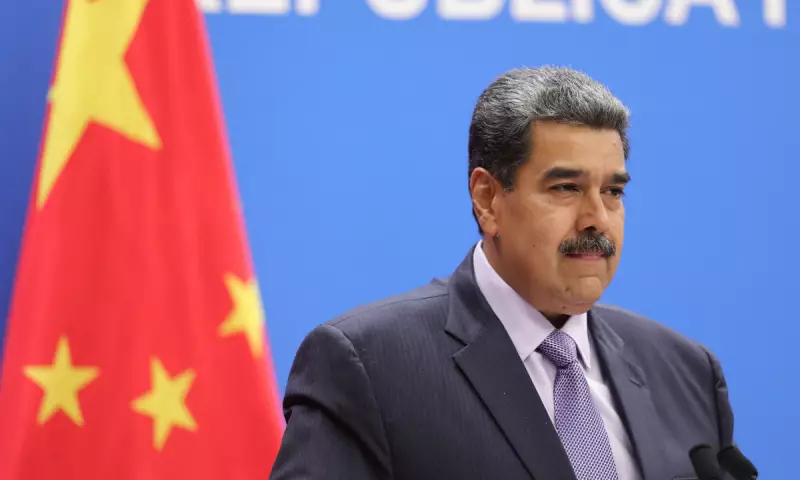
In a dramatic escalation of tensions, former US President Donald Trump has announced the capture of Venezuelan President Nicolas Maduro by American special forces. The development, which Trump revealed in a telephone interview on Saturday, 3 January 2026, has triggered a wave of international condemnation and thrown the South American nation into a deep crisis.
Operation and Accusations: The US Justification
Speaking from West Palm Beach, Florida, Trump detailed that Maduro and his wife, Cilia Flores, were extracted from Venezuela by helicopter and transferred to a ship. "They're on a ship but they'll be heading into New York. The helicopters took them out," Trump stated. He confirmed that Maduro would face federal charges in New York, likely related to long-standing US accusations of drug trafficking.
Trump asserted that the United States would now play a central role in Venezuela's future, stating the aim was to bring "liberty for the people" and prevent anyone from taking over Maduro's rule. US Vice President JD Vance, commenting on social media platform X, claimed Venezuela had ignored opportunities to de-escalate. He reiterated accusations that Maduro led a drug trafficking network and stole oil, declaring, "You don't get to avoid justice for drug trafficking in the United States because you live in a palace in Caracas."
The Venezuelan government has vehemently denied these charges for years, arguing that Washington's true motive is to control the country's vast oil reserves.
Venezuela's Response and Demand for Proof
The Venezuelan administration has labeled the US operation an "extremely serious military aggression." With communication lines severed, the whereabouts of the president remain unconfirmed by independent sources.
Venezuelan Vice President Delcy Rodriguez, speaking on state television, said she did not know the location of Maduro or Flores and urgently called on Washington to provide "proof of life." She stated the government was seeking immediate clarification following overnight airstrikes on Caracas and other locations that preceded the capture.
A World Reacts: Condemnation and Calls for Restraint
The international reaction was swift and largely critical of the United States' unilateral military action.
The European Union, through foreign policy chief Kaja Kallas, urged restraint and respect for international law. While the bloc has previously questioned Maduro's legitimacy, Kallas stressed that "under all circumstances, the principles of international law and the UN Charter must be respected." Leaders like Ursula von der Leyen and Antonio Costa echoed calls for a peaceful, democratic transition and de-escalation.
Russia, a key ally of Caracas, condemned the "armed aggression" and demanded immediate clarification on Maduro's fate, expressing extreme alarm. Brazilian President Luiz Inácio Lula da Silva called the strikes and capture a "serious affront" to Venezuelan sovereignty that crossed an unacceptable line, threatening regional peace. He urged the United Nations to respond vigorously.
Chile's Gabriel Boric condemned the action, and Spain offered to mediate, calling for a democratic and negotiated solution. Turkey advised restraint to prevent wider consequences, while China warned its citizens in Venezuela to avoid travel and stay in safe areas.
In the United Kingdom, Prime Minister Keir Starmer emphasized that Britain was not involved and that all countries must uphold international law. The UK Foreign Office updated its travel advice, warning against all travel to Venezuela.
Perhaps the most immediate regional response came from Colombian President Gustavo Petro, who ordered security forces to the Venezuelan border. He described the US action as an "assault on the sovereignty" of Latin America and warned of a potential humanitarian crisis.
Uncertain Future and Next Steps
As of the latest reports, there is still no independent verification of Maduro's exact location or condition. The situation remains fluid, with hundreds of British and other foreign nationals' safety becoming a priority for their respective governments.
Trump indicated he would address the nation further in a news conference scheduled for later on Saturday. This event marks one of the most direct military interventions in the Western Hemisphere in decades and sets the stage for a protracted diplomatic and possibly geopolitical confrontation.




