
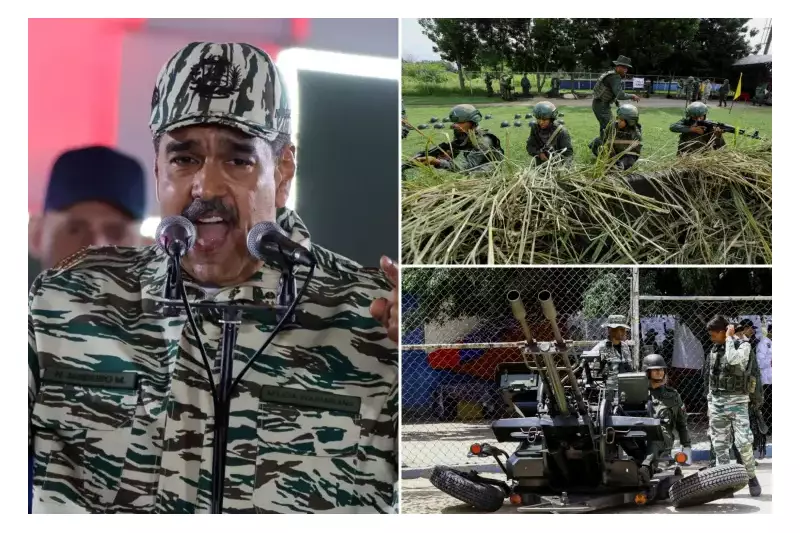
Venezuelan President Nicolás Maduro has reportedly ordered his military to prepare for a prolonged guerrilla war and a campaign of deliberate chaos, termed "anarchization," should the United States launch a ground invasion to remove him from power.
Preparations for Prolonged Resistance
According to a new report from Reuters, the Venezuelan leader is acutely aware that his nation's conventional armed forces are no match for the technological might of the American military. Instead of a direct confrontation, the strategy involves ordering military units to disperse to more than 280 locations across the country to wage a campaign of guerrilla tactics and sabotage against any invading force.
Recent preparations include the deployment of $5,000 Russian-made Igla missiles, intended for surprise attacks, especially against aerial threats. The routes leading to the capital, Caracas, have also been fortified with anti-vehicle barriers and heavy machinery to slow down any potential ground assault on the city.
The 'Anarchization' Strategy and Military Weaknesses
A key component of the plan is the so-called "anarchization" strategy. This would involve using intelligence services and party loyalists to create widespread disorder in the capital, aiming to make the country ungovernable for any US-backed replacement government.
Despite the National Bolivarian Armed Forces of Venezuela (FANB) claiming about 123,000 active personnel, sources indicate the army is small, inexperienced, and relies on aging Soviet-era weaponry. Analysts also doubt the effectiveness of Maduro's civilian militia, suggesting only a few thousand truly loyalists would mobilize in a conflict.
Escalating Tensions and External Actors
These preparations unfold against a backdrop of heightened tensions. The United States has deployed a significant naval presence to the Caribbean, including the aircraft carrier USS Gerald R. Ford and a Marine Expeditionary Unit.
The report further warns that third-party actors could complicate any conflict. Colombian guerrilla groups like the National Liberation Army are active on Venezuela's western border, and powerful drug trafficking organizations operating within the country could also become involved.
President Maduro has consistently denied allegations of his government's ties to drug traffickers. He accuses the United States of fabricating these claims to justify an invasion and seize control of Venezuela's vast oil reserves.




