
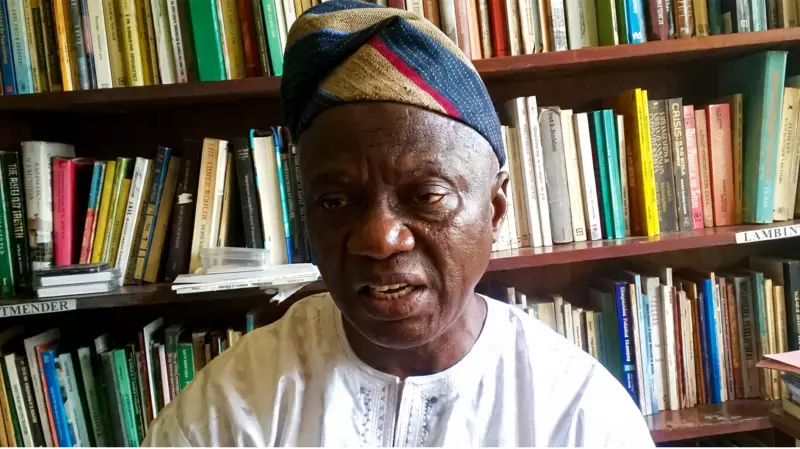
In a stark critique of contemporary international politics, Professor Lai Olurode, a former National Commissioner of the Independent National Electoral Commission (INEC), has asserted that countries subjected to American military intervention often become less secure. His comments come against the backdrop of President Donald Trump's recent invasion of Venezuela and seizure of its oil fields.
A Condemnation of "Poverty of Diplomacy"
Professor Olurode, a first-class Sociology graduate and Law alumnus of the University of Lagos, did not mince words in his assessment. He described President Trump's foreign policy approach as demonstrating a "poverty of diplomacy," "poverty of ethical resources," and "poverty of moral persuasion." He argued that Trump's actions constitute a brazen abridgment of international law and an unsupportive stance for global democracy.
"He is resorting to the use of force to seek compliance and intimidate other countries," Olurode stated during an interview. "His action is unsupportive of democracy globally. He is using acts of global terrorism to make other countries kowtow to him."
The scholar emphasized that even if Venezuelan President Nicolás Maduro had committed wrongs, established international institutions like the International Criminal Court existed for prosecution. He condemned Trump's method as "self-remedy, self-help, and gangsterism," warning it sends dangerous signals to nations with expansionist ambitions.
Nigeria Must Look Inward, Reject External Intervention
Addressing calls from some quarters for American intervention in Nigeria's internal security challenges, Professor Olurode issued a strong caution. He referenced Trump's warning of more strikes in Nigeria if attacks on Christians continued, questioning the narrative of targeted persecution.
"There is no genocide against Christians in Nigeria," he clarified. "Both Christians and Muslims have been killed... Any killing of anybody should be condemned whether they be Christians or Muslims." He urged careful consideration of solutions, noting that foreign intervention often exacerbates problems.
"I can ask you to mention a country where America had gone to and it was able to restore peace," he challenged. "America was in Libya, Afghanistan... Contrary to that, America made sure that the countries were even not as secured as they were prior to their own intervention."
He advocated for technical support and training for Nigerian forces instead of direct foreign military involvement. Olurode also pointed a finger at Western arms manufacturers, suggesting they "indirectly or directly" sponsor instability to keep Africa dependent.
Weak Institutions and the Path Forward for Nigeria
A significant part of Olurode's analysis focused on the perceived weakening of American institutions by Trump's unilateral actions. "President Trump has displayed that he is more powerful than the American institutions," he observed, noting this should be a major concern for the civilized world.
For Nigeria to maintain strategic autonomy and integrity, Olurode prescribed a radical shift towards inclusive and competitive democracy. He criticized the current "winner-takes-all" system, exemplified by the 2023 elections involving the APC, PDP, and Labour Party, as discouraging nation-building.
He proposed a proportional representation model where political parties gain governance roles based on their electoral performance. "If you give them a breathing space... I'm sure they will say President Bola Tinubu forever. And that will be good for our democracy," he argued, believing this would reduce political violence and increase legitimacy.
On improving voter turnout, which has seen a downward trend, Olurode listed key factors: the perceived disconnect between the state and citizens, lengthy voting procedures, and fear of violence. He stressed that INEC's autonomy and credibility are paramount for the 2027 elections, expressing hope that President Tinubu, as a "fighter for democracy," would respect the people's will.
Professor Olurode's final message was a call for collective global action to prevent a repetition of unilateral invasions and for Nigeria to build internal resilience through inclusive politics, rejecting solutions that compromise its sovereignty.




