
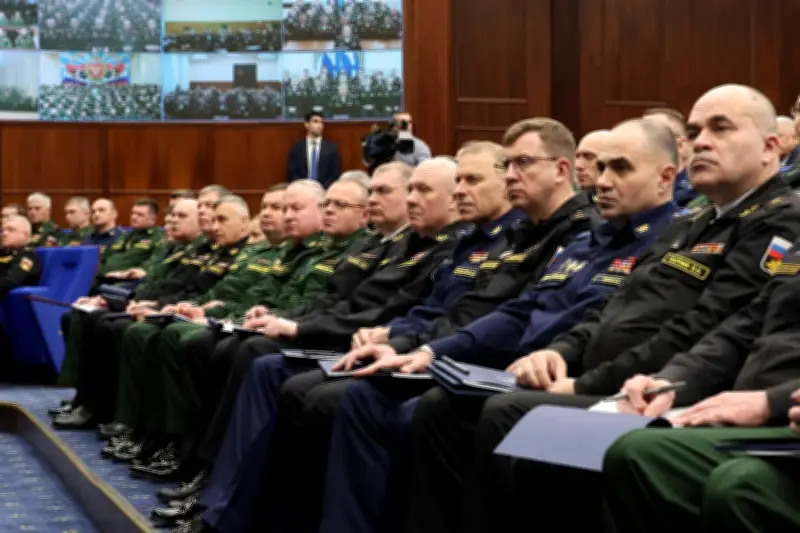
Russian President Vladimir Putin is facing mounting pressure from members of Russia's political and business elite, with a new report claiming that several influential insiders have begun to question the Kremlin's handling of the war in Ukraine and the country's struggling economy. According to The Sun, the public airing of dissent marks a rare break from the strict discipline normally expected within Russia's corridors of power, and it comes as Western sanctions and battlefield losses continue to take a toll.
Top Banker and Billionaire Speak Out
Among those who have reportedly gone public with their concerns is German Gref, the head of Russia's largest bank, Sberbank, and a former senior government official. The Sun reports that Gref has called for an end to the war in Ukraine, arguing that the prolonged conflict has inflicted severe damage on Russia's economy. Likewise, Russian billionaire Andrey Melnichenko has reportedly made an appeal to Western countries for economic support and called for an end to one-man rule in Russia.
These are not fringe voices. Gref has long been considered a close ally of Putin, having served in senior roles in the Russian government in the early 2000s. Melnichenko, a coal and fertiliser tycoon, was previously known for his business acumen rather than political outspokenness. Their willingness to speak out underscores the depth of concern among Russia's elite, according to observers.
Elite Warnings About the Regime's Future
Ukraine war analyst Jason Smart told The Sun that Russia's elite are increasingly focused on protecting their financial interests as economic pressure mounts. "They understand that Putin's regime is on very shaky ground. And at this point, there's a very good chance that it will fall," he said. Smart's assessment echoes a growing sentiment among Kremlin watchers that the regime's long-term stability is no longer guaranteed.
The report also notes that wealthy Russians have quietly transferred billions of dollars abroad over the past year in a bid to safeguard their assets amid the uncertainty. Smart explained: "They are doing what they can right now to make sure that they are able to preserve their assets." This movement of capital is seen as a barometer of confidence among those who have the most to lose from political upheaval.
Putin's Reduced Public Appearances and Security Buildup
According to The Sun, Putin has significantly reduced his public appearances in recent months, while security around his residences has reportedly been strengthened. The report further alleges that Russia's National Guard has expanded both its personnel and military capabilities, including the addition of tank units. The reason for this buildup, Smart suggested, may be more about internal threats than external ones.
"Why do you need tanks unless you're gonna have battle with other tanks? But that's exactly what they're planning for. The potential for mutiny. There are those around Putin who understand that his days are numbered," Smart told The Sun. This interpretation points to possible fractures within the Russian security apparatus, a development that could have serious implications for the stability of the Kremlin.
Kremlin Insiders Growing Impatient
Russian political analyst and government critic Igor Eidman also told The Sun that frustration among members of the Russian establishment is rising. "The Kremlin elites are growing impatient. They understand the war cannot be won and are increasingly promoting the idea that something has to change, and urgently," Eidman said. His comments suggest that the consensus within the ruling circle is beginning to shift, even if public pronouncements remain tightly controlled.
The mood inside Moscow is increasingly reminiscent of the final months of the Soviet Union, when key figures began to distance themselves from a failing leadership, according to some analysts. Eidman's remarks highlight the urgency that some elites now feel about changing course before the country's problems become even more severe.
Kazakhstan's Call to Freeze the Conflict
The report also draws attention to Kazakhstan's president, Kassym-Jomart Tokayev, who recently urged Putin to consider freezing the conflict in Ukraine during a face-to-face meeting. Tokayev reportedly said: "Perhaps it is already time to freeze this conflict, return to the Istanbul 2.0 formula, as significant results were achieved there." The reference is to the Istanbul peace talks held in 2022, which at the time raised hopes of a negotiated settlement.
Former UK Defence Attaché to Russia, John Foreman, told The Sun that Tokayev's remarks could signal a desire by Kazakhstan to distance itself from Moscow while still maintaining diplomatic ties. "The world has turned following Putin's self-inflicted strategic catastrophe in 2022. A ferocious Ukraine on his borders, huge casualties, a bigger NATO, Russia's former territories in Central Asia distancing themselves, and China taking Russia to the cleaners," Foreman said.
Central Asian States Drift Away
Beyond Kazakhstan, The Sun's report claims that Armenia, Azerbaijan, and Uzbekistan have increasingly sought to reduce their dependence on Moscow. This creates greater opportunities for both China and the United States to expand their influence in Central Asia, potentially reshaping the balance of power in the region. As Russia's attention remains fixed on Ukraine, its traditional allies appear to be hedging their bets.
The claims contained in The Sun report have not been independently verified, and the Kremlin has not publicly responded to the allegations regarding internal dissatisfaction among Russia's political and business elite. Nevertheless, the report adds to a growing body of anecdotal and analytical evidence suggesting that Putin's once-unquestioned authority is facing serious strains at home and abroad.




