
Former FBI Director Robert Mueller Passes Away at 81
Robert S. Mueller III, the former director of the Federal Bureau of Investigation who later served as special counsel investigating Russian interference in the 2016 U.S. election, has died at the age of 81. His family confirmed his passing on Friday, March 20, 2026, though they did not disclose the specific cause of death.
Mueller's Transformative Leadership at the FBI
Mueller served as FBI director for twelve years, assuming the role just days before the devastating September 11 attacks in 2001. His tenure oversaw one of the most significant transformations in the bureau's history, shifting its primary focus toward counterterrorism and intelligence gathering in response to evolving global security threats. During this period, Mueller implemented sweeping structural changes that included:
- Improved coordination with intelligence agencies like the CIA and NSA
- Expanded use of surveillance powers under post-9/11 legislation
- Enhanced counterterrorism capabilities throughout the organization
Despite the aggressive national security posture of that era, Mueller's leadership also involved internal resistance to controversial practices. FBI agents under his supervision raised concerns about abuses in CIA "black sites" and detention facilities such as Abu Ghraib. He was also involved in a major internal government clash over a secret domestic surveillance program, where Mueller and senior Justice Department officials threatened resignation over constitutional concerns.
The Special Counsel Investigation
After stepping down as FBI director in 2013, Mueller returned to public service in 2017 when he was appointed special counsel following the dismissal of FBI director James Comey by President Donald Trump. The investigation examined potential links between Trump's presidential campaign and Russian efforts to influence the 2016 election.
Over nearly two years, Mueller's team brought charges against multiple individuals, including campaign chairman Paul Manafort, who was later imprisoned, and secured convictions or guilty pleas from several key figures such as Michael Flynn and Roger Stone. The probe also detailed how Russian operatives conducted a coordinated misinformation campaign through entities like the Internet Research Agency.
Mueller's final report, submitted in 2019, concluded that Russia had indeed interfered in the election and that the Trump campaign expected to benefit from those efforts. However, it did not establish a criminal conspiracy between the campaign and Russia. On the issue of obstruction of justice, Mueller stated that while the investigation did not conclude the president committed a crime, it also did not exonerate him.
Political Fallout and Trump's Response
The report's release sparked intense political debate across the United States. Then-Attorney General William Barr summarized its findings in a way that critics argued downplayed its conclusions, while Trump repeatedly dismissed the investigation as a "witch hunt." Mueller himself remained largely silent publicly, aside from limited congressional testimony and a later written defense of his team's work.
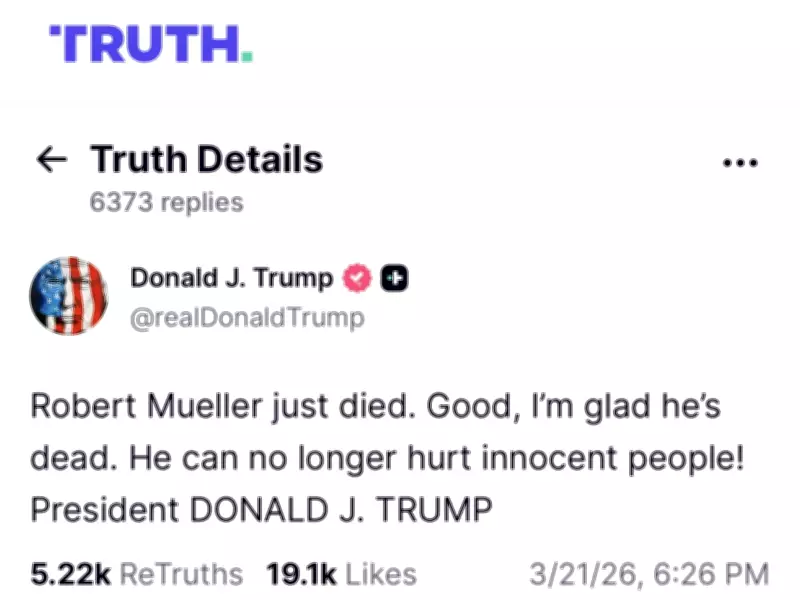
Following news of Mueller's death, former President Donald Trump responded critically on social media, underscoring the enduring tensions between the two men. "Robert Mueller just died. Good, I'm glad he's dead. He can no longer hurt innocent people!" Trump wrote in his post.
A Lifetime of Public Service
Beyond his later career, Mueller had a long and distinguished record of public service. He served as a Marine in the Vietnam War, earning a Bronze Star for bravery and a Purple Heart after being wounded in combat. He later built a reputation as a tough federal prosecutor, handling major cases including the investigation into the Lockerbie bombing.
Mueller's legacy is defined by two pivotal chapters in American history: reshaping the FBI in the aftermath of 9/11 and leading one of the most politically consequential investigations in modern U.S. history. His death marks the end of an era for American law enforcement and national security.




