
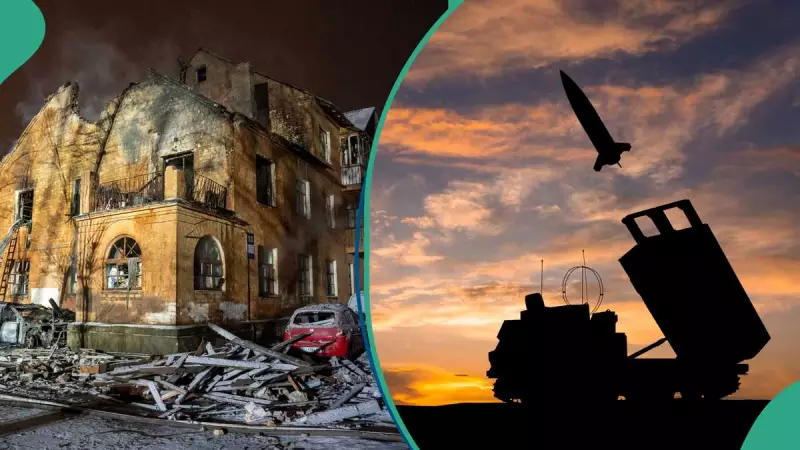
In a significant escalation of hostilities, Russia conducted a large-scale overnight military assault on Ukraine, deploying a rare and advanced hypersonic ballistic missile. The strikes, which occurred overnight, resulted in the deaths of four people in the capital, Kyiv, and left at least 25 others injured.
Rare Missile Deployment and Widespread Assault
The attack marked only the second confirmed use of the Oreshnik intermediate-range hypersonic missile since its first deployment against Dnipro in November 2024. Ukrainian authorities reported that the assault involved a barrage of 13 ballistic missiles, 22 cruise missiles, and 242 drones, many targeting critical energy infrastructure and civilian areas.
Explosions were reported near the western city of Lviv, approximately 60 kilometres from the Polish border, where a ballistic missile struck infrastructure. Videos circulating online showed repeated blasts lighting up the night sky in the region. The Russian defence ministry framed the strike as retaliation for an alleged Ukrainian drone attempt on President Vladimir Putin's residence in late December, a claim that Kyiv and some European officials have strongly denied.
Humanitarian Crisis in Freezing Kyiv
The assault inflicted severe damage on Kyiv's civilian infrastructure during a period of harsh winter weather. Mayor Vitali Klitschko reported that nearly 6,000 apartment buildings—half the city's total—were left without heating due to damage to critical systems. Power outages affected thousands of households as temperatures were forecast to plunge to minus 15 degrees Celsius.
Emergency crews worked through multiple impact zones, with social media footage showing fires and significant damage in several neighbourhoods. Tragically, a paramedic was killed after responding to what officials described as a "double-tap" strike, where a second explosion targets first responders. Several apartment buildings along the Dnipro River and in central districts sustained damage, and one projectile even damaged a building at the Qatari embassy.
International Condemnation and Regional Tensions
The use of the Oreshnik missile so close to the border of the European Union and NATO drew swift condemnation. Ukrainian Foreign Minister Andrii Sybiha stated that such a strike "is a grave threat to the security on the European continent and a test for the transatlantic community."
European Union foreign policy chief Kaja Kallas asserted that the missile deployment was a deliberate message to Western capitals. "Putin doesn't want peace, Russia's reply to diplomacy is more missiles and destruction," she wrote on social media platform X.
Analysts describe the Oreshnik as a formidable weapon with a potential range of up to 5,500 kilometres. Its warhead is designed to break into multiple inert projectiles during descent, creating a sequence of closely timed explosions that complicate defence systems.
As Ukrainian crews worked to restore essential services, the conflict's reciprocal nature was highlighted by Russian claims that Ukrainian shelling cut electricity to parts of Belgorod and disrupted utilities in Oryol. President Volodymyr Zelensky emphasized that the strikes deliberately targeted everyday life during freezing conditions and that restoration efforts were a top priority.




