
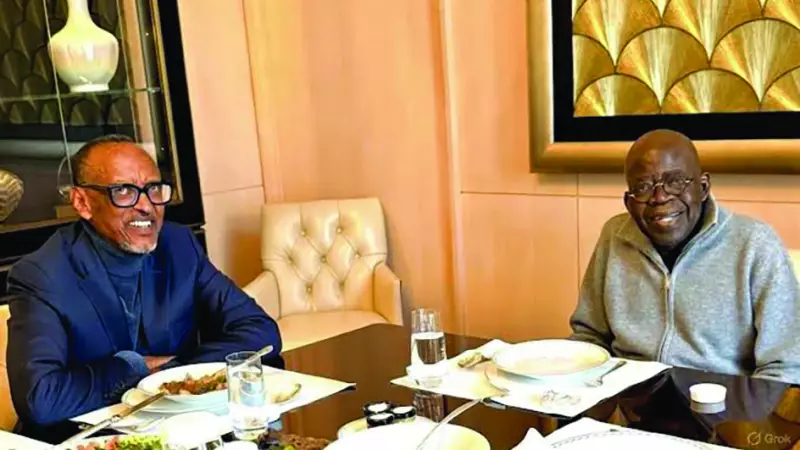
President Bola Tinubu of Nigeria and President Paul Kagame of Rwanda held a significant private lunch meeting in Paris, France, on January 4, 2026, marking another step in deepening diplomatic relations between the two African nations.
A Strategic Diplomatic Engagement
The meeting, which took place away from the public eye, was announced via the verified X (formerly Twitter) handle of President Tinubu's Special Assistant on Social Media, Dele Olusegun (@DOlusegun). While no specific agenda was publicly disclosed, the engagement underscores a deliberate strategy of high-level, quiet diplomacy aimed at advancing Nigeria's foreign policy goals on the continent.
Paris has emerged as a crucial hub for President Tinubu's international outreach since he took office in 2023. The French capital has hosted several of his bilateral meetings and working lunches, including engagements with French President Emmanuel Macron, often coinciding with global summits or official visits.
This was not the first interaction between the two leaders in recent times. They had previously met in Abu Dhabi, United Arab Emirates, in February 2025, indicating a pattern of sustained dialogue. Analysts see these sideline meetings as vital platforms for aligning positions on continental issues and strengthening Nigeria's influence across Africa's regional blocs.
Foundations of Nigeria-Rwanda Partnership
The warm bilateral relations between Nigeria and Rwanda are built on shared priorities within the African Union (AU). Key areas of cooperation include:
- Advancing economic integration under the African Continental Free Trade Area (AfCFTA).
- Enhancing regional security collaboration.
- Pushing for institutional reforms on the continent.
This partnership represents a strategic bridge between West and East Africa, leveraging the influence of both nations.
Domestic Security and Global Warnings
While President Tinubu was fostering international ties, prominent Nigerian voices raised critical concerns about domestic security and global politics. Renowned human rights lawyer and Senior Advocate of Nigeria (SAN), Femi Falana, speaking in Ilawe Ekiti, called on the Federal Government to properly equip and motivate the armed forces to defeat terrorism and banditry without foreign intervention.
Falana expressed deep regret that, from available evidence, terrorist groups often appear better armed than Nigerian troops. He blamed the situation on the misappropriation of funds meant for arms procurement and urged the government to recover such stolen funds and deploy them for their original purpose. "If the members of the armed forces are well equipped and motivated, they can deal with terrorism and banditry," Falana asserted.
Separately, former Nigerian Ambassador to the Philippines, Dr. Yemi Farounbi, issued a stark warning about the international implications of U.S. President Donald Trump's foreign policy. In an interview with The Guardian in Ibadan, Farounbi described Trump's recent intervention in Venezuela as a dangerous precedent where "might often overrides right."
He cautioned that such actions, which violate national sovereignty, could embolden other major powers like Russia and China to act aggressively. Farounbi warned that this shift away from multilateral frameworks could weaken institutions like the United Nations and create a cycle of insecurity for smaller nations globally. He specifically urged the Nigerian government to be vigilant and not allow Trump to promote religious war in Nigeria.
The convergence of these events highlights the dual focus of Nigeria's current affairs: building strategic alliances abroad while grappling with profound internal security challenges and navigating a volatile global political landscape.




