
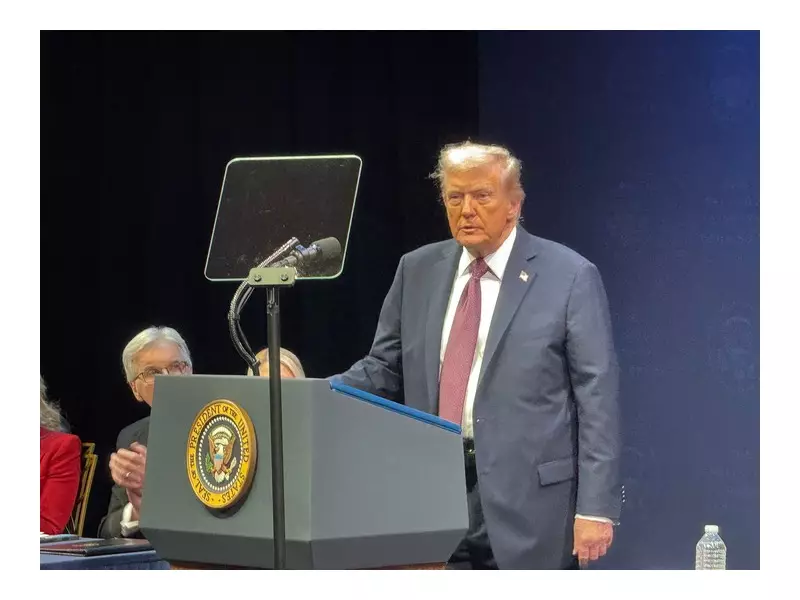
United States President Donald Trump is set to orchestrate a high-stakes diplomatic meeting this Thursday, bringing together the leaders of Rwanda and the Democratic Republic of Congo. The event, to be held at the recently renamed Donald J. Trump US Institute of Peace, aims to produce a signed peace agreement. This move comes despite reports of intense and ongoing violence in the eastern regions of the DRC.
A Deal Forged Amidst the Gunfire
President Trump intends to present this accord as a significant foreign policy victory. However, the timing is starkly contrasted by the situation on the ground. On the eve of this Washington meeting, fierce fighting escalated in eastern DRC. The M23 armed group, which is widely believed to receive backing from Rwanda, has been making substantial military gains against the forces loyal to the Kinshasa government.
An administrative official from the town of Kaziba, Rene Chubaka Kalembire, reported devastating effects, stating that many houses were bombed and there were numerous casualties. This resurgence of conflict follows a period of heightened tension that exploded in late January when the M23 captured major cities including Goma and Bukavu.
This Thursday's summit follows a previous agreement brokered over five months ago by the countries' foreign ministers under US and Qatari mediation. That deal, which included a ceasefire pledge, has largely collapsed, with both sides accusing each other of repeated violations.
The Strategic Prize: Critical Minerals
Analysts suggest that beyond the peace rhetoric, a core US interest lies in the vast mineral wealth of the DRC, particularly in the unstable east. The DRC holds the majority of the world's cobalt, a mineral essential for manufacturing batteries in electric vehicles, alongside significant deposits of copper and other key resources.
President Trump has openly expressed a desire for the United States to secure access to these minerals, which he fears could otherwise be dominated by China. The DRC government has outlined that the expected agreement will include not just a peace framework, but also a plan for regional economic integration and a "strategic partnership" concerning natural resources.
Presidential spokeswoman Tina Salama was quick to defend the deal, insisting to reporters in Washington that "This isn't selling out on minerals to the Americans" and rejecting the notion that it represents "peace for minerals." She emphasized that Kinshasa's priority remains achieving genuine peace before moving to economic development stages.
Deep-Seated Grievances and Migrant Talks
The path to a lasting agreement remains fraught with mutual distrust and preconditions. Rwanda has stated that ending its "defensive measures" is contingent on the DRC government neutralizing the FDLR, an ethnic Hutu rebel group linked to the 1994 genocide in Rwanda.
Public accusations have flown between the capitals in recent days. Rwandan President Paul Kagame accused the DRC of delaying the signing process, while DRC Communication Minister Patrick Muyaya countered that the ongoing fighting demonstrates Rwanda's lack of seriousness about peace.
Separately, both African nations have been engaged in discussions with the Trump administration on a top US priority: migration. As President Trump pursues a large-scale deportation drive, his administration is negotiating for countries to accept migrants. Rwanda had previously agreed to a similar arrangement with the United Kingdom, a plan that was canceled after Prime Minister Keir Starmer took office.
The meeting at the Trump Institute of Peace, a venue Trump himself once closed as part of government cost-cutting, will be closely watched. It represents a bold attempt to claim a diplomatic win in a complex, decades-old conflict where peace on paper has repeatedly failed to translate to peace on the ground.




