
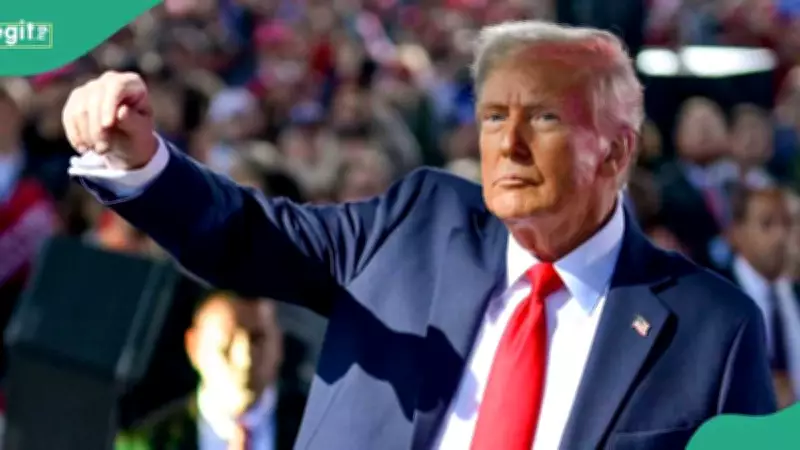
Trump Alleges CNN Sourced Iran Ceasefire Report from Fake Nigerian News Platform
Former United States President Donald Trump has launched a sharp criticism against CNN, accusing the news network of basing its coverage of the Iran-US ceasefire agreement on information from what he described as a "fake news site" originating from Nigeria. The controversy erupted following CNN's report on the ceasefire announced on Tuesday, April 7, 2026.
Details of the Allegation and CNN's Response
In a statement, Trump labeled CNN's reporting as fraudulent, specifically targeting the network's reliance on an unnamed Nigerian platform. "The alleged Statement put out by CNN World News is a FRAUD, as CNN well knows. The false Statement was linked to a Fake News site (from Nigeria) and, of course, immediately picked up by CNN, and blared out as a 'legitimate' headline," Trump asserted. He further referred to the source as "a new, trouble making site from Nigeria," though he did not provide the platform's name or any supporting evidence for his claim.
CNN has firmly denied Trump's allegations. The network clarified that its report was sourced directly from Iranian officials, not from any Nigerian outlet. "The statement in question was obtained by CNN from Iranian officials and reported on multiple Iranian state media outlets. We received the statement from specific official Iranian spokespeople who are known to us," a CNN representative stated. This rebuttal underscores the network's stance that its coverage was legitimate and verified.
Background on the Iran-US Ceasefire Agreement
The ceasefire agreement came after a period of heightened tensions between the United States and Iran. According to reports, Iran's Supreme National Security Council (SNSC) claimed a significant victory in the conflict, stating that the US had been forced to accept a 10-point plan. The SNSC's statement read, "The enemy, in its unfair, unlawful, and criminal war against the Iranian nation, has suffered an undeniable, historic, and crushing defeat."
Key points of the agreement include:
- A two-week ceasefire accepted by Iran, with warnings of a full-force response to any enemy 'errors.'
- US President Donald Trump backing off threats to widen attacks, contingent on the reopening of the Strait of Hormuz.
- Strong international condemnation in response to Trump's earlier threats to target civilian infrastructure in Iran.
Additionally, Pope Leo XIV criticized Trump's ultimatum to Iran, describing the threat to bomb the country back to the Stone Age as unacceptable. The conflict had begun 40 days prior with a US-Israel military operation that assassinated Iran's Supreme Leader, escalating tensions that led to the ceasefire discussions.
Implications for Media Integrity and International Relations
This incident highlights ongoing concerns about media integrity and the spread of misinformation in global news reporting. Trump's allegations against CNN reflect a broader pattern of skepticism towards mainstream media, while CNN's defense emphasizes the importance of verified sourcing in journalism. The involvement of a Nigerian platform, albeit unnamed, adds a layer of complexity to the discourse on fake news and its impact on international affairs.
As the situation develops, it remains crucial for news organizations to maintain transparency in their reporting processes to uphold public trust. The exchange between Trump and CNN also underscores the delicate nature of ceasefire agreements and the role of media in shaping public perception during geopolitical conflicts.




