
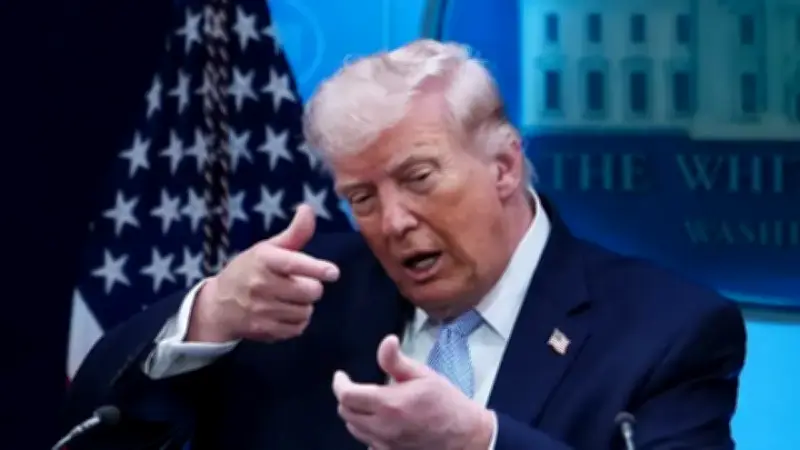
President Donald Trump announced Saturday that the United States has agreed to pause military action against Iran after receiving requests from Tehran and other Middle Eastern governments, claiming that the framework of a potential deal has been reached. The proposed agreement, as outlined by Trump, would include the full reopening of the Strait of Hormuz and the dismantling of Iran's nuclear threat.
In a post on Truth Social, Trump wrote: "We have just been asked by Iran, and other Middle Eastern Countries, to hold off any attack in that the perimeters of a deal has been agreed to." He emphasized that the deal would require the "Immediate, Complete, and Total OPENING OF THE HORMUZ STRAIT" as well as an end to Iran's nuclear program.
US 'Locked and Loaded' but Open to Rapid Negotiations
Trump stressed that the US military remains fully prepared for action, saying the country is "locked and loaded and ready to go" against Iran. However, he confirmed that he had agreed to call off strikes "subject to being able to rapidly make a DEAL." He also stated that Israel, America's partner in the ongoing conflict, "joins me in this commitment."
"Get to work, everybody, and get it DONE," Trump wrote, signaling urgency for negotiators to finalize a new agreement.
State Department Urges Americans to Prepare for Departure
The announcement came shortly after the US State Department issued an urgent advisory on Saturday urging Americans throughout the Middle East to either consider leaving the region or be ready to depart at short notice. The warning highlighted potential flight disruptions, periodic airspace closures, and heightened security risks as the conflict continues to intensify.
"Americans currently in the Middle East should exercise caution and heightened vigilance and should be prepared for flight cancellations, periodic airspace closures, and potential travel disruptions," the State Department said. "Some airlines in the region have postponed resumption of earlier flight schedules; others have cancelled some routes. Americans in the region should consider departing, or be prepared to depart should there be escalation."
The advisory was circulated through US embassies in ten countries: the United Arab Emirates, Bahrain, Iraq, Israel, Jordan, Kuwait, Lebanon, Oman, Qatar, and Saudi Arabia. Notably, a nearly identical statement was released earlier this month, but that version did not urge Americans to consider departing or to reconsider travel plans, indicating Washington's growing alarm over a possible wider regional war.
Kuwait Engages Drone Attacks Amid US-Iran Escalation
On the same day, the Kuwait Army reported that its air defense systems intercepted hostile drone attacks linked to Iranian aggression. "Kuwaiti air defenses are currently engaging hostile drone attacks following the Iranian aggression. The General Staff of the Army notes that any explosions heard are a result of air defense systems intercepting the hostile attacks," the army said in a statement.
The interception came just two days after the US military confirmed it had carried out a "heavy wave of strikes" on Iran, following reports that President Trump had used profanity in a phone call, vowing to "beat the f-----g s--- out of" the country. A Trump ally, speaking anonymously, revealed that the president has grown increasingly frustrated with the war's trajectory, adding, "There was not a real strategy for how long or what they should do to get to the endpoint."
Six Months of Conflict and Rising Costs
The conflict between the US and Iran has now entered its sixth month, defying early predictions that it would be quickly resolved. The prolonged fighting has driven global oil prices upward, with US gas prices also climbing as a direct consequence.
There was a brief period of hope in June when the US and Iran signed a memorandum of understanding that laid out a process for negotiations to end the war. However, that fragile calm shattered in early July when Trump declared the ceasefire "over," prompting both nations to resume striking targets across the Middle East.
The latest escalation has also brought the region to the brink, with diplomatic channels appearing to reopen just as military tensions reached a peak. Trump's announcement on Saturday offers a potential off-ramp, but the president made clear that the United States will not hesitate to resume attacks if a rapid agreement is not reached. "Get to work, everybody, and get it DONE," he urged, leaving the world to watch whether diplomacy can outpace the drums of war.




