
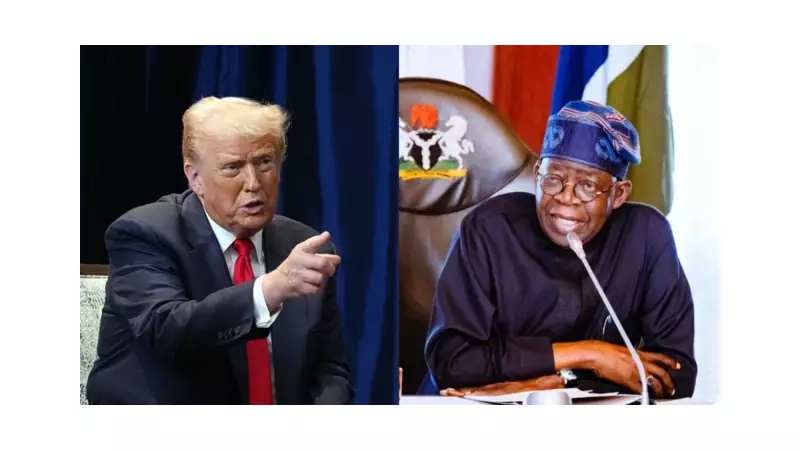
Former United States President Donald Trump has issued a stark warning, suggesting that Washington could authorise additional military strikes on Nigerian soil. This threat is contingent on the continuation of violence that he specifically described as the killing of Christians within the country.
The Warning from Washington
Trump made these significant remarks during an interview with The New York Times. The discussion centred on whether the Christmas Day missile strikes against Islamic State militants signalled the start of a wider campaign. The former President connected this action to his prior threats about deploying American forces to Nigeria in a forceful manner to eliminate terrorists targeting Christians.
"I’d love to make it a one-time strike," Trump told the publication. "But if they continue to kill Christians it will be a many-time strike." This statement underscores a potential shift towards more direct and repeated U.S. military intervention in Nigeria's security affairs, based on a specific religious narrative.
Nigeria's Official Stance and Contradictory Claims
The Nigerian government, under President Bola Tinubu, has moved swiftly to frame the Christmas Day event as an isolated incident. Ademola Oshodi, the Senior Special Assistant to the President on Foreign Affairs and Protocol, publicly described the U.S. strike as a "one-off event." This position aims to assert national sovereignty and downplay the prospect of ongoing foreign military operations.
Officials in Abuja have consistently rejected allegations of targeted violence against Christians. Adding a layer of complexity to the discourse, Massad Boulos, who served as Trump's senior adviser for Arab and African affairs, stated in October that groups like Boko Haram and ISIS are responsible for more Muslim fatalities than Christian ones in the region. When questioned about this analysis, Trump acknowledged Muslim casualties but maintained, "I think that Muslims are being killed also in Nigeria. But it’s mostly Christians."
Implications and Ongoing Surveillance
The geopolitical fallout from these exchanges is tangible. Following the reported strikes, analysis of flight-tracking data indicated a resumption of U.S. intelligence and surveillance activities in Nigerian airspace. This suggests that despite official statements, American military and intelligence assets remain highly engaged in monitoring the security situation.
The situation presents a delicate challenge for the Nigerian government, which must balance its diplomatic relationship with a powerful ally, address legitimate security concerns within its borders, and counter a narrative that it views as inaccurate and damaging to national unity. The threat of further unilateral action by a potential future U.S. administration adds a significant variable to Nigeria's complex security calculus.




