
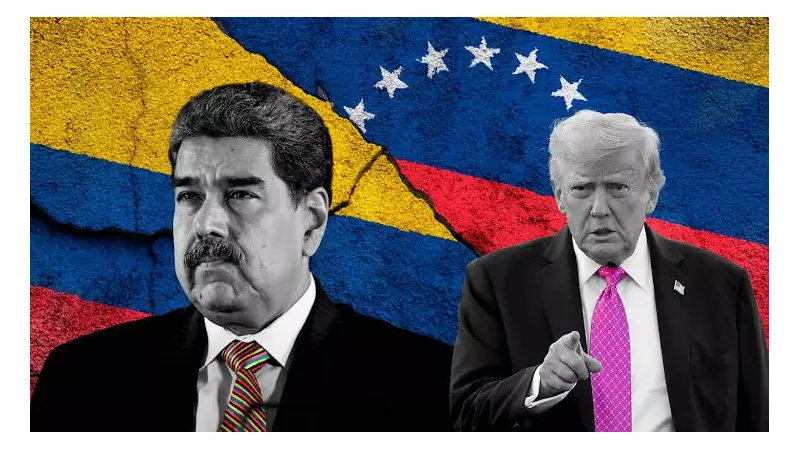
In a dramatic escalation of tensions, former US President Donald Trump has issued a stark warning to Venezuela's new interim leader, Delcy Rodriguez, following a daring American military operation that captured her predecessor, Nicolas Maduro. The raid, which unfolded in the early hours of Saturday, January 3, 2026, has plunged the South American nation into a deep political crisis and raised urgent questions about Washington's long-term strategy.
Operation Capture: Maduro Seized in Caracas Raid
The stunning sequence of events began when US forces launched a coordinated assault on the Venezuelan capital. American commandos, supported by attack jets and naval assets, swooped into Caracas via helicopters. Their target was the country's long-standing leader, Nicolas Maduro, who faced federal narcotrafficking charges in New York. The operation successfully spirited away Maduro and his wife, Cilia Flores.
By late Saturday, a video released by the White House showed the 63-year-old deposed leader handcuffed and in sandals, being escorted through a US Drug Enforcement Administration facility in Manhattan. "Good night, happy new year," Maduro was heard saying in English. Earlier images depicted him blindfolded and with noise-canceling ear protectors aboard a US naval vessel. He is scheduled to appear in a Manhattan court on Monday, January 5.
Trump's Ultimatum and Strategic Ambiguity
In a telephone interview with The Atlantic on Sunday, January 4, Trump delivered a blunt message to Maduro's successor. He stated that if interim president Delcy Rodriguez "doesn't do what's right, she is going to pay a very big price, probably bigger than Maduro." This threat underscores the high stakes for the remnants of Maduro's government.
However, the administration's public statements revealed a complex and sometimes contradictory strategy. On Saturday, Trump asserted that the United States would "run" Venezuela until a transition could be made, leaving open the possibility of continued military "boots on the ground." His focus was clear: securing access to Venezuela's enormous crude oil reserves, the largest proven in the world.
Yet, on Sunday, Secretary of State Marco Rubio offered a different tone. He told CBS News that Washington was not seeking complete regime change or immediate elections. "We're going to make an assessment on the basis of what they do," Rubio said, emphasizing that the US was fighting drug traffickers and "not a war against Venezuela." He did confirm, however, that a large US naval presence would remain in the Caribbean to enforce an oil export blockade, providing "tremendous leverage."
Fallout and International Reaction
Back in Caracas, the streets were reported calm by AFP correspondents in the raid's aftermath. Residents queued for food, and the heavy police presence from the previous day had vanished. The Venezuelan military announced it recognized Rodriguez—formerly Maduro's vice president—as acting president and urged citizens to resume normal life.
Rodriguez, in her first remarks since the attack, struck a defiant note, declaring Maduro the country's sole legitimate leader and vowing, "we're ready to defend our natural resources."
Internationally, the operation drew sharp criticism and concern. A joint statement from Brazil, Chile, Colombia, Mexico, Uruguay, and Spain expressed "rejection" of the US action and "concern about any attempt at governmental control or administration or outside appropriation of natural or strategic resources." The UN Security Council scheduled an emergency meeting for Monday to address the crisis.
Meanwhile, the political reaction within the United States was divided. Senate top Democrat Chuck Schumer told ABC News that Americans were left "scratching their heads in wonderment and in fear" over Trump's strategy. As the world watches, the fate of Venezuela, its leadership, and its vast oil wealth hangs in the balance, setting the stage for a major geopolitical confrontation in the new year.




