
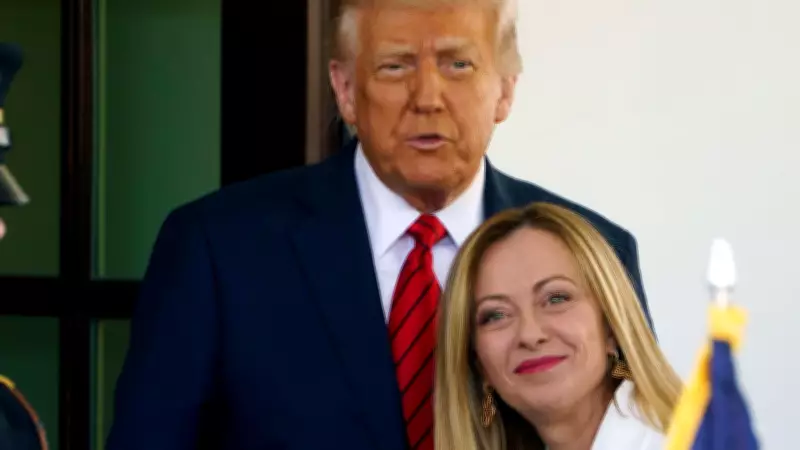
Trump Delivers Blunt Public Rebuke to Italian Prime Minister Meloni
Former U.S. President Donald Trump has publicly turned against Italian Prime Minister Giorgia Meloni, delivering a sharp criticism that signals a dramatic fracture in what was previously considered a close trans-Atlantic political alliance. In an interview published on Tuesday with the Italian newspaper Corriere della Sera, Trump expressed profound disappointment in Meloni's recent policy shifts, particularly her refusal to support U.S. military efforts aimed at reopening the strategic Strait of Hormuz.
'I Thought She Had Courage. I Was Wrong'
'I'm shocked by her. I thought she had courage. I was wrong,' Trump was quoted as saying in the interview, marking a stark departure from his previous praise where he had described Meloni as a 'great leader.' This public falling-out represents significant political risks for the Italian leader, who had previously leveraged her relationship with Trump to enhance her international standing and diplomatic influence.
The friction between the two prominent conservative leaders has intensified recently over multiple contentious issues, including the ongoing conflict with Iran and Meloni's defense of the papacy. After Meloni denounced Trump's weekend criticism of Pope Leo as 'unacceptable,' the former U.S. President responded with equal intensity, asserting that 'She is the one who is unacceptable, because she does not care whether Iran has a nuclear weapon and would blow Italy up in two minutes if it had the chance.'
Accusations and Energy Dependence
Trump further escalated his criticism by accusing Italy of wanting America 'to do the job for her' while the European nation continues to suffer from some of the highest energy costs in the world due to the ongoing regional conflicts. This accusation carries particular weight given Italy's heavy dependence on energy imports, with Trump claiming that they 'depend on Donald Trump to keep it [the Strait] open,' adding substantial pressure to a relationship that has transitioned from strategic partnership to public diplomatic confrontation.
The timing of this public rift presents additional challenges for Meloni, who currently faces domestic political difficulties including a recent defeat in a referendum on judicial reform. Furthermore, with recent polls indicating that 66% of Italians now hold a negative view of the former U.S. leader, Meloni's association with Trump is increasingly viewed as a political liability rather than an asset in her home country.
Strategic Implications and Diplomatic Fallout
This public deterioration in U.S.-Italian relations underlines the volatile nature of international alliances in contemporary global politics. The specific policy disagreements over military strategy in the Middle East, combined with personal diplomatic clashes, have exposed fundamental differences in approach between the two leaders who were once considered ideological allies on the international stage.
The situation continues to evolve as both leaders navigate complex domestic and international pressures, with the public nature of their disagreement likely to influence diplomatic relations between their respective nations for the foreseeable future. Observers note that such high-profile fractures between Western allies could have broader implications for trans-Atlantic cooperation on security and economic matters.




