
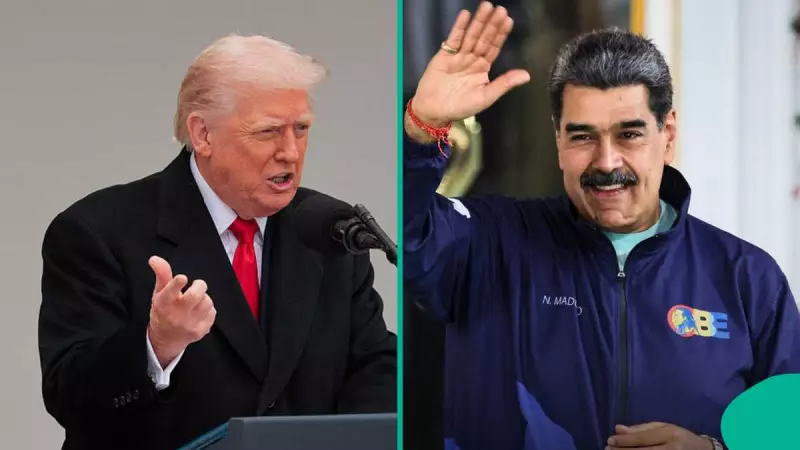
The political and security crisis in Venezuela has entered a dangerous new phase following a direct ultimatum from United States President Donald Trump to the country's leader, Nicolas Maduro. The demand for Maduro's immediate resignation and the subsequent closure of Venezuelan airspace by Washington signal a sharp escalation in pressure on the Caracas regime.
The Ultimatum and Stalled Negotiations
According to reports, President Trump delivered a stern warning to Nicolas Maduro in a phone call, demanding he leave Venezuela immediately. The U.S. offer included guaranteed evacuation for Maduro, his wife Cilia Flores, and their son, but only if the Venezuelan leader agreed to resign on the spot. The conversation, however, reached an impasse.
Sources indicate the stalemate centred on two key demands from Maduro. First, he sought global amnesty for any crimes committed by him and his inner circle, a request flatly rejected by Washington. Second, he wanted to retain control of Venezuela's armed forces, a condition modelled on a past arrangement in Nicaragua. The U.S. insisted on an unconditional and immediate resignation, which Caracas refused.
Rapid Escalation: Airspace Closed and Expert Warnings
Within hours of the failed talks, the situation escalated dramatically. President Trump announced that Venezuelan airspace would be considered "closed in its entirety." This move was interpreted by defence and diplomatic experts as a prelude to potential military action. The Maduro government's attempts to schedule a follow-up call with Washington reportedly went unanswered.
Former Venezuelan diplomat Vanessa Neumann told Fox News Digital that the regime now faces its most serious threat. "I think the operations will start imminently," she stated. Neumann explained that clearing the airspace is a clear public warning that missiles could be used to destroy command, control, and retaliatory infrastructure.
She described the scenario as "a capture-or-kill" situation, with targets identified through years of covert operations. Neumann also highlighted the weakness of Maduro's military, noting their equipment is extremely old, decayed, and poorly maintained, with Russian-supplied hardware labelled as "junk."
Terrorist Designation and the Drug Trade Nexus
Ahead of the airspace closure, the U.S. took a significant step by officially designating the Cartel de los Soles as a foreign terrorist organisation. This group is allegedly deeply linked to Venezuela's government. Neumann detailed how the cartel has turned the state oil company into a front for narcotics trading and money laundering.
She accused the regime of using Venezuelan military jets to transport hard drugs from Colombia, process them domestically, and move the narcotics into Central America, Europe, and the United States. The cartel is also identified as a key collaborator and financier of Hezbollah, having funded terrorist attacks that killed American citizens. The European Parliament had also voted in favour of a similar EU terrorist designation for the group in September.
The U.S. has ramped up military and intelligence campaigns against these drug networks, including strikes on suspected narcotics boats. Neumann suggested that with Maduro's international backers like Russia and Iran weakened, and China unlikely to offer strong support, the timing for action may be ripe.
Potential Targets and Regional Fallout
Experts identified key regime figures who could be targeted in any operation, including Vice President Delcy Rodríguez, Diosdado Cabello (Minister of Interior, Justice and Peace), and Alexander Granko Arteaga, the head of Venezuela's counter-intelligence agency. Granko's role in suppressing military dissent is seen as a major obstacle to internal uprisings.
The crisis has already caused regional disruption. Venezuela's decision to ban six foreign airlines—including Iberia, TAP, Avianca, LATAM, GOL, and Turkish Airlines—for suspending flights over safety concerns was branded as "disproportionate." The airlines had acted on U.S. safety warnings related to Washington's anti-narcotics military deployment in waters off Venezuela.
Neumann concluded that the Venezuelan people have exhausted democratic avenues, through elections and protests, to remove Maduro, leaving the international community with limited options. The standoff now presents one of the most critical geopolitical challenges in the Western Hemisphere, with the potential for significant military confrontation.




