
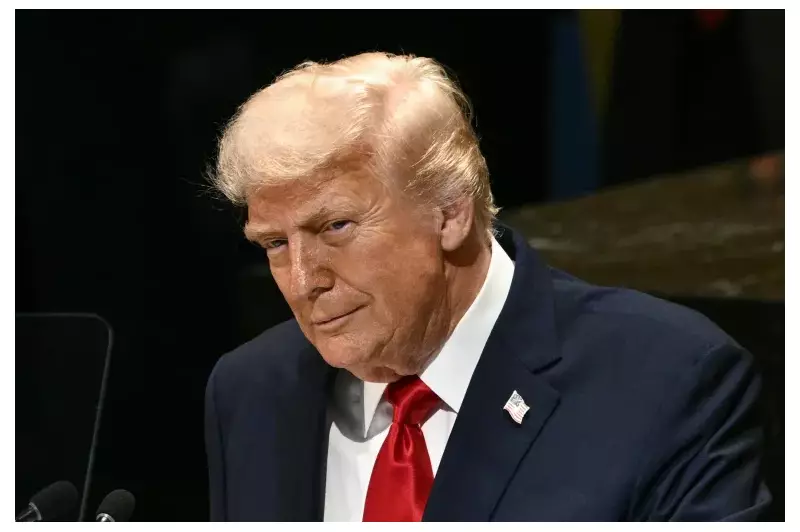
In a significant departure from decades of American foreign policy, the administration of President Donald Trump has unveiled a new national security strategy that fundamentally redefines the United States' role in the world. The document, released on Friday, 5 December 2025, outlines a sharp pivot away from global leadership towards asserting dominance in the Western Hemisphere and taking a combative stance against mass migration.
America First in Action: Regional Focus Over Global Reach
The strategy paper, which details Trump's "America First" doctrine, explicitly rejects the pursuit of global domination. It states the US will no longer "waste blood and treasure" to limit the influence of every major power worldwide. Instead, it calls for a strategic military realignment to address urgent threats closer to home, particularly in Latin America.
This marks a clear break from previous US efforts to refocus on Asia. While China is still identified as a top competitor, the strategy is more concentrated on economic rivalry than military containment in the Pacific. The document supports the status quo regarding Taiwan, urging allies like Japan and South Korea to shoulder more responsibility for the island's defense against Beijing.
The strategy boldly declares a "Trump Corollary" to the Monroe Doctrine, a 19th-century policy that declared Latin America a US sphere of influence. This modern version justifies recent aggressive actions in the region, including maritime strikes on alleged drug traffickers, interventions against leftist governments like Venezuela's, and efforts to control strategic assets such as the Panama Canal.
Confronting Allies and Ending an "Era of Mass Migration"
One of the most striking elements of the new strategy is its harsh criticism of traditional European allies. The document accuses Europe of civilizational decline and vows to actively cultivate internal "resistance" to the European Union's values, particularly on immigration. This aligns with the rise of far-right parties across the continent that Trump has often praised.
Germany swiftly rejected this approach, stating it does not require "outside advice." The strategy also criticizes European weakness and calls for an end to the perception of NATO as a "perpetually expanding alliance," a stance seen as favorable to Russia amid the ongoing Ukraine war.
On the domestic front, the strategy reinforces Trump's longstanding hardline on immigration. It declares that "the era of mass migration must end" and frames border security as the "primary element of national security." This provides a policy foundation for the high-profile raids and deportations of undocumented individuals that have characterized his administration since he returned to office in January 2025.
Shrinking Attention on Africa and the Middle East
The new American blueprint notably reduces focus on regions that have long consumed Washington's attention. It argues that with increased domestic energy production, America's historic reasons for deep involvement in the oil-rich Middle East "will recede." While it commits to Israel's security, the language is less effusive than in Trump's first term.
For Africa, the strategy pays minimal attention, signaling a move away from relationships based on liberal ideology and aid. Instead, it emphasizes pragmatic goals like securing access to critical minerals, indicating a more transactional approach to the continent.
This comprehensive strategy document solidifies President Trump's intent to reshape America's global engagements, prioritizing hemispheric control, ideological battles with allies, and domestic protectionism over traditional superpower diplomacy.




