
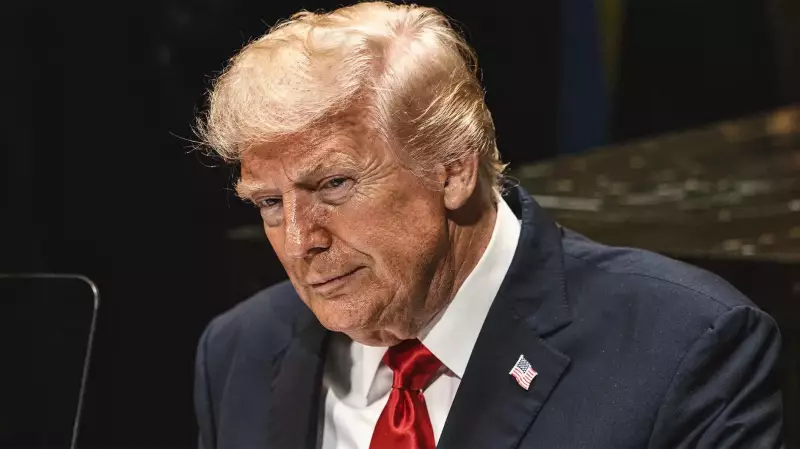
United States President Donald Trump has recently raised the spectre of military action against Nigeria, claiming a need to save Christians from what he termed a "genocide." This alarming threat, made via social media, has drawn sharp parallels to historical justifications for Western imperialism in Africa.
Echoes of Kipling and the 'Civilising' Mission
The threat recalls the era of colonial expansion, famously rationalised by Rudyard Kipling's 1899 poem 'The White Man's Burden.' Kipling urged America to take up this burden during its invasion of the Philippines, framing imperialism as a noble mission to stop wars, end famine, and cure disease. In reality, this ideology masked a ruthless scramble for territory and resources.
As noted by late political scientist Samuel Huntington, Western conquests relied more on brutal force than the power of ideas. The colonisation of Africa was executed with both the gun and the Bible, aiming to convert so-called pagans. President Trump's rhetoric appears to follow a similar pattern, targeting Nigeria, a nation of 230 million people rich in oil and minerals.
In his post, Trump suggested the U.S. might go into the "now disgraced country, 'guns-a-blazing,' to completely wipe out the Islamic terrorists." However, this comes from a leader who previously dismissed Nigeria and other African nations as "shithole countries" and whose administration dismantled key humanitarian aid structures.
Unpacking Trump's Three Probable Motives
Given the context, analysts point to three likely drivers behind Trump's threatening posture.
1. The Mercantilist Quest for Minerals: Africa holds roughly 30 per cent of the world's rare-earth minerals, crucial for modern technology. Trump's engagement with Africa has been conspicuously focused on resource extraction. His meetings with five African presidents in July centred on minerals, as did his mediated talks between the Democratic Republic of the Congo and Rwanda.
This is not new behaviour. Since 2011, Trump has advocated stealing Iraq's oil. His aggressive moves against Venezuela, including seizing an oil tanker, border on piracy. Nigeria, with its vast resources and perceived governance weaknesses, seems a potential target for such plunder.
2. Pandering to White Evangelical Voters: White evangelical Christians remain a core part of Trump's base. Right-wing think tanks like the Heritage Foundation and Gatestone Institute have actively promoted a false narrative of "Christian genocide" in Nigeria, a framing echoed by U.S. Senator Ted Cruz. By threatening intervention, Trump positions himself as Christianity's staunch defender, a potent rallying cry for his supporters.
3. Promoting Racist Stereotypes and the 'White Savior': Trump is accused of invoking the "white savior" trope to energise his MAGA (Make America Great Again) base. His rhetoric often emboldens racist impulses. This year alone, he falsely accused South Africa's Black-led government of genocide against white farmers and disparaged Somali immigrants as "garbage." His National Security Strategy openly calls for Europe to halt immigration to remain "European." Threatening Nigeria fits this pattern of stoking ethnonationalist grievances.
Nigeria's Complex Reality and Security Failures
While Nigeria faces severe security challenges, Trump's framing is dangerously simplistic and inaccurate. The country's conflicts have resulted in over 100,000 deaths since 2011, with about 8,000 killed in 2025 alone. However, jihadist groups like Boko Haram and Islamic State West Africa Province kill far more Muslims than Christians.
In the Middle Belt, conflicts between predominantly Muslim Fulani herders and Christian farmers have caused some 12,000 deaths since 2010, but these are largely driven by competition for land, grazing rights, and water, not religion. Widespread kidnappings in the northwest are primarily motivated by banditry.
These crises are exacerbated by profound governance failures. President Bola Ahmed Tinubu's administration, like its predecessors, has waged an inept counter-insurgency. The concept of prebendalism—using public office for personal gain—described by scholar Richard Joseph, is rampant. Corruption has crippled the military and police, with National Security Adviser Nuhu Ribadu accusing security personnel of selling weapons to "bad people."
Despite Tinubu's claim of eliminating over 13,500 terrorists since May 2023, Amnesty International estimates at least 10,217 terror-related fatalities in the same period. This volatile atmosphere allows attackers to operate with impunity.
Ultimately, Trump's threat reflects an imperial mindset, viewing Nigeria not as a sovereign nation but as part of a mission to revive an era of white Christian supremacy. While some Nigerians may appreciate the global spotlight on their government's security failings, the motives behind the threat are rooted in mercantilism, domestic politics, and racism, not genuine humanitarian concern.
Prof. Adekeye Adebajo is a senior research fellow at the Centre for the Advancement of Scholarship, University of Pretoria, South Africa.




