
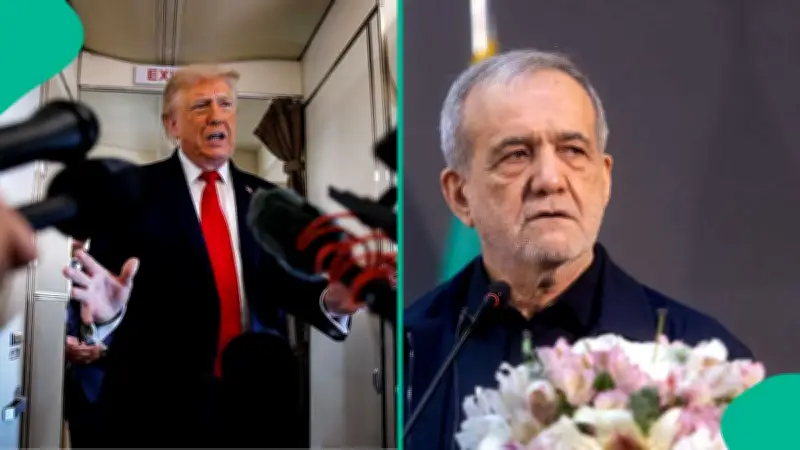
The United States and Iran have signed a landmark interim agreement to halt their war, marking the first deal between the two nations since 1979. President Donald Trump issued fresh threats against Tehran even as he praised Iranians as “smart people” and expressed hope for peace in the Middle East. The 14-point memorandum promises sanctions relief, unfreezing of assets, and a $300 billion reconstruction fund, while extending the ceasefire for another 60 days.
Trump’s threats and concessions
Speaking at the G7 summit in France, Trump softened his earlier stance on Iran’s missile programme, saying it would be “unfair” for Tehran not to have ballistic missiles. This marked a shift from his February vow to destroy Iran’s missile industry. Despite his combative rhetoric, Trump acknowledged Iran’s resilience, calling Iranians “smart people” and expressing hope that the truce would bring peace to the Middle East and lower oil prices.
Iran’s reaction to US agreement
Iran celebrated the moment, with lead negotiator Mohammad Baqer Qalibaf stating: “Everything we sought to achieve through military action, we obtained several times over through negotiation.” The deal includes the unfreezing of billions of dollars in Iranian assets and a $300 billion investment fund for post-war reconstruction. The war began on February 28 with the assassination of Supreme Leader Ayatollah Ali Khamenei. It quickly escalated into a regional conflict, killing more than 7,000 people, mostly in Iran and Lebanon. The fighting drove up energy prices, triggered inflation, and raised fears of a global food crisis.
Key points of the 14-point agreement
- Ceasefire extension: The truce in Iran and Lebanon is extended by 60 days.
- Maritime traffic: Full resumption in the Strait of Hormuz “with no charge.”
- Sanctions relief: Waiving of U.S. sanctions and unfreezing of Iranian assets.
- Nuclear commitments: Iran vows not to build nuclear weapons and agrees to down-blend uranium under IAEA supervision.
- Reconstruction fund: $300 billion allocated for rebuilding.
Brent crude futures fell below $80 on Wednesday, their lowest since the war began, as markets anticipated the reopening of the Strait of Hormuz. Prices later rose slightly after Trump threatened renewed violence.
G7 leaders welcome Iran deal
The leaders of France, Germany, Britain, Japan, Italy, Canada and the U.S. issued a joint statement demanding an immediate ceasefire in Lebanon. They hailed the agreement as a step towards stability, though Israel, not part of the negotiations, insisted it retained the right to use force against Hezbollah. Trump criticised Israeli Prime Minister Benjamin Netanyahu’s aggressive tactics in Lebanon, saying: “You don’t have to knock down a building every time somebody walks into it that’s from Hezbollah.” Despite the agreement, fighting continued in southern Lebanon, with reports of Israeli air strikes and Hezbollah drone attacks.
UAE to unlock frozen Iranian funds
Legit.ng earlier reported that the United Arab Emirates has strongly denied claims that it agreed to release billions of dollars to Iran following weeks of attacks during the ongoing war involving the United States and Israel. According to a Reuters exclusive, four sources alleged that the UAE had made a tactical shift, agreeing to unlock funds in exchange for halting Iranian strikes.




